
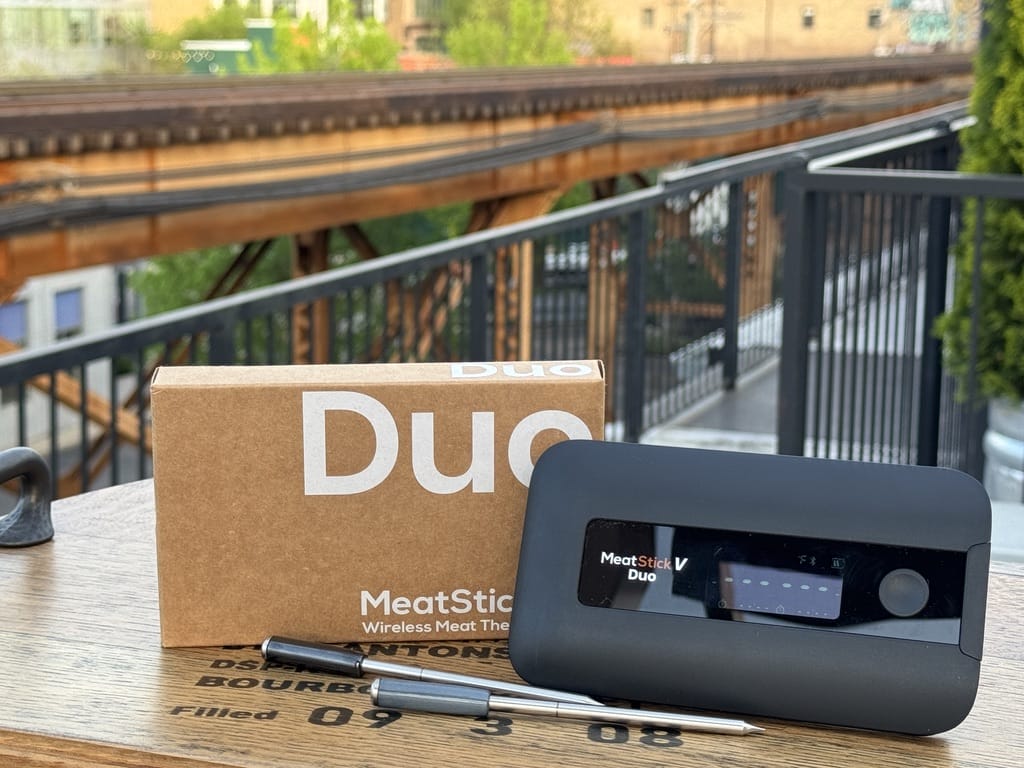
During the summer in Chicago, I fire up the Traeger as often as humanly possible. I mean, who doesn’t love smoked meats? And it doesn’t hurt that it gets me out of the house and gives me an excuse to sit on the roof and sip some bourbon while a hunk of beef slowly becomes dinner.
If you’ve read any of our previous entries on wireless thermometers, you know I’m a devoted believer in the hassle-free cook. Most recently we looked at the MeatStick V: great hardware but companion software that made me want to throw my phone off the aforementioned roof. Well, the good folks at MeatStick have released a new version, the MeatStick V Duo, and sent me one to put through its paces.
Right off the bat, I want to be transparent about how we procured this. At Thirty-One Whiskey, we take pride in purchasing all of the materials used for a review. But in any situation where we are provided a sample or product to test, we tell you about it up front and are transparent about where those materials came from. Which is basically what I’m doing right now: disclosing that the product we are reviewing today was provided free of charge by the manufacturer. All that said, we believe we can still adequately maintain our impartiality since the manufacturer did not influence or edit this review prior to publication.
Okay, with that fine print out of the way… let’s get into it.
Some Background
In my opinion, there is no better grilling accessory than a good wireless thermometer probe. I even take one on vacation, because there is no way I’m risking a blown medium-rare on steak night in a rental kitchen with an oven I’ve never met. We’ve covered several generations of this hardware here, including the MeatStick 4X and the MeatStick V, plus a Meater for good measure.
First, a little company history. Imagine being so obsessed with grilling that you and your friends start a company to ensure no meat is ever abused again. According to their website:
As native Californians, the idea for The MeatStick came to us after an afternoon BBQ with friends. While we were chatting and playing a game of charades, their 4 expensive New York Strips were overcooked and completely ruined the mood! After trying several wired cooking thermometers, the problem was still the same: you had to walk over to your thermometer to check the progress of your meat. And with the drive to solve this problem, The MeatStick’s journey began.
I can completely relate. When I started embracing the low-and-slow gospel of proper Texas barbecue, I started with a wired thermometer. I didn’t want to put down my bourbon and climb out of the pool to see how the brisket was doing, so a wired probe with a handheld unit was quickly acquired. It solved exactly one problem and created two more.
The MeatStick line fixes all of that: Bluetooth and WiFi push the readings straight to your phone, so the only thing you have to get out of the pool for is a refill.
What’s Actually New
Let’s talk about what makes the V Duo different, because this is an iteration rather than a reinvention.
The obvious one is right there in the name: you get two probes. This is fantastic when you’re chasing different doneness levels on steak night, running two different cuts at once, or want multiple readings across one big piece of meat. The one call-out: only one of the two probes (the Prime Stick) includes the ambient air sensor. The second one (the Core Stick) is internal-only. Not a deal breaker, but given the acreage inside my Ironwood 885, I’d love to be able to hunt for cold spots with both.
All in, that works out to eleven sensors: five internal on each probe, plus the single ambient sensor on the Prime Stick.
The other big change is the base, which now has an LCD screen. Honestly, this might be my favorite part of the whole package. Yes, the app still does the heavy lifting, but being able to glance at the base and get battery life, cook time, and current temps without unlocking my phone is a genuinely better experience. It’s nice having a second probe. It’s fantastic not having to pull out my phone every ten minutes.
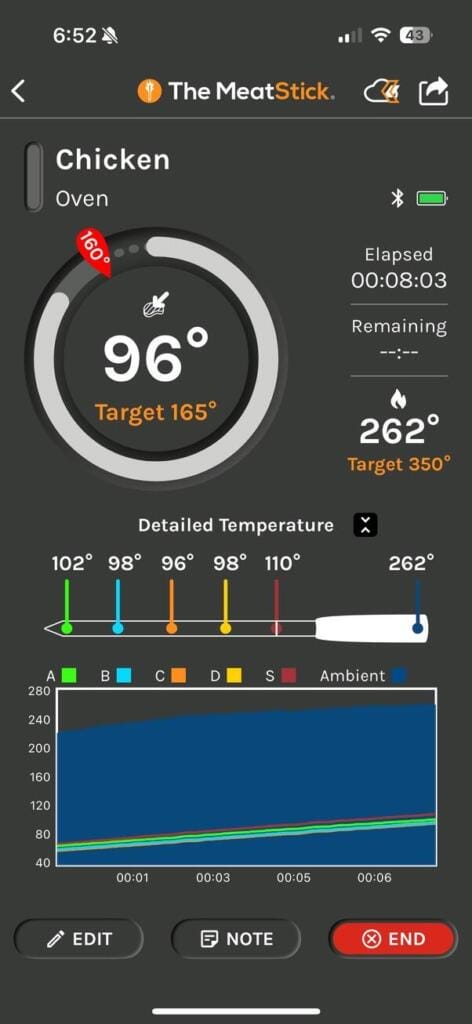
Both probes carry over the multiple-sensor-along-the-shaft design, which I appreciate most on thinner cuts. Take the humble chicken breast: it’s genuinely hard to get a probe into the thickest part without burying the tip out the far side. The multiple sensors solve this by working together and reporting the lowest reading, so a mediocre probe placement doesn’t turn into an undercooked dinner.
Case in point: in the screenshot below, I was cooking chicken. Sensor A read 102 degrees because the tip had wandered too close to the edge of the meat, where it’s hotter. Sensors B, C, and D were buried in the thicker middle and reading cooler. Guess which number the app cares about? As someone who is genuinely obsessive about food safety, that’s why I’m confident in everything I serve.
The probes also retain the FireForge construction, rated to handle 650 degrees Celsius / 1200 degrees Fahrenheit, which means you can leave them in through a hard sear instead of playing the yank-it-out-and-guess game.
On range: MeatStick spec sheets list the internal sensors at 14–212°F and the ambient sensor at 14–1200°F. That’s plenty for anything short of a pizza oven. The probes are also fully sealed to IPX9K standards, meaning deep fryer, sous vide, and dishwasher are all fair game. You can drop this thing into a turkey, drop the turkey into the fryer, and eat worry-free — let’s see that plastic pop-up sensor that comes in a turkey pull that off.
WiFi in the base carries over from the V, and thank goodness. Since I do all my grilling on the roof deck, Bluetooth alone was a nonstarter; step inside and down a flight of stairs and the connection was gone. WiFi means I can check on my meat from anywhere, including places where I probably shouldn’t be checking on my meat.
The companion app is available for both iOS and Android and still offers the guided cooking system that walks you through a cook if you’d rather not do the math yourself.
Let’s Cook
The single most infuriating thing about the MeatStick V was how the app handled firmware. Like any good nerd, I check for updates the moment a new gadget comes out of the box. But updates came frequently, and you couldn’t skip them — so if the probe was already in the meat, your options were to pull it out, wash it off, dock it, update, and start over. I am genuinely delighted to report that you can now skip the update and get on with your cook. It’s the little things that make the biggest difference.
Cook one: steak night.
The family was split between medium-rare people and medium-plus people (I’m not naming names, but I know who you are). Perfect excuse to run both probes at once.
Setup was easy and everything came out exactly as ordered. The lack of an ambient reading on the second probe stung a bit here, since this was an unfamiliar grill and I would have liked to know whether I was fighting a hot spot. With a single probe, I’d have monitored the medium-rare steak properly and eyeballed the rest for the blasphemers.
Cook two: the real test.
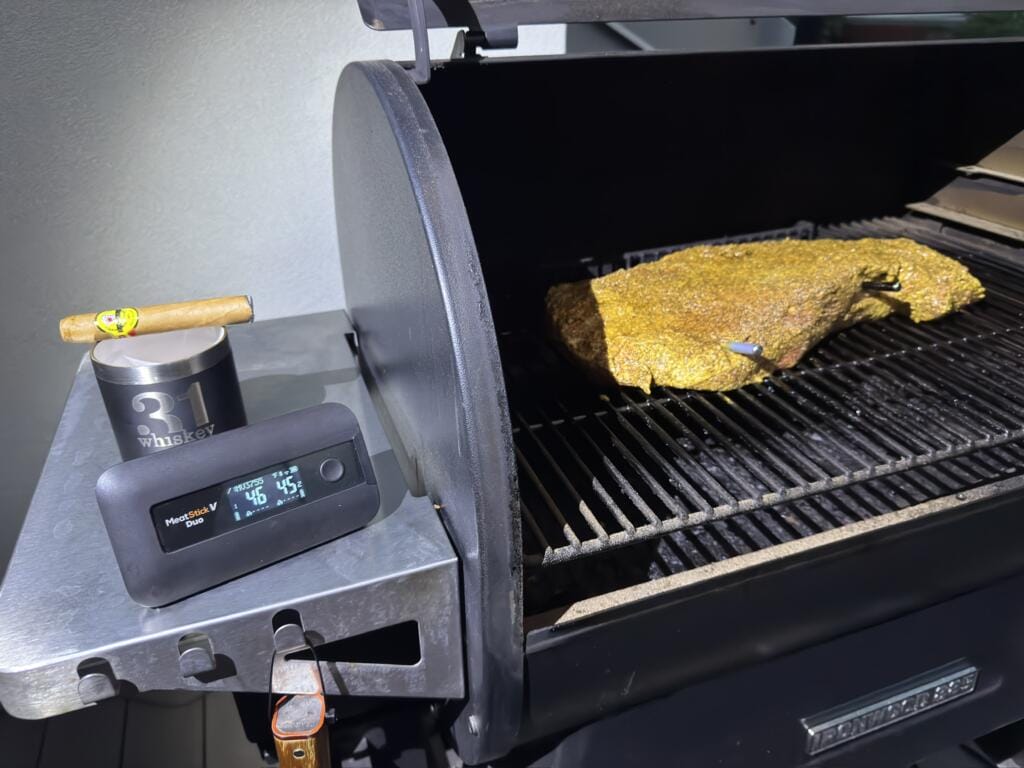
A 14-pound brisket for the Fourth of July.
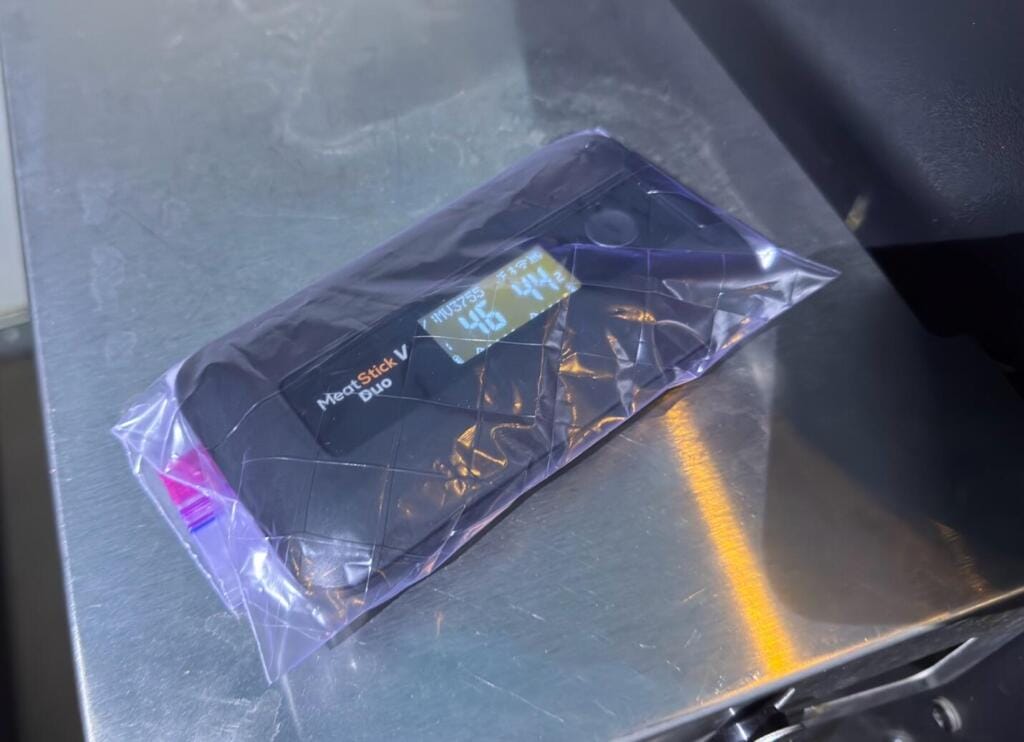
The story starts on July 3rd — a rainy Chicago evening, with a 9 p.m. start time so the brisket would be done and rested before guests arrived. Small nit: I’d love a waterproof base, because I don’t let a little rain stop me. In this case I sealed it in a Ziploc bag and carried on.
Everything went normally until about 11 p.m., when the V Duo made its first real catch: a low ambient temperature alarm. The storm had flickered the power just long enough to shut down the Traeger — something I never would have thought to check. The alert on my phone let me catch it and re-light the grill within minutes. Without it, I’d have woken up to a cold, sad, expensive piece of beef. You can see the temperature drop about two hours into the cook in the screenshot below.
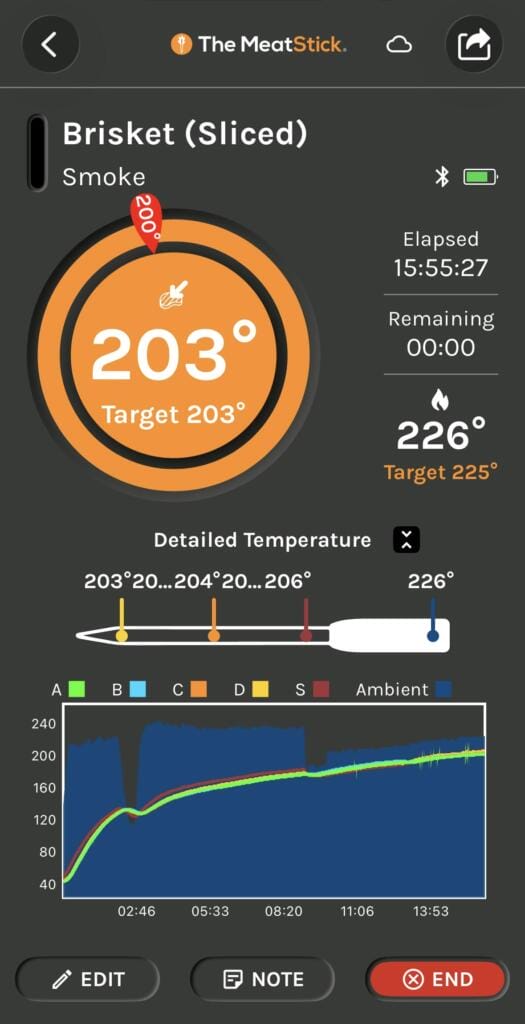
I’d set an alarm for 5 a.m. to check progress, expecting to be near the stall and ready to wrap in butcher paper. Being able to check the numbers from bed before committing to standing up is exactly the kind of luxury this product exists to provide.
The rest of the cook went off without a hitch. Wrapped until 204 degrees, then tucked into its BBQ blanket to rest. The brisket came out juicy, tender, and flavorful — the perfect way to celebrate Independence Day, and at no point did I have to worry about ruining it.
The Bottom Line
My favorite part isn’t the second probe or the screen. It’s that they fixed the firmware nag. You have no idea how much that mattered.
The V Duo brings two meaningful upgrades over the V: a second probe and an LCD base. Is that enough to make you run out and replace a perfectly good thermometer? Probably not. My MeatStick V is still going strong, and its smaller form factor packs better in a suitcase. But if you’re shopping for your first serious wireless probe — or upgrading from something wired — this is the one I’d hand you. If you grill with any seriousness at all, a reliable wireless probe isn’t a luxury. It’s the thing that lets you go live your life while the smoker does its work.
MeatStick V Duo Wireless Meat Thermometer
List Price: $179.99
Sale Price at Publication: $139.99
Link: amazon.com
Overall Rating: 5/5
Two probes, zero guesswork, and — finally — an app that stays out of the way.