
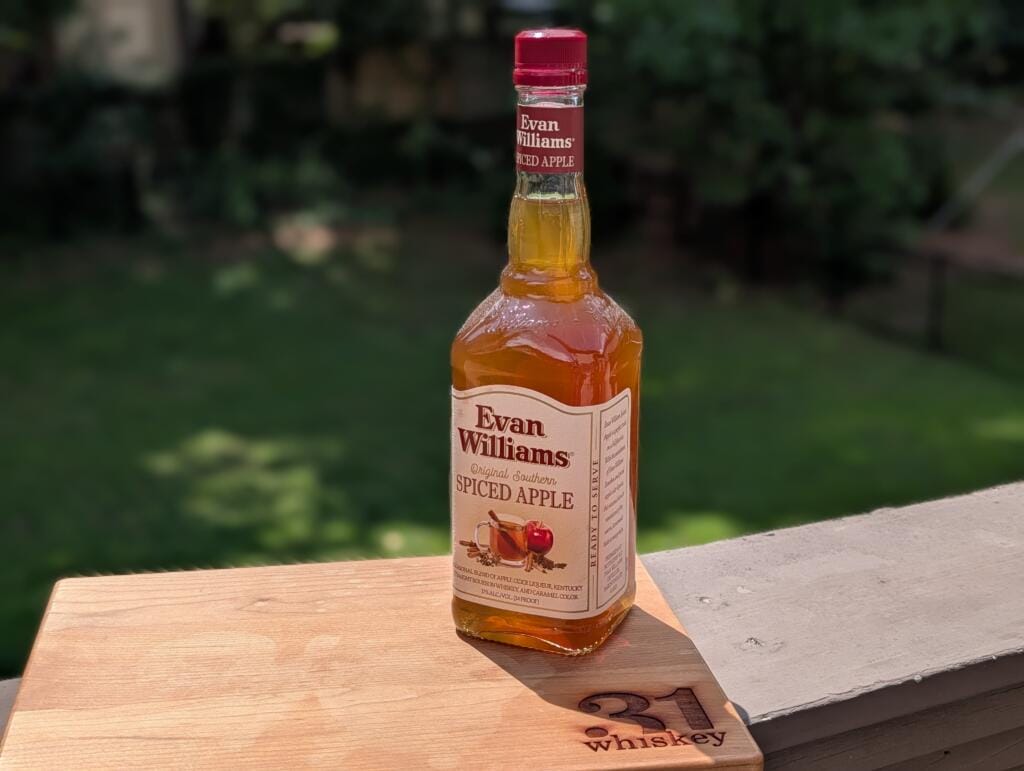
I bought this bottle last November, along with a couple of other seasonal spirits, fully intending to write the whole batch up as a Christmas feature. Then I procrastinated. Around June I decided it would be funny to run them as a “Christmas in July” thing instead — a bit of self-aware counterprogramming. But… then I procrastinated again.
So here I am in the late August, in North Carolina, in the kind of heat that makes the air feel like a wet towel, pouring a spiced apple cider liqueur whose own manufacturer says it’s “best enjoyed warm” and tells you to look for it “in September when the weather cools”. I’m not merely late for Christmas. I’m late for a fall seasonal that stopped shipping before Christmas even arrived. This bottle has been sitting on my shelf for nine months quietly judging me, but today it finally gets its say.
The bottle itself is doing its part to make me feel bad about this. Red cap, cream-colored label, and a photo illustration of a steaming mug of hot toddy (which in this weather reads less like an invitation and more like a threat). Let’s get into it, because the thing inside turns out to be more interesting than I expected — and it is absolutely covered in cinnamon.
History
Here’s the thing about Evan Williams: the man on the label almost certainly didn’t do what the label says he did.
The bottle proclaims Evan Williams to be “Kentucky’s 1st Distiller” operating from 1783. But the Filson Historical Society (the people who actually keep Kentucky’s records) believe a good chunk of that story is untrue. The first recorded reference to Williams as a distiller doesn’t appear until an 1892 publication, over a century after the fact, and Williams himself doesn’t appear to have arrived in the area until 1794… eleven years after the date printed on the bottle. The brand as it exists today wasn’t introduced until 1957 and has no connection to the historical Evan Williams beyond the name on the front.
I’ve written about this before and I’ll keep writing about it, because it’s such a perfect specimen of the genre: a bourbon heritage claim that’s less a lie than a piece of historical fan fiction that hardened into marketing over seventy years of repetition. Every time I see “1783” embossed on these bottles, I think about the fact that the guy hadn’t shown up yet.
To add insult to injury, the actual history is better anyway. Old Heavenhill Springs Distillery was founded in Bardstown, Kentucky in 1935, right after Prohibition ended, by a group of investors betting that legal booze was about to be extremely good business. One of those investors was Joseph L. Beam (first cousin to Jim Beam) who became the operation’s first master distiller. Over the following years, the Shapira family bought out the other investors, took sole ownership, and renamed the place Heaven Hill. Remarkably, Joseph Beam’s descendants are still the master distillers there today.
In 1996, the main distilling facility burned down. Ninety thousand barrels of whiskey went up, and the burning spirit set the creek feeding the distillery on fire for nearly two miles downstream — which is one of those details that sounds invented but isn’t. The company survived, bought the Bernheim distillery from Diageo in 1999, and moved production there while keeping all aging at the original Bardstown site.
That 1935 bet paid off enormously. Heaven Hill is now the largest independent family-owned spirits producer in the United States and the second-largest holder of Kentucky bourbon inventory in the world.
As for this bottle specifically: Heaven Hill has been running fall apple seasonals for well over a decade. The direct ancestor is Evan Williams Apple Orchard Seasonal Liqueur, launched in 2012 at 17% ABV and about $11.99, explicitly built as a September-through-November product to sit alongside their long-running Evan Williams Egg Nog. The current Kentucky Cider is the evolution of that program: same seasonal window, same idea, tuned proof.
Product
The bourbon side of this is well-documented, because Evan Williams is one of the best-understood budget bourbons in America. The standard mash bill is 75% corn, 13% rye, 12% malted barley, distilled at Bernheim and aged in charred new oak at Bardstown. The line used to carry a seven-year age statement; demand outran supply years ago and the age statement came off, with the whiskey now going out at as little as five years. Evan Williams describes the bourbon in this blend as “extra-aged”, which is a marketing phrase carrying no legal weight whatsoever — there’s no TTB definition of “extra-aged” and without a number on the label, it means precisely as much as the brand wants you to think it means.
Now, the classification. As I covered with Winter Jack, the TTB sets hard floors: 40% ABV to call something whisky at all (27 CFR 5.143) and 30% ABV to call it flavored whisky (27 CFR 5.151). This bottle is 34 proof — 17% ABV. It clears neither bar, which is why you’ll see it retailed as a “liqueur” or a “whiskey specialty” rather than as whiskey. Under 27 CFR 5.156, it’s a distilled spirits specialty product… meaning it needs a truthful statement of composition sitting next to whatever name marketing came up with. “Kentucky Cider” is the fanciful part. The blend-of-bourbon-and-apple-cider-liqueur line underneath is the part that has to be true.
And here’s where this bottle gets genuinely more interesting than the Jack Daniel’s equivalent, because it answers the question I couldn’t answer last time:
Why is it cloudy? Because there’s real apple cider in it. When Heaven Hill launched the Apple Orchard predecessor, their own press materials stated the product was made with real apple cider and — critically — that consumers should refrigerate it after opening and shake it well before pouring. That’s not a normal instruction for a shelf-stable spirit… that’s an instruction for a product with actual perishable fruit content suspended in it. Evan Williams’ own tasting notes for the current bottle list the color as “slight cloudy, pale gold”, meaning they’re not hiding the haze, they’re describing it as a feature.
So the cloudiness isn’t a defect or an accident. It’s the physical evidence of the one genuinely legitimate thing about this product: there’s real cider in the bottle, and it hasn’t been filtered into submission to make the liquid look prettier. I’ll give credit where it’s earned — that’s more integrity of composition than I expected, and more than most flavored whiskeys bother with.
What Heaven Hill doesn’t disclose is the cinnamon. Their published notes cite cinnamon, allspice, and nutmeg, but there’s no breakdown of whether those are natural extracts, spice infusions, or artificial flavoring, and no sugar content. Based on what’s in my glass, I have a strong opinion about which one the cinnamon is, which I’ll elaborate on in my tasting notes.
One more note, and it’s a real one: if you own this bottle, refrigerate it after opening. Mine has been sitting on a shelf since November. That is, in hindsight, not what the manufacturer intended, and I’d be doing you a disservice not to mention it — though I will say the bottle showed no signs of having turned.
Packaging
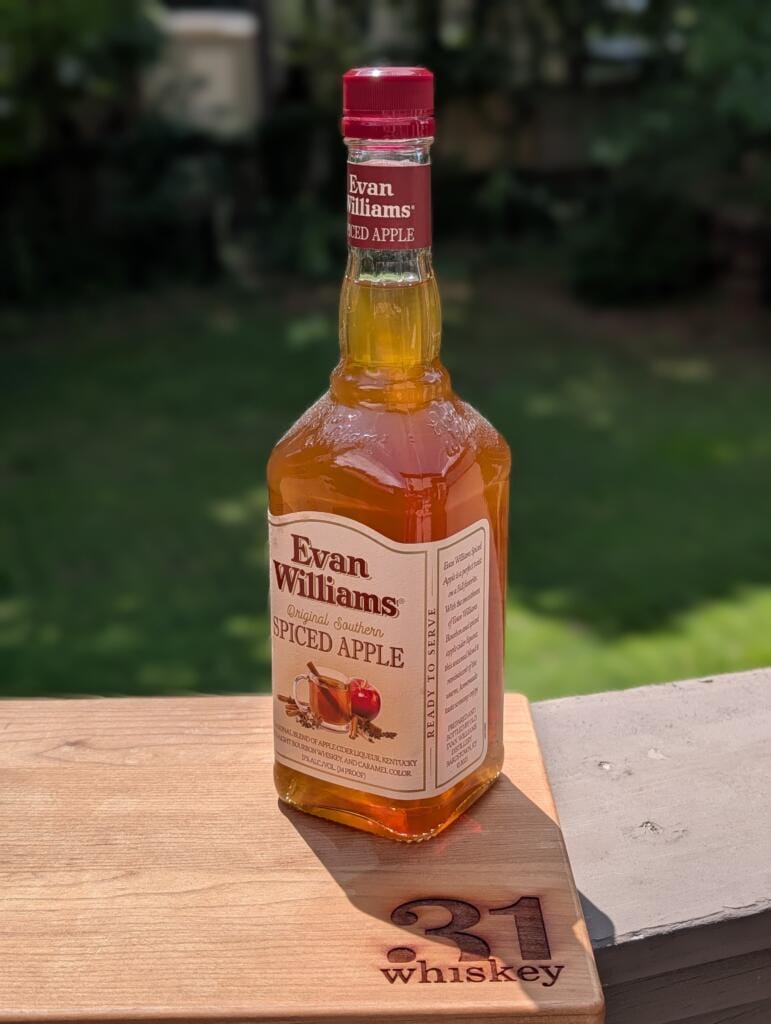
Evan Williams’ standard bottles are notorious for labels that swallow the entire face of the glass — a practice I’ve complained about before, and one that exists largely so bar patrons can’t tell they’re being poured from a nearly empty bottle. It’s a shame every time, because it hides the spirit.
This one is better. The design changes from the standard lineup are minor but well-judged: a red cap and a cream-colored label carrying a photo illustration of a hot toddy in a mug. That’s the whole intervention, and it works, because the base bottle is familiar enough that shifting the color temperature is sufficient to say “this one’s for autumn”. It’s the packaging equivalent of your dad putting on a flannel — same guy, clearly October.
More importantly, the cream label leaves you enough glass to actually see the liquid, which matters here, because that cloudy rust-gold color is the most distinctive visual thing about this product. When your spirit looks like cider from a roadside stand, letting people see it is doing the bottle a favor.
My one gripe is the photographic toddy. Photo imagery on a spirits label always reads a bit “supermarket shelf-talker” to me — serving-suggestion energy, the same instinct that puts a picture of a finished sandwich on a package of deli meat. An engraved or illustrated mug would have looked more expensive at identical cost.
Neat
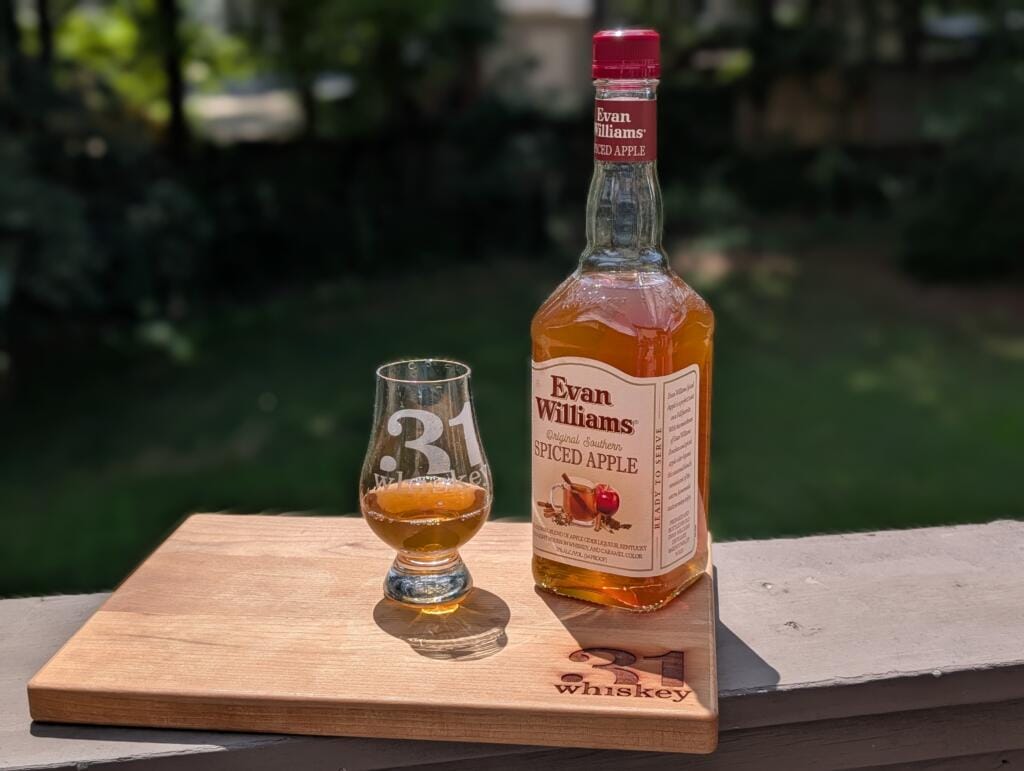
In the glass, this is a genuine departure from anything in the Evan Williams straight lineup: reddish brown, hazy, verging on rusty, much closer to a jug of unfiltered cider from a roadside stand than to bourbon. Which, as we now know, is exactly what it partly is.
The aroma is the best thing this bottle does, and I want that on record before I start complaining. It smells precisely like a hot toddy: cinnamon spice leading, vanilla behind it, ripe apple woven through, and, if you hunt for it, a faint whisper of that banana note I get off charcoal-filtered whiskey. It’s warm, inviting, and genuinely lovely to sit with. Evan Williams’ own notes claim cotton candy on the nose, and honestly, I see where they got it.
Then you take a sip and the cinnamon kicks the door in.
Neat at room temperature, cinnamon isn’t so much the lead flavor as it is the only flavor with a speaking part. And it’s not bakery cinnamon — no, it’s candle cinnamon. It tastes the way walking into a Christmas Tree Shops smells: that wall of cinnamon-scented pillar candles hitting you at the door, aggressive and unmistakably synthetic. (For those outside the Northeast, where the chain was an institution: it grew to about 70 stores before liquidating every one of them in the summer of 2023. So the analogy is now both regional and historical.)
Underneath, there’s something deeper and more resinous that I read as clove, though the brand says allspice and I’ll defer to them on their own formula. Either way, it pokes out at an angle that doesn’t sit right. It’s like the flavor equivalent of a background actor making eye contact with the camera and generally just trying too hard.
The apple is the supporting player, and thank God for it, because it’s supplying all the sweetness and actual fruit character here. Without it, you’re essentially chewing a cinnamon stick. The finish is short, sweet, mouth-coating — and more cinnamon.
There is, notably, no bourbon in evidence. At 17% ABV blended against a sweetened cider liqueur, the Evan Williams underneath is doing structural work, not flavor work.
On Ice
Usually ice does one of two useful things: knocks down whatever’s too loud, or thins the sugar and exposes what’s hiding beneath it. I was hoping for the former — that a couple cubes would put the cinnamon back in its chair and let everything else breathe.
Sadly, that didn’t happen. The cinnamon remains the loudest thing in the room by a comfortable margin. What does improve is the apple, which steps forward substantially and starts trading punches instead of just absorbing them. What you get is apple cider and cinnamon spice in a full-contact brawl across your tongue, and — genuinely — I don’t entirely hate it. Cinnamon and apple work for a reason, and this delivers a well-saturated version of both. There’s real intensity here, which is more than I could say for Winter Jack, where the entire profile was so faint it barely registered.
The bourbon, meanwhile, has left the building entirely. Neat, I could find a trace of something. On the rocks, though, there’s nothing — no caramel, no vanilla, no oak, none of the brown sugar and butter that makes Evan Williams 1783 a genuinely good four-star bourbon for fourteen dollars. Whatever whiskey is in here functions strictly as an alcohol delivery mechanism.
That’s the same complaint I lodged against Yukon Jack, where I couldn’t detect a single note from distillation or barrel and concluded it was a waste of perfectly good whiskey. The meaningful difference: Yukon Jack tasted like Lemon Pledge, and this at least tastes like autumn.
This is the best version of this spirit. Pour it over rocks and stop there.
Cocktail (Old Fashioned)
I went in optimistic. There’s ample sweetness already and real richness from the cinnamon and allspice, so aromatic bitters seemed like a natural fit to come in, add herbal complexity, and give the thing a spine. That’s exactly what happened with Piehole Apple Pie Whiskey and with Tailgate’s Cinnamon Apple Moonshine, both of which became legitimately good cocktails once the bitters arrived.
Sadly, not the case here. The bitters are simply gone — swallowed whole by the cinnamon before they can contribute anything. Worse, they don’t disappear cleanly: what survives turns up as an unpleasant undertone loitering on the aftertaste, a faint bitter smear the cinnamon then paints over. All of the downside of adding bitters, none of the balance.
Skip it. Skip the sugar cube too, obviously, at which point you’ve simply reinvented “on the rocks”.
Take that as the operating rule for this bottle: these flavors don’t blend, they conquer. Anything you add gets bullied into submission. There’s no room at this table.
Overall Rating
Credit where it’s due, because it isn’t nothing. Seasonal and novelty spirits fail catastrophically all the time — they often read beautifully on a marketing deck but arrive in the glass as an incoherent mess. We’ve reviewed a waffle-and-syrup cream liqueur that was undrinkable at room temperature and a barrel-proof “whiskey” that tasted like floor cleaner. Thankfully, this is not that. This is a competent, professionally executed blend of flavors that belong together, from a company that has been refining this exact seasonal product since 2012 and knows precisely what it’s doing. The real cider content is a genuine point of merit.
And that competence is also the ceiling. Cinnamon, apple, allspice, vanilla — this is dead center of the autumn flavor safe zone, the identical combination you’ve met in every candle, air freshener, coffee syrup, and grocery end-cap since Labor Day. There’s no idea here past “the usual fall flavors, with booze in them”. A one-trick pony, but the trick is one you’ve watched a hundred times. The synthetic edge on the cinnamon keeps it from being genuinely good rather than merely acceptable, and the failed old fashioned closes off the one flexible use case. Rocks or nothing.
Against MSRP, it’s entirely defensible. At $10–15 price point, this is cheap, it does what the label promises, and if you’re bringing something to a gathering in October where half the guests don’t drink whiskey, it will do its job without embarrassing you. That’s a real use case and I won’t sneer at it — this is the same brand whose Green Label earned four stars largely on the strength of costing nine dollars.
But if you want an apple spirit with actual depth and barrel character, Black Dirt’s Applejack Brandy is a five-star bottle around fifty dollars that will spoil this permanently. If you want cinnamon and apple that makes good cocktails, Tailgate managed it at 4/5. And if you want actual Evan Williams, spend a dollar or two more on the 1783, which is a better bourbon than this is a cider.
| Evan Williams Kentucky Cider Spiced Apple Production Location: Unknown Classification: Other Aging: No Age Statement (NAS) Proof: 17% ABV Price: $14.99 / 750 ml Overall Rating:   |
Overall Rating: 3/5
Real cider, fake cinnamon, and about as surprising as a scented candle in a Christmas Tree Shops.