
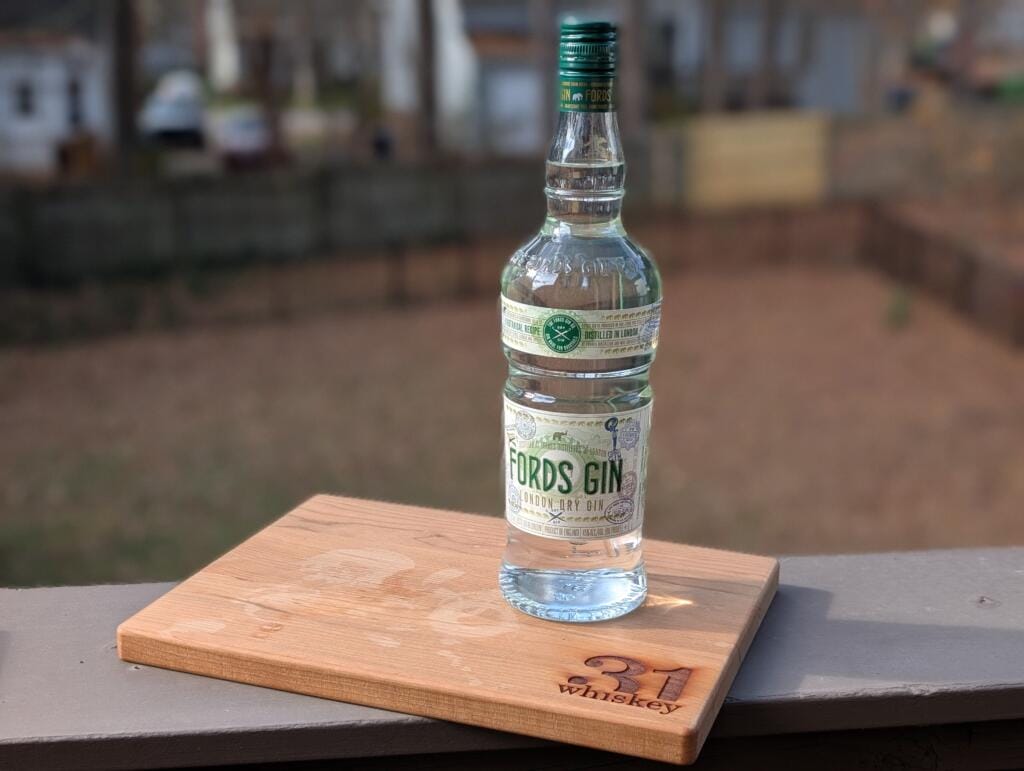
Gin is a spirit that may have gotten a bit too big for its britches in some regards. Craft distilleries love to cram all sorts of flavors and unique elements into their spirits, and we’ve reviewed them to mixed results here at 31W. Some, like Treaty Oak’s Yaupon Gin, are legitimately delicious — but others are more flash and less substance. Today we’re looking at a gin specifically designed for mixing in cocktails by a man known for his famous cocktail bars, and it’s shaping up to be a no-nonsense kind of awesome in a glass.
History
Simon Ford is a true expert in the world of distilled spirits and cocktails. He started his career managing a wine shop in London, England in 1993, learning the industry and its customers. Ford then transitioned into being a brand ambassador for big names like Seagram’s and Plymouth Gin before landing a role as the Director of Marketing for Pernod Ricard in 2008. Using that industry experience, he opened successful bars including Koba in Brighton in 2002 and a cocktail bar called The 86 Co. in New York City in 2012.
Leveraging his knowledge of the industry and delicious cocktails, Ford set out to create the perfect gin for mixing cocktails at his New York bar and partnered with long time distiller Charles Maxwell to make the perfect spirit for their purpose. The result was Ford’s Gin, which won the award for Best New Spirit in 2013 by Tales of the Cocktail.
Ford’s Gin continued to gain popularity and market share, and was acquired in June of 2019 by the Brown-Forman Corporation. Ford continues to work as the Global Marketing Director for his gin under BF’s leadership.
Product
- Learn More: What Is Gin?
Gin is an odd spirit in that it is distilled twice and the raw liquor being used isn’t quite as important as the rest of the process.
This gin starts as a batch of neutral spirits produced in an undisclosed location from an undisclosed raw material. Which is fine — the whole point is that it’s a blank canvas on which the distiller can work their magic.
That raw alcohol is imported to the Thames Distillery in London, England, which was founded in 1996 by Ford’s Gin collaborator Charles Maxwell. It’s here that the gin is given its distinct flavors, as they place nine different botanicals in a giant teabag and let that steep in the alcohol for fifteen hours, letting all of the essential oils and aromatic components infuse into the spirit. Those botanicals are:
- Juniper
- Coriander seed
- Lemon peel
- Bitter orange peel
- Grapefruit peel
- Jasmine
- Angelica root
- Orris root
- Cassia
Once infused, the botanical elements are removed and the spirit is re-distilled in batches through the distillery’s two pot stills. The resulting gin is bottled and shipped for sale worldwide.
Packaging
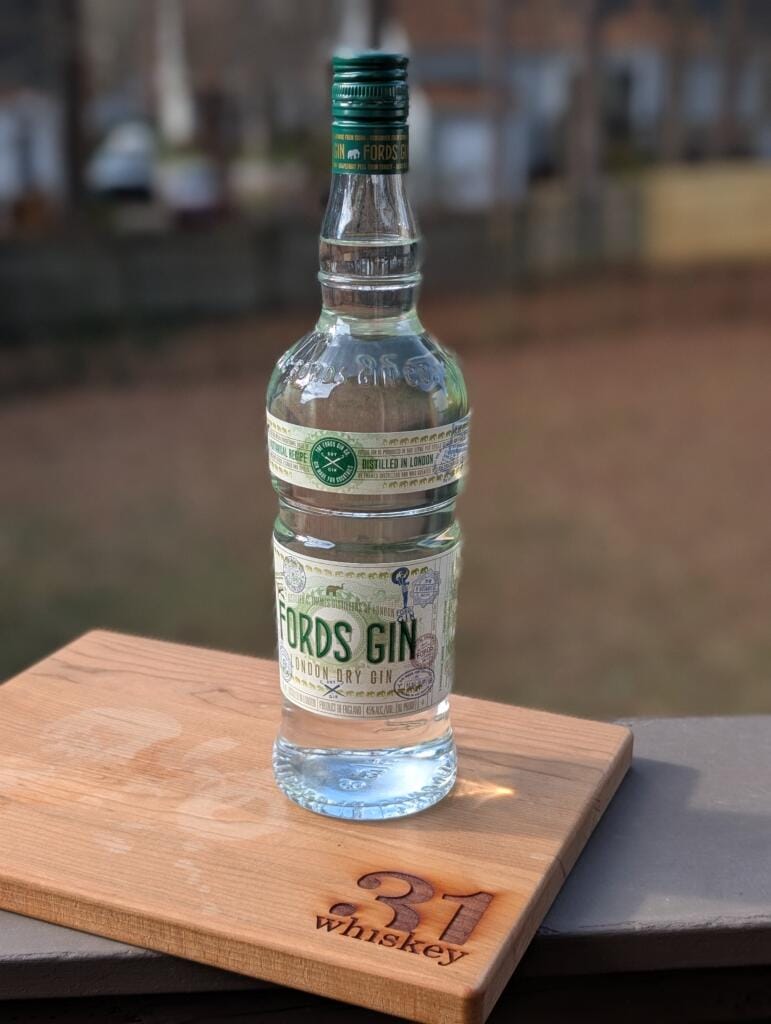
This bottle seems perfectly designed for mixing cocktails, with a secondary consideration to the marketing. And I appreciate that focus on the goal.
Overall, it’s a pretty standard shape — cylindrical body, plain glass coloring, and a medium length neck — but it seems perfectly designed to work behind a bar. The body is slim and flares outwards from the base to the shoulder, giving it an almost wedge-like shape that lets bartenders slot it back into their well quicker than a large or straight walled body. There’s a swell in the neck that’s just perfectly sized for a bartender to hold the bottle and give them a little more control while pouring. And even the screw-top on the bottle, while a cost saving measure, is also easier to operate and easier to keep clean than a cork stopper, meaning the bottle will last longer.
All fantastic choices for the audience this bottle was designed to appeal to.
On the label, they do make some design decisions in favor of the mass appeal marketing aspect. The general vibe of the brand is ‘1930’s globetrotting adventure’, with the label is designed like the travel stamps you’d see on luggage and passports of the era. It’s something you’d really only notice if you owned the bottle or if you looked up the brand, and for a London gin made in London proper it seems very fitting and appealing.
Not every bottle and branding campaign needs to be flashy and ostentatious. It needs to suit the target market. And I think, in this case, they did a great job.
Neat
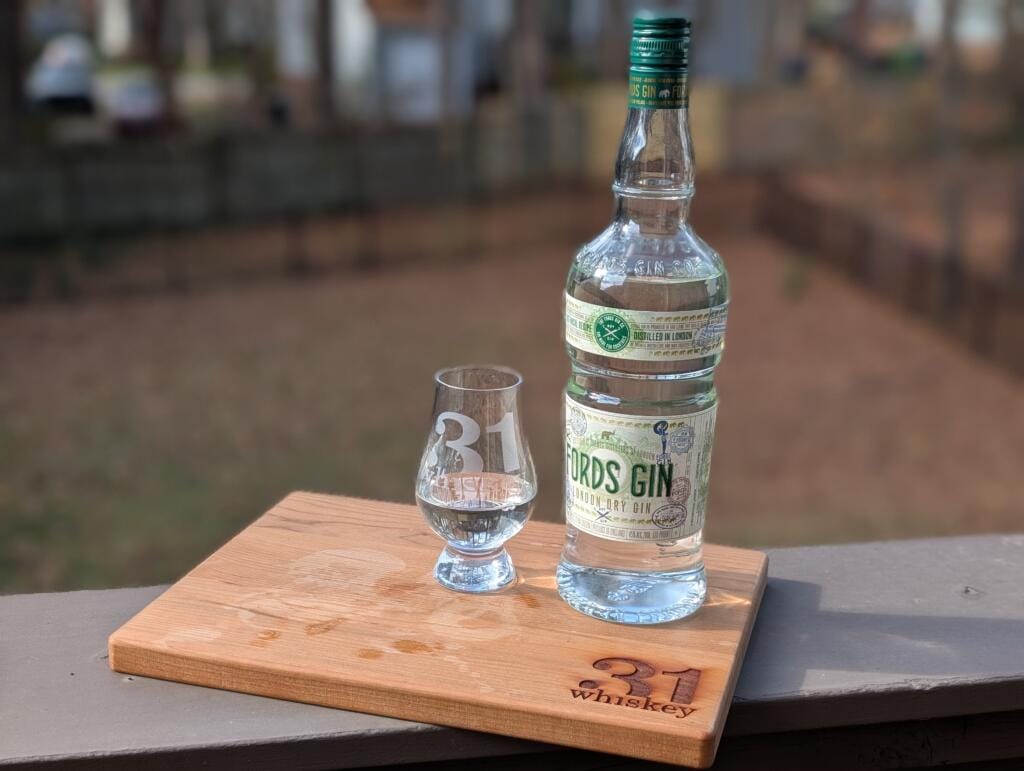
As a London Dry Gin, you’d expect this to be a juniper forward spirit — and as soon as you pour yourself a glass, you’ll see just how accurate that is. The smell of a pine forest in the cold of winter is what I’m getting here, with some lemon zest, orange rind, and cardamom spice.
Surprisingly, there isn’t nearly as much juniper in the actual flavor profile as I had expected. The earthier and citrus components are the largest flavors in here — specifically, the coriander spice, orange and lemon peel, and the orris and angelica root all combining to make a flavor profile that is smoother, richer, and with a deeper tone than I’d usually expect from a gin.
Theoretically, these are specifically the flavors that should make for some great cocktails if everything goes according to plan. Which makes total sense for a gin intended for mixing instead of sipping. Otherwise, it’s a bit little lackluster all on its own — it’s perfectly drinkable, but without much fanfare or complexity.
On Ice
Ice can be the kiss of death for a gin. All of the flavors in this spirit come from elements that flow through the distillation process, which makes them lighter and more susceptible to dilution and loss of fidelity with the cold from the ice cubes. But it seems like the flavors that Ford picked for his gin are specifically designed to survive this hostile environment, and might even get a little better.
The most surprising thing about this “London Dry Gin” is that I’m getting absolutely zero juniper at this point. There was some in the aroma and very little in the flavor when taken neat, but at this point that at best it’s a faint whisper in the background.
What is accentuated here is the citrus and the coriander spice. Those two elements are bolder and louder than ever, providing a delicious zesty flavor profile with some nice saturation and weight in the mouth. It’s velvety and delicious, like a candied orange slice with some Indian spices on it.
Cocktail (Gin & Tonic)
I gotta say, I think Simon Ford might be onto something here.
Even with the added uniqueness and further dilution of the tonic water, there’s still plenty of flavor here. The same citrus and spice keeps coming through, and that makes for an interesting cocktail. For much the same reason that I like the Tanqueray Rangpur Lime, this is adding just the right level of orange and lemon zest to a cocktail that really needs something fruity to make it work.
Add yourself a slice of lime and you’re good to go, but a dash of lemon simple syrup really makes it perfect.
Cocktail (Negroni)
I’m not sure if the negroni is growing on me as a cocktail, or if I’ve just had a couple good ones in a row here… but either way, this is getting surprisingly close to being a well balanced cocktail.
What’s really helping this make the grade is the richness and saturation of the coriander and the root elements, which provide enough of an earthy vibe to almost (but not completely) offset the bitterness in the Campari. There’s still plenty of that on the aftertaste, but at least up front the cocktail has a fighting chance.
On the disappointing side, while the overall vibe might be more balanced, the individual flavors still aren’t quite coming through. There’s just not enough volume to the citrus to make it clearly visible, but given the overall results I feel like it’s at least trying its best.
Overall Rating
I think this is an excellent example of a gin that knows its audience and designs to make something to specifically suit that use case. Too many spirits try to be a jack of all trades, when sometimes all you really need is a good bottle of gin that sits in the cabinet under your bartop. Not something to impress the neat sippers, but instead something to grab when you’re trying to perfect your version of a Saturn.
That’s not to say there’s no room for improvement here, though. In a London Dry Gin I expect a certain flavor profile — namely one where Santa shoves an entire pine tree up my nostril. That juniper-forward element is the defining feature of this style of gin, and I’m not really seeing it here. I get levels of juniper and flavors in the spirit are somewhat subjective, but to me it misses that mark and instead comes down on the American side of the equation.
That mismatch between expectation and reality is the only reason I’m knocking off a half star. Otherwise, this is a great example of a gin designed to be mixed, and that doesn’t take itself very seriously.
| Ford's London Dry Gin Produced By: Ford's Production Location: United KingdomClassification: London Dry Gin Aging: No Age Statement (NAS) Proof: 45% ABV Price: $28.99 / 750 ml Overall Rating:   |

All reviews are evaluated within the context of their specific spirit classification as specified above. Click here to check out similar spirits we have reviewed.
Overall Rating: 4.5/5
Light on the juniper, but heavy on the citrus and spice. A fantastic gin for mixing cocktails.