
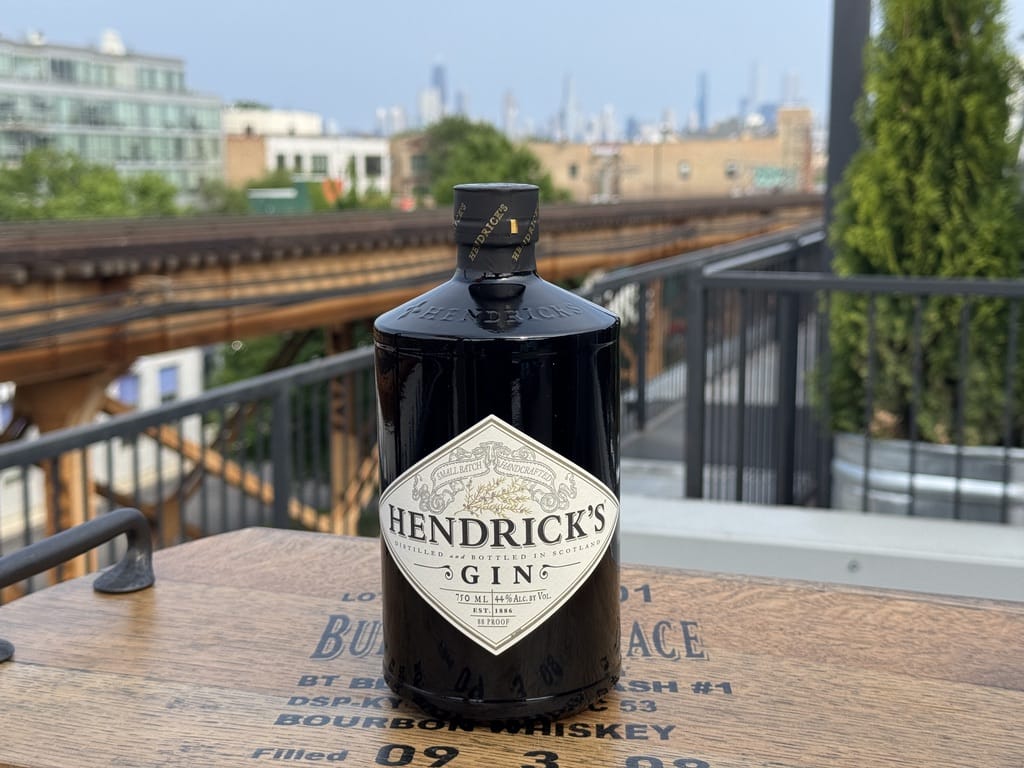
For a whiskey review site running for 7+ years, I’m shocked that somehow we have yet to review Hendrick’s Gin. I mean, seriously — I always just assumed it was one of the earlier spirits we reviewed. Imagine my surprise that, upon buying a bottle of Hendrick’s Oasium expression, I searched for our review of Hendrick’s original… and found… nothing. And since I feel like it’s a necessity to go back and review the original first, here we go: let’s take a look at one of the most ubiquitous gins around.
History
In 1999, William Grant & Sons wanted to get into the gin game. They didn’t want to do it by creating a run of the mill bathtub gin — rather, they wanted to create an “ultra-premium” gin. We’ve reviewed quite a few of William Grant & Sons spirits over the years, including Glenfiddich Scotch, Hudson bourbon, Tullamore DEW Irish whiskey, Sailor Jerry rum, and Millargo tequila. (Needless to say, they dabble in a bit of everything.)
Hendrick’s was the brainchild of Leslie Gracey, who is still the master distiller for Hendrick’s to this day. Gracey had the idea to make a gin with the normal botanical flavors, but to also add cucumber and rose to the mix.
Hendrick’s saw great success relatively quickly. In 2003, only four years after initial launch, the Wall Street Journal named it the “best gin in the world”. It’s earned numerous other awards and is credited as the spirit that helped bring gin back into the mainstream in the early 21st century.
In 2017, Hendrick’s started releasing a regular “reimagining” of the gin. These new expressions add various flavors and botanicals with one new expression released every year or two. The first was Orbium, which added blue lotus, cinchona, and wormwood (a Malort gin?!). There have been 10 total of these reimaging bottles released, with Oasium (the aforementioned catalyst for Thirty-One Whiskey getting into the Hendrick’s game) being the most recent.
Product
- Learn More: What Is Gin?
Hendrick’s gin starts with a neutral spirit, which really means raw whiskey that has been so highly refined that there’s almost no flavor left in it — just pure alcohol. Typically a minimum of 95% alcohol by volume, in fact, leaving very little room for any other flavoring.
Hendrick’s uses that neutral spirit in two different ways, through two different distilling technologies each using a different infusion technique.
In a a small copper pot-still dating back to the 1860’s, they place the neutral spirit and a blend of 11 botanicals to steep overnight like a large boozy tea in a process called “maceration”. The mixture is then distilled in the morning creating one component of the finished gin.
Added to that is another strain of gin that is distilled through a Carter-Head still constructed in 1948. In this case, rather than steeping the botanicals in the raw alcohol, the heated alcohol vapors are passed through a basket of botanical elements that infuse elements of those botanicals into the gin in a process called “vapor infusion”.
The ratio of how these two distillates are blended is a secret, but we do know rose and cucumber are added to finish the gin after blending.
As far as the botanicals go, there is nothing surprising: juniper, orange peel, lemon peel, elderflower, angelica root, caraway seed, chamomile, orris root, coriander, and cubeb berry.
After the final product is blended, and the right mix of flavorings from all the various components is complete, the gin leaves the still at about 142 proof (less than the legal limit for whiskey, which is 160 proof) and is bottled at 88 proof.
Packaging
I feel like this is one area that Hendrick’s really shines. Styled after an apothecary bottle, this hits all the right gin notes for me. This bottle is completely cylindrical, short, has a very sharp shoulder, and nearly non-existent neck. It’s topped off with a cork and plastic stopper.
Embossed on the shoulder is the name “Hendrick’s” with an image of generic botanicals on either side. The glass is dark, which I often see as a negative for whiskey, when you want to see the beautiful golden umber liquid. However, with a clear gin… who cares. So I’m glad they chose a vibe and leaned into it hard, and no points off for the opaque bottle.
The label is a large diamond with the name of the gin, distilling location, and all of the pertinent information. It’s simple, yet elegant. The apothecary bottle has become a distinctive part of the brand, being used with various color palettes for different expressions. The only thing I dislike about this bottle is pouring from it (an important part of the functionality): it looks great, but I’ve yet to pour a drink and not splash all over. The airflow is all wrong, causing the gin to pour unevenly.
Neat
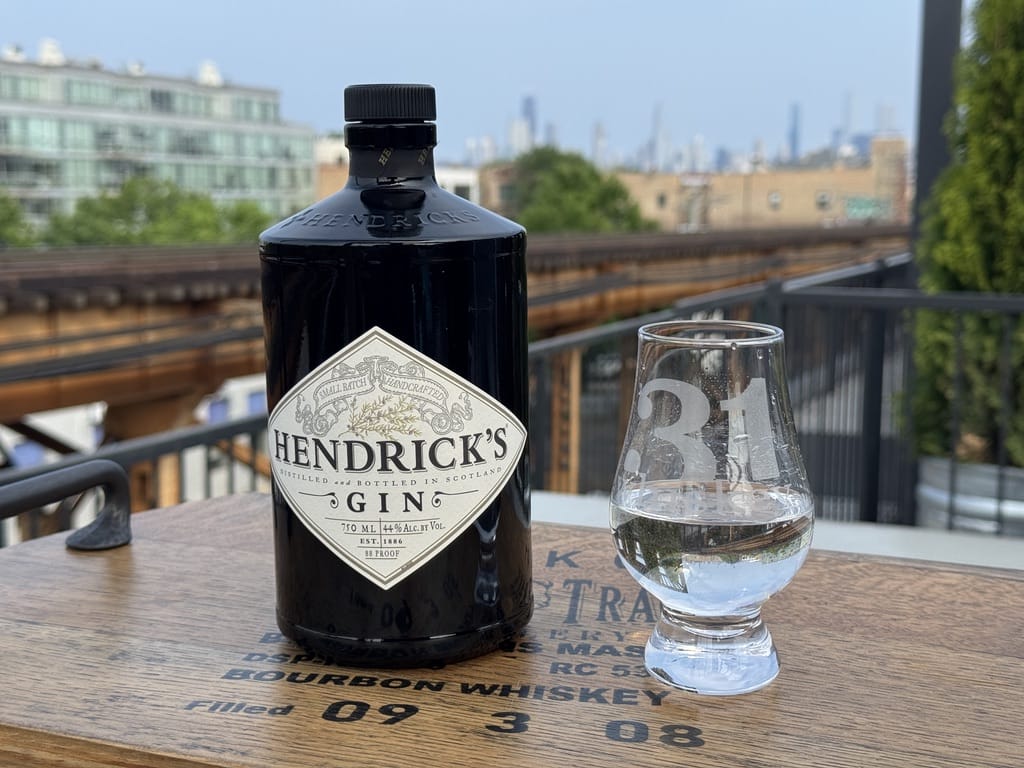
This might be the first time I’ve ever sipped Henrick’s neat… and I am surprisingly unimpressed.
If we start with the aromas, I first get a pungent, sharp alcohol scent. It’s not pleasant. However, after you get past that, you get a lot of the standard gin flavors starting with juniper and citrus. It’s mild, and not overpowering in the least.
The first sip it just ho-hum. It’s mild. Juniper and strong lemon notes are coming through, but not many other botanicals shine. There is a gentle sweetness to it all., and it finishes with some heat and a strong earthy note.
Overall, it’s clean, dry… and pretty boring for a gin.
On Ice
The gin flavors really open up on the rocks; thanks to the added ice cubes, you can start to pick out individual botanicals now. As you’d expect, the juniper is still prominent, along with the orange and lemon citrus — but now coriander (which I did not taste at all neat) is very much front and center.
I pick up more of the cucumber, as well. I still do not get any of the rose flavor, but that is such a delicate element that it might just be too subtle for my whiskey-washed taste buds. There is a tropical, floral note, which I think is the elderflower, and a very mild anise note that I think is the angelica root.
Overall, you get a lot more flavors on the rocks. It’s also worth noting that the mild warming sensation is also gone, leaving something a little more crisp and dangerously drinkable.
Cocktail (Gin & Tonic)
This was the first way I ever drank Hendrick’s gin — and, if available, is always my gin of choice for a G&T. Just so you understand when I say I think this is the best G&T out there.
You get the standard G&T flavors in this version: mild sweetness from the fresh lime, bitterness from the quinine in the tonic water, fresh citrus from the garnish and the gin. But Hendrick’s seems to add something more, too.
The more bitter elements of the gin tend to shine in this cocktail. The juniper is very forward, and I get a lot of the angelica root and caraway seed, but the cubeb berry steals the show here. The pungent all-spice and black pepper flavor blends exceptionally with the tonic and lime.
As I mentioned, I may be biased… but if you ask me, this is the pinnacle of gin & tonics.
Cocktail (Negroni)
Potentially unpopular opinion: I don’t think a negroni can be too bitter. There may be people who disagree with me (to be fair, I think most people would). If you are one of them, take what I say here with a large cube of sugar liberally splashed in your cocktail…
I think this is a fantastic negroni.
I love how the strong bitter botanicals of the gin seem to blend so well with the Campari. Yes, Campari is very bitter itself, adding to the overall bitter flavor profile of this cocktail, but it’s also sweet. And that sweetness is where the magic seems to be happening — the sweetness of the Campari leads the flavor pack, giving you a burst of sweet, citrus herbaceousness before it’s off to bitter-town.
This may be a bold statement, but this negroni reminds me of Malort, and I am here for it.
Overall Rating
I have always been a Hendrick’s fan, especially in a gin & tonic. The goal may have been to create an ultra-premium gin, but at $35 it’s a great deal. It’s priced alongside many other great gins, and out-classes them all easily.
That said, my review is based on my expertise as well as my own preferences — I tend to enjoy bitter drinks, and this gin is definitively more on the bitter side. It’s interesting that they put such an emphasis on the cucumber and rose in the marketing materials, because they hardly make an appearance. I was honestly surprised to learn that Hendrick’s uses cucumber — I despise cucumber water. I guess I just needed cucumber gin instead.
| Hendrick’s Gin Production Location: Scotland Classification: Gin Aging: No Age Statement (NAS) Proof: 44% ABV Price: $34.99 / 750 ml Overall Rating:   |
Overall Rating: 4/5
Hendrick’s makes the best G&T and that is a hill I will die on.