
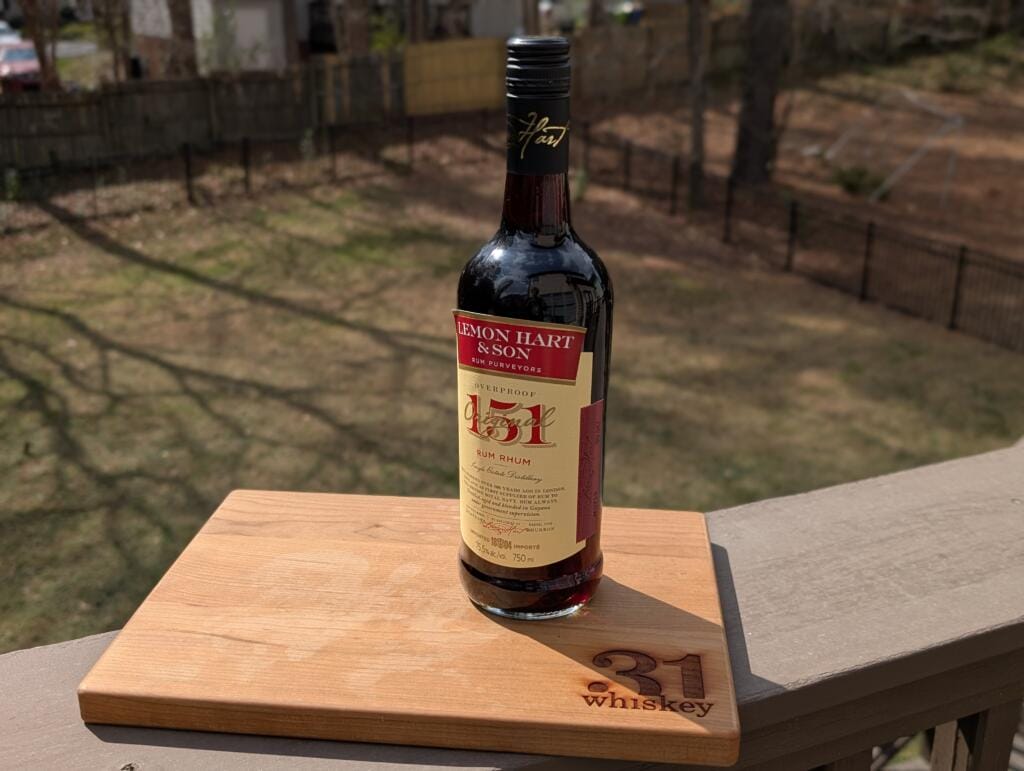
Every spring, without fail, I start getting the itch to make tiki cocktails. I’m sure it’s just the combination of the winter weather making me stir crazy and the alluring tease of summer, but to me this is the start of tiki season. And there’s no better way to kick it off this year than to review a rum with a long and storied history — one that is called out by name by the most famous tiki cocktail craftsmen in the world: Lemon Hart Rum 151.
History
Abraham Hart was a German merchant who, in 1720, decided to move to the British town of Penzance on the far southwest tip of the island nation. From there, he started a business importing rums from various distillers in the Caribbean and selling them onwards to others for eventual blending and bottling. In 1804, Hart’s grandson Lehman (later anglicized to Lemon) decided to take the family business to the next level — so instead of selling raw stocks of rum to other manufacturers, he instead worked on his own proprietary blend of rums that he bottled under the name Lemon Hart & Son.
The idea was a successful one, earning plenty of business not only from the local population but also becoming a trusted supplier of high proof rum to the British Royal Navy. The flagship product was a blend of Demerara rums sourced from distilleries along the Demerara river in the Caribbean country of Guyana which was well loved by sailors and British drinkers alike.
Lemon died in 1845, leaving the company to his son David who continued to successfully operate it through World War II. During this time, the brand name became world famous — and even more so during the 1930’s tiki culture craze where cocktail creators like Trader Vic and Don the Beachcomber called specifically for Lemon Hart & Son’s Overproof 151 Rum in their cocktails.
The family continued to operate the import and bottling business until 1948 when they joined with another rum importer to form the United Rum Merchants (URM). The business would then be acquired a number of times over the years until in 2005 it was eventually purchased by the massive French spirits corporation Pernod Ricard.
The modern incarnation of Lemon Hart & Son began in 2010 when the Canadian based Mosaiq Inc. company purchased the brand from Pernod Ricard and began bottling their own version of the spirit.
Product
- Learn More: What Is Rum?
I’m usually skeptical of modern reincarnations of historical brands — but in this case it does appear that, while they might not be using the exact same process and facilities as the historical version for their modern rum, they are following the same pattern and sourcing from the same areas as before. (In other words, they are making an effort to have this be as close as they can get to the original.)
Just like with the historical Lemon Hart & Son rum, this spirit comes from the Caribbean island of Guyana. At one time there was a thriving industry of distillers here, but today there’s just one left: Demerara Distillers Limited. It’s the same distillery that also makes El Dorado and other brands, located on the Demerara river in Guyana.
This rum starts off as backstrap molasses — the leftover sludge that is the end result of the sugar refining process. Raw cane sugar is pressed to extract the juice, which is then boiled off in successive pans to produce granulated sugar. The purity of that sugar decreases with each trip to the pan, eventually leaving only a thick sugary slop of impurities and noxious elements. That molasses is mixed with water and yeast and left for 26 hours to ferment, allowing the yeast to convert the sugars into alcohol.
Once fermented, the liquid is then distilled in a unique wooden column still — the last of its kind still used in mass production facilities. Designed identically to the one created by Aeneas Coffey, inventor of the column still, it was constructed in 1880 and has been in use at the distillery ever since. This still is able to concentrate the alcohol content and selectively capture the desired elements in the rum.
After distillation, the spirit is then placed into previously used American bourbon barrels for an undisclosed period of time before being bottled at a scorching hot 151 proof (aka 75.5% alcohol by volume).
The entire process from fermentation through bottling happens at the Demerara Distillers Limited facility in Guyana.
Packaging
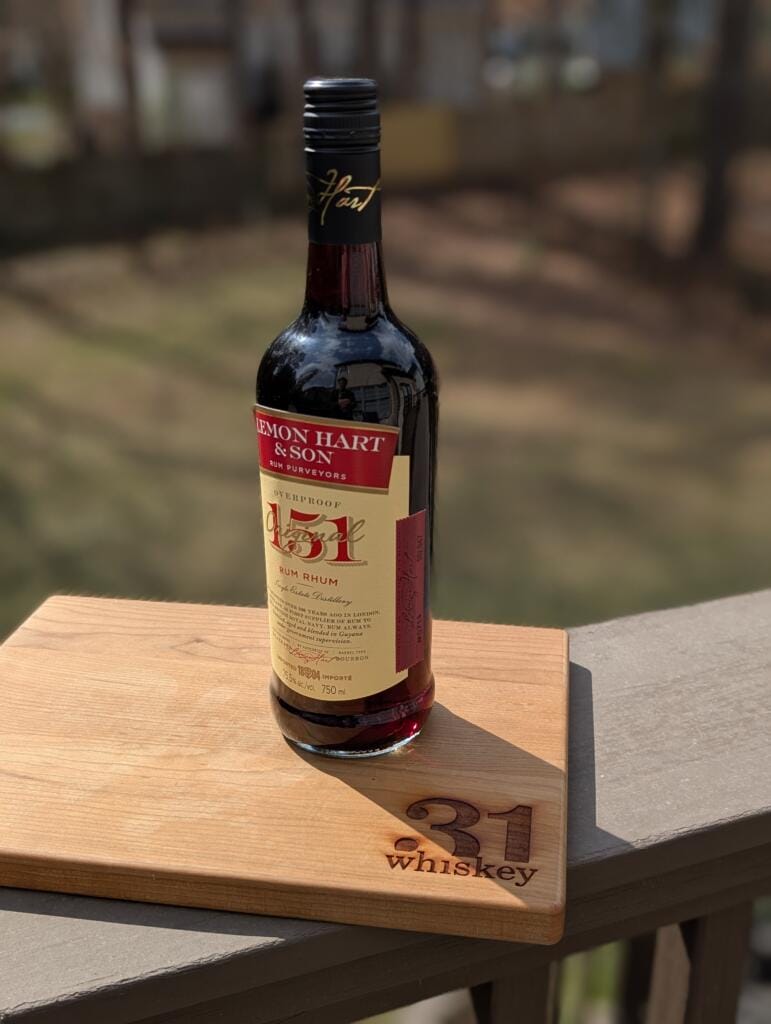
This feels very much like a bottle of rum that was designed to be used for cocktails and not necessarily worshipped on its own. And in that context, this bottle absolutely makes sense.
The shape is what you’d expect from a bottle of spirits: cylindrical body, rounded shoulder, and a medium length neck. The only thing I’d note is that the base of the bottle has a flare to it, which is very handy for bartenders as that will give you some wiggle room if you keep this in the well behind the bar rather than on the back shelf. The glass itself appears at first tinted brown… but no, that’s just the extreme dark color of the rum showing through.
Up top, the bottle is capped off with a metal screw-on closure, which is handy for quick access and cheap to produce.
The label on the bottle isn’t much to write home about. The style is reminiscent of other older bottles of spirits, especially those from the UK, with the brand information in a stripe at the top and some older styled lettering on the front. The label has a yellowed and aged aesthetic, which might be a nice nod to the age of the brand itself. There’s no images or embellishments to speak of here, just a clean label design.
Neat
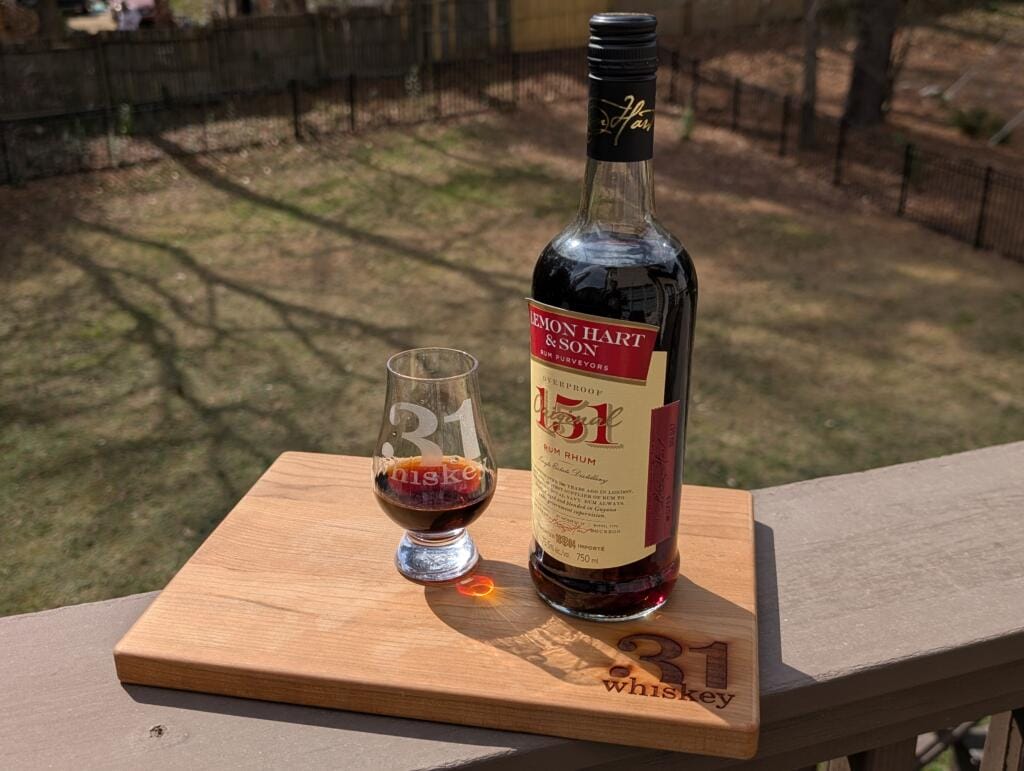
I said it previously in this article, but this rum is so dark that it looked initially like the glass was tinted. I like a good dark rum, so I’m not bothered personally, but you should be warned that it does look like you just poured yourself a nice glass of strong coffee instead of a rum.
Coming off the glass are the typical aromas I’d expect from a molasses based rum. Specifically, I’m getting molasses, dark chocolate, banana, over-ripe mango, coffee, baking spices, and burnt caramel.
You’ll get exactly zero tasting notes at first — because the alcohol content hits you like an 18-wheeler at highway speed.
But as your taste buds recover, you’ll start to see some of those flavors develop and the results are actually quite nice. Up front, the tropical fruits like banana and over-ripe mango lay a delicious sweet and fruity foundation, and are quickly joined by some charred brown sugar and dark chocolate notes. On the finish I get more of the baking spices that you’d expect from a bourbon barrel, followed by some brown sugar and vanilla, eventually finishing with a lingering tropical fruit note and cinnamon.
There’s glimmers of good flavors in here, but that alcohol content is intense.
On Ice
Normally, I’m dreading the addition of some ice to a spirit, as it has a tendency to mess with the flavors and cause unpredictable results. But in this case, this is a spirit that really does need to be watered down to be palatable.
With the ice on board, this settles down and becomes something remarkably sippable. There’s a silky dark chocolate note that starts early and underscores everything else, adding some lovely depth and character to the flavor profile. Built on top of that is charred brown sugar, vanilla, baking spices, and sugary molasses, before we finally gets some tropical fruits like the banana and over-ripe mango near the finish. Those tropical fruits do linger, along with some charred brown sugar and coffee, leaving a distinctly deep impression behind.
Cocktail (Dark & Stormy)
Usually, it takes a properly “dark” rum to make this cocktail work as intended… but this might be just as good.
The biggest contributor to the success of this cocktail is the dark chocolate and charred brown sugar flavors from the rum, which interact perfectly with the lime juice and the ginger beer. It adds a delicious base for the other components to build upon, and results in a nicely balanced and interesting cocktail.
Honestly, I’d like to see more tropical fruit in the resulting flavor profile, but I’d still happily sip this as-is all evening.
Overall Rating
I want to start off by highlighting that this is one of the few brands I’ve seen properly resurrect an old label. Like other similar brands, there’s no real connection between the new bottle and the 1890’s version other than the legal entity (after changing hands repeatedly in the meantime) — but unlike some of the others, they seem to have taken the care to actually source the spirit from the original location of the historical brand and are attempting to make it taste somewhat close to how it would have tasted when Trader Vic was throwing it into his Mai Tais.
As for the actual product… normally, I expect a rum to be light and tropical, but this is almost closer to an Islay scotch with the charring and the dark chocolate notes. It has a richness and a depth that isn’t common in Caribbean rums, which makes it less than ideal for sipping — but downright perfect for mixing. There’s a rich and deep base to the flavor that immediately adds a chocolatey and coffee kind of vibe to whatever you are making, and for some of these fruity tiki cocktails that’s exactly the kind of down to earth rum that you need.
To me, this is a specialty rum with one specific purpose. It works great in a cocktail, but taken on its own it leaves a lot to be desired. I need a hefty helping of ice just to taste it properly without scorching my taste buds, which keeps it out of the five star range unfortunately. Add in the price and the competition and what you have is a bottle of rum that is perfect for those scenarios when you need it… but those scenarios aren’t everyday occurrences.
| Lemon Hart 151 Production Location: Guyana Classification: Rum Aging: No Age Statement (NAS) Proof: 75.5% ABV Price: $39.95 / 750 ml   |
Overall Rating: 3/5
A rum with a deep and rich flavor profile of dark chocolate, coffee, charred brown sugar, tropical fruits… and scorching heat from the alcohol content.