
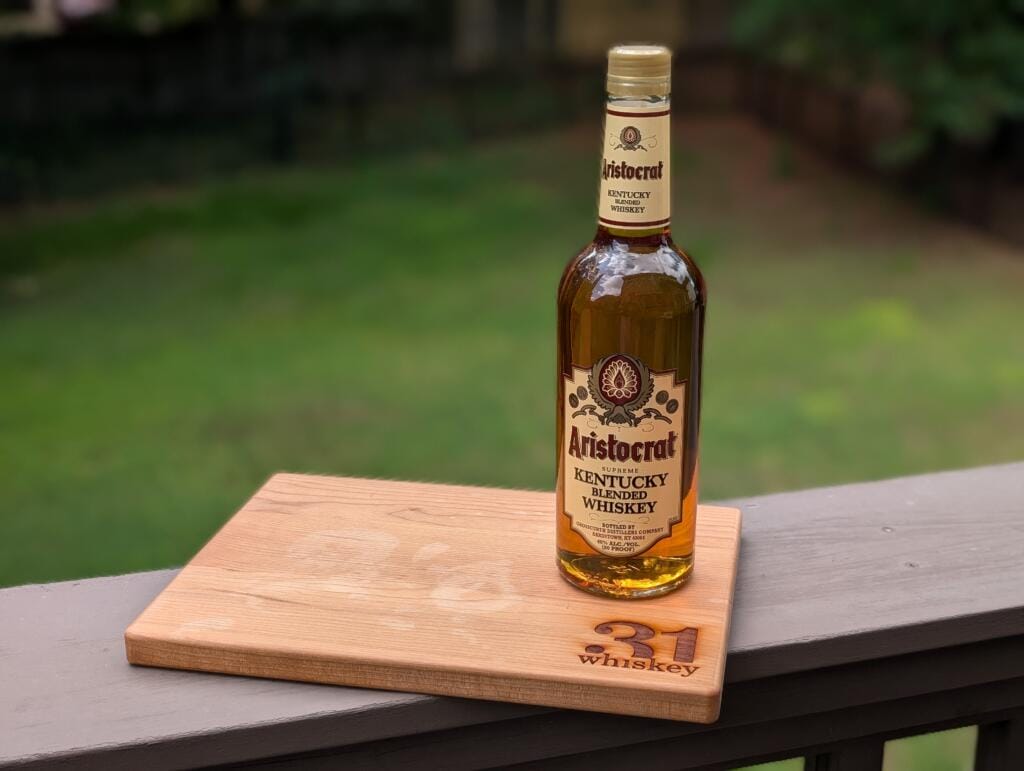
We’re nearing the end of the 2024 spooky season whiskey reviews here at Thirty-One Whiskey, and so far it’s been a fairly mild season — but this bottle might just step up the scary. Every person I’ve mentioned this bottle to has recoiled in horror with memories of other past experiences with the stuff, and everything about this bottle tells me to stay away. But with Halloween just over the horizon, the time has come to crack it open and face my fears.
History
John Bond and his son David opened a distillery in 1810 in Anderson County, Kentucky. The facility would change hands a few times over the years, eventually being sold to J. M. Waterfill and George H. Frazier just before the start of the American Civil War in 1860. The distillery produced a brand of whiskey marketed as “Waterfill & Frazier” which rose to some prominence. In the 1880s, they partnered with another local whiskey maker named John Dowling to finance a refurbishment of the facility subsequently and renamed the company to “Waterfill, Dowling & Company”. Dowling gradually increased his ownership stake, buying out Waterfill and Frazier until by 1900 he owned the facility outright and operated the distillery with the assistance of his brother Edward. They kept the Waterfill & Frazier brand name around even after their departure from the business.
In 1902, Dowling opened a new distillery and shifted production to this new modern location. Around this same time, he brought his wife Mary into the business as a partner, who then became the sole proprietor of the business after his passing a few years later. Mary Dowling suddenly found herself as one of only a handful of pioneering women to be in charge of a major distillery, and over the years became a Kentucky legend for her ability to produce high quality Kentucky whiskey.
Her fame quickly turned to infamy following the start of prohibition, which shuttered her distillery and prevented her from selling her existing massive stockpile of whiskey — legally, at least. For the next four years, she worked with local bootleggers to keep the population well supplied until in 1924 when federal revenue agents set a trap for Mary Dowling, who was arrested along with her three sons for selling illegal whiskey. They were convicted, but that conviction was later overturned after the court stenographer died and no one could read their chicken scratch handwriting well enough to reconstruct the court record.
The Dowling family seems to have had enough with the United States at that point, and together they partnered with Joseph Beam (Jim Beam’s first cousin) to disassemble the old distillery brick by brick and have it transported to Juarez, Mexico where prohibition was not the law of the land. They dubbed this the “D.M. Distillery” (for “Dowling Mexican”) and operated for five years, producing blended whiskey for distribution and sale in South America under the Waterfill & Frazier brand name. Evidence suggests that some of that Mexican whiskey made its way back to the United States through less than legal channels, as evidenced by a letter written from Julian “Pappy” Van Winkle to Mary Dowling complaining that her Mexican whiskey was making it hard for him to sell his American made spirits.
Mary died four years before the end of prohibition in the United States, and in 1934 her son John rebuilt and re-opened a new distillery in Fisherville, Kentucky just outside of Louisville. Here they continued producing spirits under the Waterfill & Frazier brand name, and that distillery was sold to the Charles and Theresa Grosscurth in 1948. The new owners also created and distributed spirits under the “Aristocrat” brand name, marketing their spirits as “Supreme” versions of vodka and whiskey, but the business did not succeed and the facility closed in the 1950s. The Grosscurth distillery burned down in the 1960’s and was demolished in the 1970’s with Heaven Hill purchasing the brand names.
Heaven Hill continues to produce and market spirits under the Aristocrat brand name, using a DBA of Grosscurth Distillers Co. for this bottle.
Product
This is labeled as a “Kentucky Blended Whiskey” with the “Blended” part significantly smaller in size than the rest of those words on the label. What this means from a practical perspective is that only 20% of the contents actually need to be whiskey, and the rest can be ‘neutral spirits’. In other words: it can be as high as one part whiskey to four parts cheap vodka.
What little whiskey is in here is likely to be at least mediocre, since federal regulations require it to be a “straight” whiskey. That means the spirit needs to be made from grains, at least 51% of which were corn, that were cooked, fermented, and distilled prior to being barreled for at least four years. That’s a solid recipe for a whiskey, but unfortunately not what makes up the majority of this liquid.
For the remaining volume, they use what’s called ‘neutral grain spirits’. This is some kind of grain (corn, usually) that is cooked, fermented, and distilled to such a high proof that it loses all flavor. It’s pretty much industrial alcohol that gets watered down and mixed in with the actual whiskey to create the bottle we see here today.
On the one hand, I appreciate that blended whiskey is what Mary Dowling produced in her Mexican distillery after being run out of the United States for bootlegging, and that makes this at least somewhat historically linked to the lineage of the brand name… but I don’t think that was the intention here. I think this was done to be cheap, not to be interesting or to pay homage to the history of the brand.
Packaging
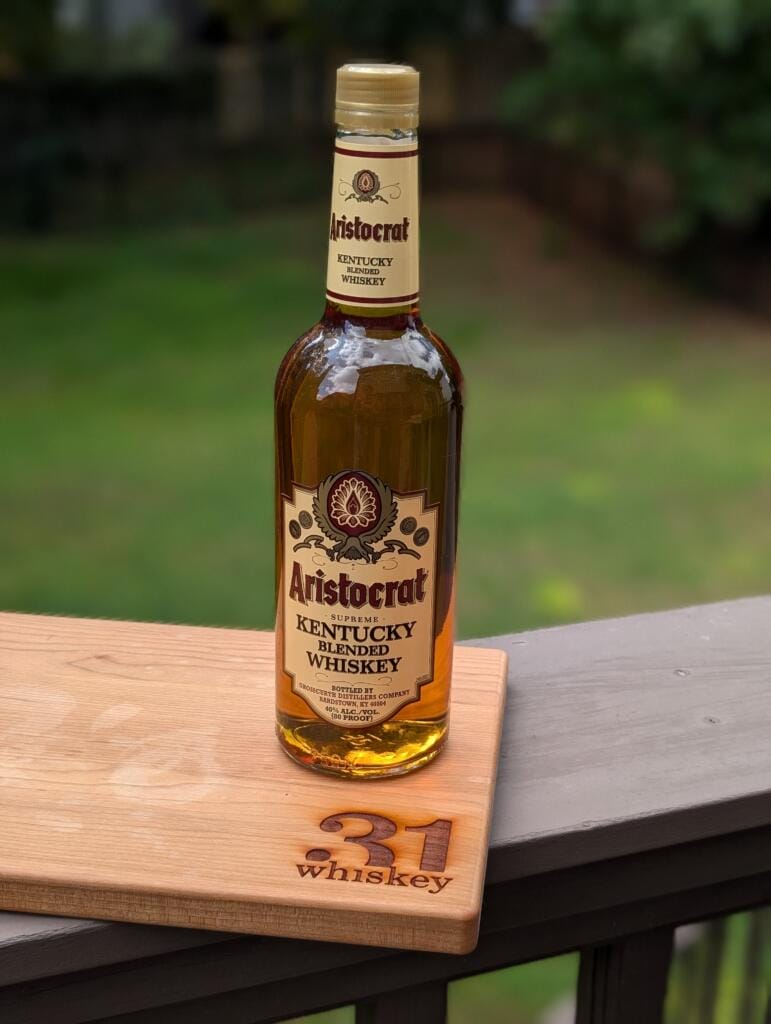
I feel like Heaven Hill defaults to this design when they don’t want to put a lot of effort into the actual shape of the bottle. This looks exactly like their J.T.S. Brown, J.W. Dant, and Mellow Corn lines of whiskey, just with a different label and different colored cap.
The body of the bottle is cylindrical with a rounded shoulder and a medium length neck. The neck has a slight taper from the base to the top, and is capped off with a plastic screw-on cap. There are no distinctive markings on the glass that I can find — it’s just a blank bottle.
For the label, I feel like I’m looking at the embodiment of a dive bar. It’s got the same color scheme as Miller’s Banquet line of beer, but without the self awareness and cool retro vibe. It’s just the dingy and dated version of retro.
Neat
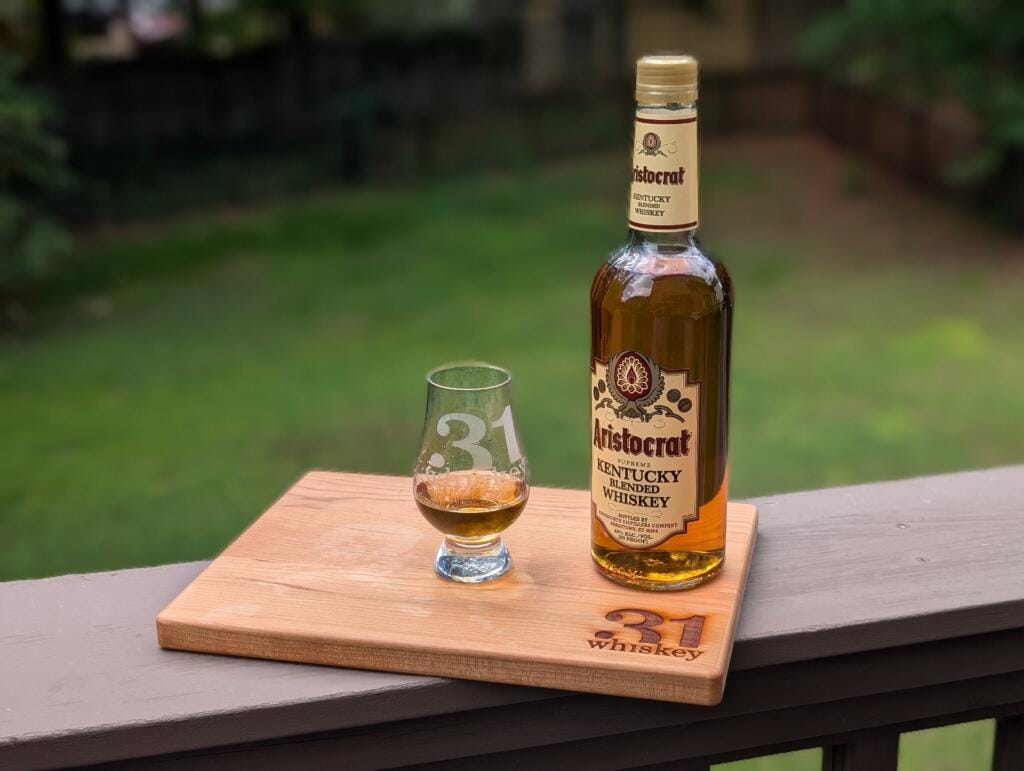
The whiskey is the right color, which is a good start. It’s that kind of dark gold that has just a hint of rusty orange to it — not as much as a proper bourbon, but just enough to pull off the illusion.
Taking a whiff of the glass, this is definitely in line with other blended whiskies. There’s an artificially sweet note in here at first that makes it seem like sniffing a glass of candy corn, but as time goes on it becomes fruitier with some apricot, grape, and apple notes. From time to time, there’s a hint of industrial alcohol… but it comes and goes and is never loud enough to really make a huge difference.
All of that falls completely flat when taking a sip. That first impression about candy corn comes back aggressively — this is like a glass of corn syrup and vanilla with just a tiny hint of molasses. None of that fruit from the aroma comes through, leaving this boring and simple in terms of the flavor profile.
And that’s what I mean when I say that it’s in line with other blended whiskies: there’s great promise in the aroma that fails to deliver in the flavor. That’s been the case with everything from American blends to Scottish blends, and remains true here.
On Ice
If we thought this was bland when taken neat, adding some ice takes it to a whole new level. A level down, that is… we’re now in the basement of my expectations.
At this point, this tastes like a glass of water where someone waved a bottle of whiskey in its general direction. There’s some spice in here, likely from the alcohol content itself, but the only flavor I’m getting is a tiny hint of caramel. And even that isn’t ideal — there’s a little bit of charred bitterness on there that makes it not as enjoyable as I’d hope.
It’s not terrible, but it’s like a plain turkey sandwich with mayo. Completely bland and flavorless.
Cocktail (Old Fashioned)
This is a glass of cold, watered down bitters. That’s all.
If I have one positive thing to say, it’s that there might be a hint of sweetness from the whiskey that is providing some balance to the bitters and making it a relatively nice experience. There’s nothing whatsoever interesting going on here in terms of complimentary flavors — it’s all the elements from the bitters and nothing from the whiskey — but at least there’s something going on.
Fizz (Mule)
I look for two things in particular in a mule: a pleasant flavor interaction with the whiskey, and an interesting texture that wouldn’t be there otherwise.
In terms of the flavor, I do think that I see something redeeming here. It’s not great, but there’s a hint of sweetness and caramel that seems to be balancing with the ginger beer and lime juice. Or, at least, trying to balance. It isn’t the amazing flavors that I’d expect from a proper straight bourbon, but there’s enough here to see that something is happening under the surface.
And while there is a different texture, I wouldn’t call it good. I’m really getting a clear image of that bitterness on the end, like the bite from a piece of dark chocolate… but without the flavor. It’s just like a charred piece of caramel stuck on the finish and sours the experience for me.
Overall Rating
Having faced my fear and tried out this bottle, I’m pleased to find that I’m no longer that scared of it. There’s nothing overtly terrible in here — it just isn’t very good. Which, given the price, isn’t surprising at all.
I mentioned it earlier in this review, but the key definition of the flavor profile of a blended whiskey is that it smells great but tastes relatively bland. Adding in all of that neutral spirit wipes out the more delicate flavors, and what’s left is something that might be nice on a surface level but doesn’t hold up to any level of scrutiny.
There’s no way that I’d call this “good” as a whiskey, but it lacks the faults that keep other spirits on the lower end of the spectrum. Especially compared to something like Traveler’s Club — that isn’t even close to the same level of unfortunate flavors I saw there.
For the extra dollar above some of the other bottom-shelf offerings, I’d say this is worth the price.
| Aristocrat Kentucky Blended Whiskey Production Location: Kentucky, United States Classification: Blended Whiskey Aging: No Age Statement (NAS) Proof: 40% ABV Price: $7.5 / 750 ml    |
Overall Rating: 2.5/5
A sweet and slightly fruity aroma but a flavor profile as exciting as watching paint dry.