
I absolutely love a good hefeweizen. My all-time favorite is the Live Oak HefeWeizen from Live Oak Brewing in Austin, Texas – it’s that perfect combination of crisp, refreshing, citrus-forward beer with just enough banana and clove underneath to give it some complexity. Plenty of beers have come close over the years, but none have surpassed it.
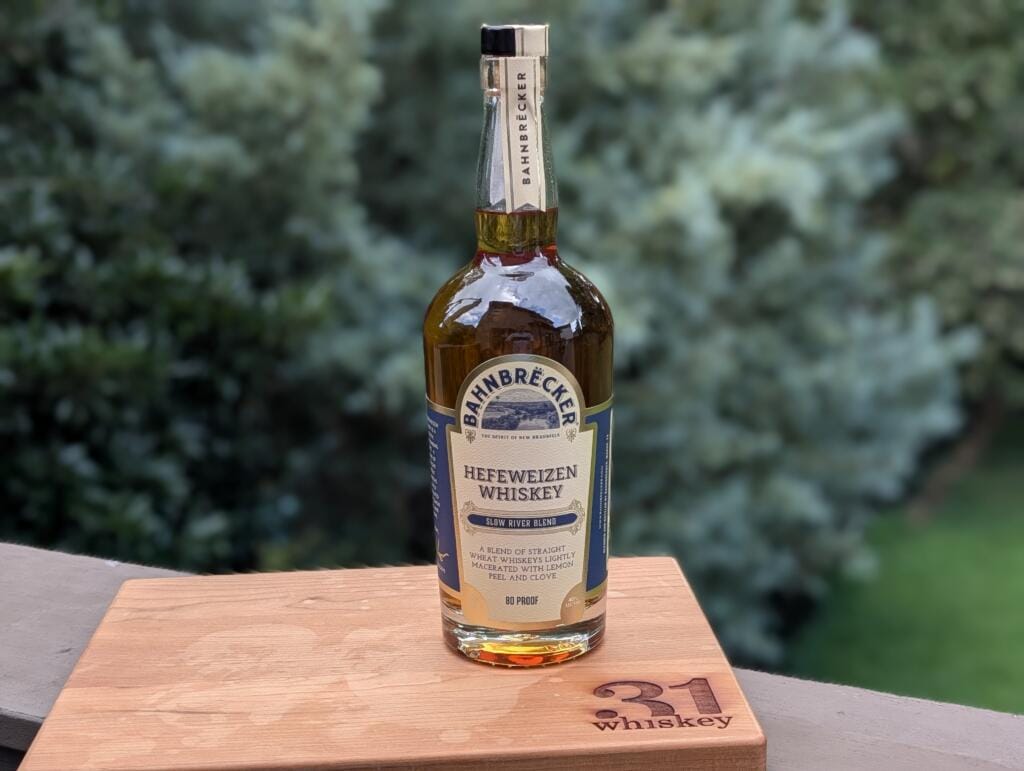
I moved away from Austin a few years ago, and I’ll admit I was a little worried that I’d built the thing up in my head. Then I was back in town a few weeks ago for a security conference, ordered one, and confirmed that it really is that good. Which put me in exactly the right frame of mind to be wandering a Texas liquor store later that trip and spot a bottle labeled Hefeweizen Whiskey. From that point, there was never any question that it was coming home with me.
History
Bahnbrëcker launched in September 2021 out of New Braunfels, Texas, co-founded by country musician Randy Rogers along with Eric Chase, Cary Schindler, Ash Wineinger, Michael Devers, and spirits-industry veteran Steve Luttmann. Slow River Blend was the brand’s first product, announced as the “world’s first Hefeweizen-style whiskey”, hitting Texas shelves and nationwide shipping on September 15, 2021 at a suggested retail price starting around $37.99.
The name is the good part of the story. Bahnbrecher (roughly “trailblazer” or “pathbreaker” in German) is a nod to New Braunfels itself, which is about as German as a Texas town gets. It was founded on March 21, 1845 by Prince Carl of Solms-Braunfels, who was working as commissioner-general of the Adelsverein (a society of German noblemen organized to shovel German immigrants toward Texas) and who named the settlement after his family’s ancestral castle back on the Lahn River. So when a spirits brand from New Braunfels decides to make a whiskey that tastes like a Bavarian wheat beer, that’s not a marketing department pulling a concept out of a hat — that’s the actual cultural DNA of the town, which is more than you can say for most brands with an umlaut on the label.
The celebrity angle is worth naming, because we’ve been burned before. When we looked at Traveller Whiskey Blend No. 40, a Chris Stapleton collaboration with Buffalo Trace’s Harlen Wheatley, all that star power and distilling pedigree produced a bottle that earned a 1/5 rating from our site and the kind of bitterness that follows you through every format you try it in. However, Rogers is not as well-known as Stapleton and Bahnbrëcker is a considerably smaller operation than Sazerac… so I went into this expecting the worst version of the celebrity-spirits playbook. Thankfully, that expectation turned out to be wrong… but more on that in our tasting notes.
Product
Here’s where I have to be straight with you about what I could and couldn’t confirm.
Per the label, this is a blend of straight wheat whiskeys lightly macerated with lemon peel and clove, bottled at 80 proof. Wheat whiskey is a TTB-defined class (27 CFR Part 5): a mash of at least 51% wheat, distilled to no more than 160 proof, and aged in new charred oak. Tack “straight” onto the front and you’re adding a minimum of two years in that new charred oak. So the base liquid here isn’t some no-age-statement mystery juice — the classification itself sets a floor. San Antonio Magazine’s reporting on the launch put the age at three to five years, which tracks.
What the brand says publicly is that the wheat is sourced from Texas and the Midwest. What the brand does not say publicly (at least not anywhere I could find) is who ran that wheat through a still. There’s no named distillery, no state-of-distillation disclosure I could locate, and the word “straight wheat whiskeys” is plural — which means at least two component whiskeys, and under the straight-whiskey rules, blended straight wheat whiskeys have to come from the same state to keep the “straight” designation. Midwestern grain plus an unnamed producer plus a brand with no visible distilling operation of its own is a pattern most whiskey drinkers can read without a decoder ring… and smells a whole lot like the MGP Distillery in Indiana.
But the flavoring is the actually interesting part of this spirit, and here Bahnbrëcker deserves genuine credit. The brand’s pitch is “infused, not flavored” and specifically WONF-free (meaning no “with other natural flavors”). Real lemon peel and real cloves are macerated into the whiskey rather than a flavor house shipping them a drum of something. Compare that to something like Webb’s Grainworks Butterball, where the word “flavored” on the label with no further explanation told you everything about the faintly artificial twinge in the glass. Real botanicals in real whiskey is the harder, more expensive way to do this, and you can taste the difference.
But I want to flag the chemistry problem sitting at the center of this product, because it’s the whole ballgame. The flavors that make a hefeweizen — that banana and clove — are not ingredients. Nobody puts a banana in a hefeweizen. They’re fermentation byproducts of specific Bavarian wheat yeast strains: isoamyl acetate for the banana, 4-vinyl guaiacol for the clove. The yeast makes them while it eats the sugar. That’s the trick, and it’s a trick you can’t perform on a finished, barrel-aged whiskey by dropping cloves in a tank. You can add clove. You cannot add the process that made the clove show up. So this was always going to be a whiskey wearing a hefeweizen costume rather than a hefeweizen in whiskey form, and how you feel about the bottle depends a lot on whether you can make peace with that.
Packaging
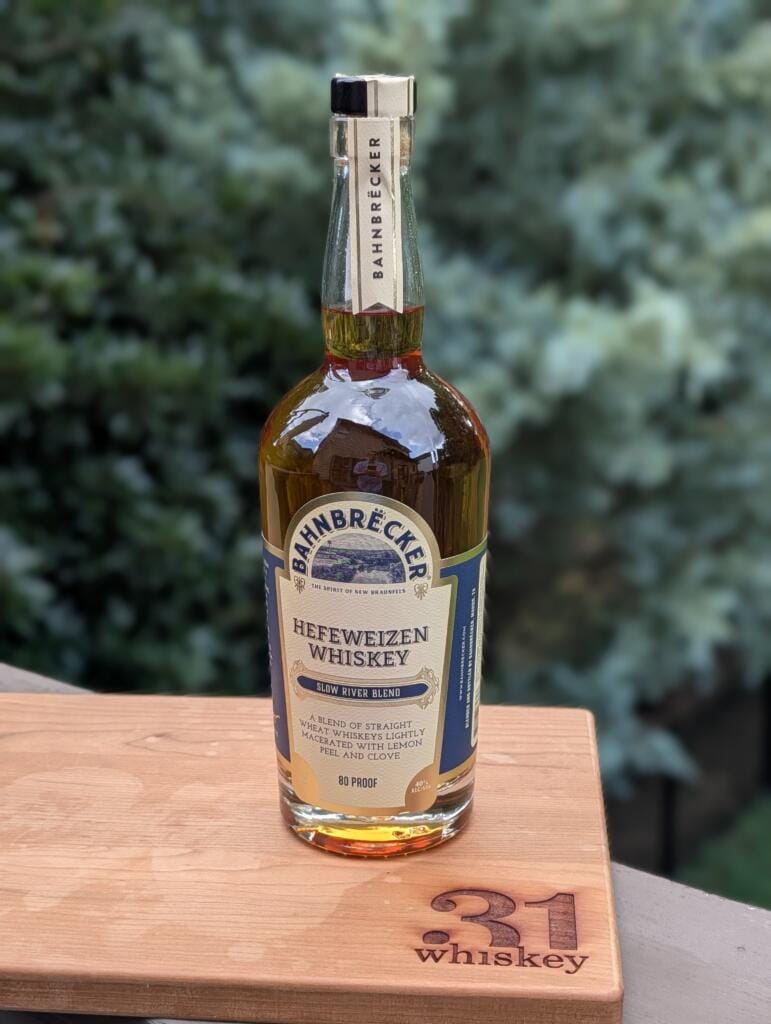
This bottle is completely conventional (and I mean that as a compliment): standard size and shape, the same general profile and typographic vibe as a bottle of Old Forester, with clear glass and good visibility of the spirit inside. After a few years of craft brands trying to win the shelf with hand grenades, decanters, and bottles shaped like things that are not bottles, there’s something reassuring about a brand that just makes a bottle.
The label is the usual cream-and-blue affair with a small illustrated vignette up top and the tagline “The Spirit of New Braunfels” underneath. Critically, it stays out of the way — it wraps enough to carry the required copy but leaves plenty of glass for the whiskey to show through, which is my most frequent packaging complaint and one that this bottle doesn’t trigger. The neck gets a printed paper tag hanging off it with the brand name running vertically, which is a small touch that does more work than it should.
The closure is a synthetic cork with a plastic top, which is fine. Not the wood-and-cork you’d want at the top of the price bracket, but also not the screw cap that would have soured the whole presentation. The overall read is a bottle that would look at home on a Texas back bar in 1974, and I suspect that’s exactly the intent.
Neat
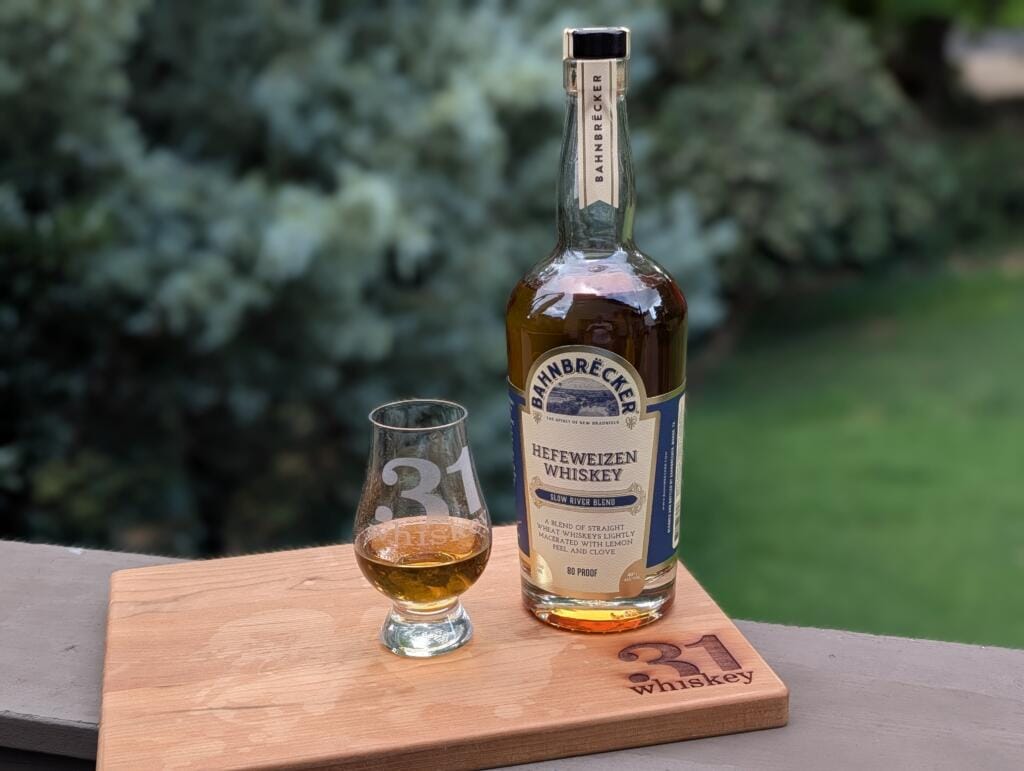
The whiskey is pale colored in the glass, with a slight hint of amber, and overall it’s nothing that’s going to stop conversation at the table. The aroma is heavy on clove with a hint of citrus behind it, and not much of the actual whiskey comes through initially — you’re getting the botanicals first and the barrel second, if at all.
The first sip is legitimately confusing. Clove and lemon peel dominate the flavor profile so completely that your brain files it under “something other than whiskey” before it can figure out what. Behind that comes in vanilla, brown sugar, and cinnamon spice, which pull the experience back toward recognizable whiskey territory. There’s a sweetness to the texture and viscosity that reads as more than what the barrel alone would give you.
Further sips do get better — the composition tightens up and the whiskey elements push forward as your palate stops being surprised — but this is where the chemistry problem shows up in the glass. There’s no crispness. There’s no lightness. A hefeweizen is refreshing above all else, and refreshing is not a thing an 80 proof spirit does neat. All the flavor markers are present and correct, but the one thing that actually makes you reach for the beer is missing.
On Ice
Usually a little ice washes out the weaker flavors while sanding the edges off the richer ones. Here it does something better: it acts as an integrator. The clove and lemon peel that were sitting on top of the whiskey neat finally get folded into it, and what was a confusing drink becomes a competent and genuinely delicious one.
It’s still missing the crispness of a good hefe, but there’s some lightness and complexity now, with the flavors you’d expect from the base spirit doing their job underneath. The new arrival is a dark chocolate note that I’d credit to the whiskey rather than the botanicals, and it adds a depth that wasn’t there before. It also read to me as a promising sign for what was going to happen in a cocktail.
Cocktail (Old Fashioned)
This is different… but good. The aromatic bitters bring herbaceous notes that elevate the drink and balance nicely against the dark chocolate and clove already in the whiskey( which makes sense, given that angostura is built on gentian, cinnamon, and clove and is essentially agreeing with the bottle rather than arguing with it). The lemon peel does the same from the other direction. One adjustment, though: Bahnbrëcker’s own recipe calls for a half ounce of simple syrup, and this whiskey does not need it. There’s already a brown-sugar sweetness and weight to the spirit, and that much syrup just makes the botanicals fight their way through. Build it with whiskey, ice, and bitters, taste it, and add a splash of sugar only if you actually miss it. (You probably won’t.)
That puts this in decent company. Flavored whiskey usually fails here in the consistent way: the flavoring is a one-note sugar bomb, the bitters have nothing to grab, and you’re drinking candy with a garnish. The Webb’s Grainworks Butterball cleared that bar the same way this does, where all you really needed was bitters and a chill, though that one kept its flavors on the surface with nothing underneath. This one has the dark chocolate from the base wheat whiskey sitting below everything, so there’s somewhere to go after the first sip. On the other end sits the Traveller Whiskey Blend No. 40, which was already bitter before the bitters showed up and could only be rescued by dumping in enough sugar that you were basically making syrup with extra steps.
Overall, this is a rich and deep Old Fashioned, and I have no complaints.
Fizz (Mule)
This is what the flavor profile needed. The effervescence of the ginger beer finally supplies the crispness and levity I’d been missing since the first pour, and the lime and ginger add just enough acidity and tartness that the whole thing lands somewhere in the neighborhood of a good hefe. The clove suddenly makes sense as a spice note against the ginger rather than as an odd guest in a whiskey glass.
I like this version of a mule a lot. It also aces the real test to the Kentucky mule: Would you know this wasn’t vodka? Because, with this spirit, you absolutely would — and in a way you’d want.
Overall Rating
I appreciate a distillery taking a swing. Hefeweizens are delicious, the flavor profile is distinctive enough to be worth chasing, and building a whiskey around it was a good instinct executed with real ingredients rather than a flavor house’s catalog. That last part matters more than the marketing copy makes it sound.
Taken neat, this doesn’t land. The botanicals sit on top of the spirit instead of in it, and the crisp refreshment that defines the beer is fundamentally unavailable at 80 proof and room temperature. But on ice, it comes together; in an Old Fashioned it’s genuinely good; and as a mule, it’s the best version of itself. At around $38 to $40, that’s a bottle earning its keep.
This will not scratch the Live Oak Hefeweizen itch. Nothing besides the beer itself is going to, and if you buy this expecting a beer in a whiskey bottle you’re going to be disappointed for reasons that are chemistry’s fault and not the distiller’s. But lemon peel and clove turn out to be excellent things to have in a wheat whiskey on their own merits, and I think the results are worth the price of admission.
| Bahnbrëcker Slow River Blend Hefeweizen Whiskey Produced By: Bahnbrëcker Production Location: Texas, United StatesClassification: Flavored Whiskey Aging: No Age Statement (NAS) Proof: 40% ABV Price: $37.99 / 750 ml Overall Rating:   |
Overall Rating: 4/5
The banana never shows up, but the clove pulls its weight.