
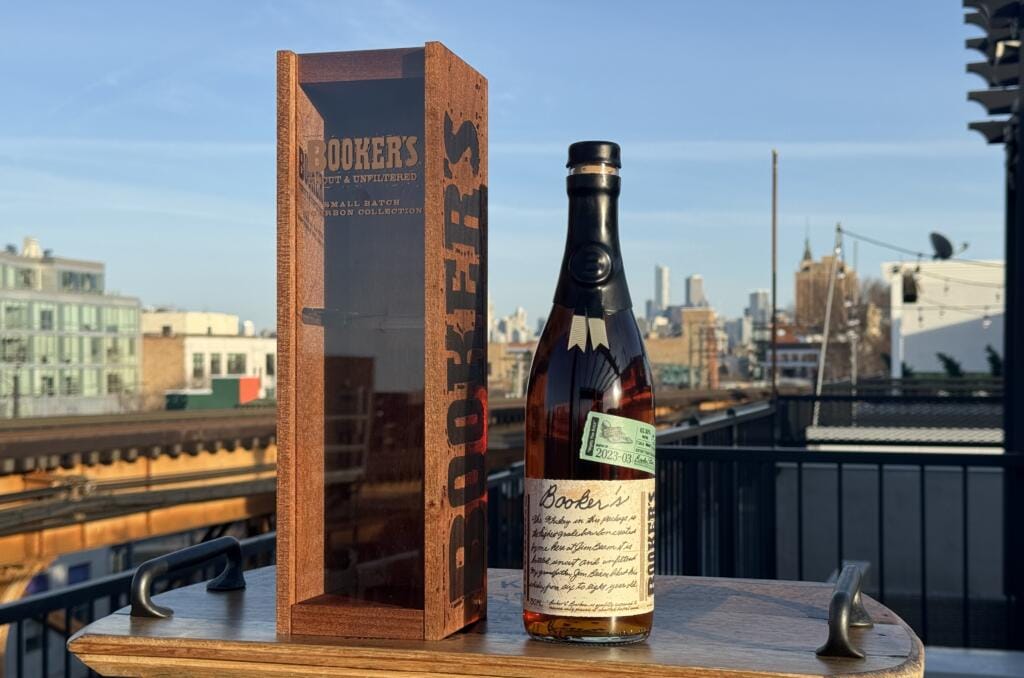
The first time I had Booker’s was at a local dive — the kind of place where the aroma of the bar follows you home at the end of the night, with a low key energy and an impressive bourbon selection. It’s also the kind of place where the bartender was not happy about having to take a bottle out of a box to pour me a drink, but the stink-eye was worth it. And a couple of months later, I happened to see that same box staring me down at the corner store and saw my opportunity to give this bottle a better try — without the bartender judgement.
History
In the long history of bourbon, Booker Noe may not ring a bell — at least not as loud of a bell as a name like Jim Beam. However, Booker is Jim’s grandson and the master distiller at Jim Beam Distillery for over 40 years.
The first Beam to produce and sell a barrel of whiskey was Jacob Beam in 1795, who produced a corn whiskey that used the sour mash fermentation process and was commonly known as “Old Tub”. His son David continued the tradition and moved the distillery to Nelson County, Kentucky to take advantage of the rail lines that were popping up and would make distribution easier.
James Beauregard Beam took over shortly before prohibition began and was forced to close the facility during that unfortunately sober period of American history. However, he was also the driving force behind reopening the distillery once prohibition was lifted. The new distillery in Clermont, Kentucky, founded in 1935, would be known as the Jim Beam distillery in his honor.
The company was successful, and they were purchased by a Chicago spirits merchant in 1945, then American Brands in 1968, and finally in January of 2014 it was purchased by the Japanese spirits giant Suntory. Despite the many changes in ownership, the Beam family and their descendants have remained involved in the production of the company’s spirits and have often held the position of master distiller.
Remaining involved and holding that role of master distiller, Booker began personally selecting bottles of whiskey, originally as gifts to friends and family but eventually as part of Beam’s small batch offering of high proof whiskey.
Product
- Learn More: What Is Bourbon Whiskey?
Despite the time off during prohibition, Jim Beam claims that their Kentucky Straight Bourbon Whiskey has been made the same way since 1795. That may be mostly true — but I get the feeling that, at the very least, the grain bill has changed over time.
Identically to their flagship Jim Beam product, the distillery starts with a fermented mash containing 77% Corn, 13% Rye, and 10% Malted Barley. That’s more rye than usual for a bourbon, but half as much as rye-heavy Bulleit uses in their spirit. Nevertheless, it still has well over half the grains coming from corn and so meets the legal requirements there.
Once fermented and distilled, the spirit is added to new charred oak barrels where it normally sits for four years before being bottled.
The astute of you may have noticed that this is pretty much identical to the production of Jim Beam up to this point, and that’s accurate. The Booker’s bottles represent the best of the Jim Beam bottles — instead of creating a whole new recipe, they just hand select the best stock with the deepest and most intense flavors and slap a new label on it. These barrels are often stored in the center of the rickhouse, where the distillers feel that there is the right confluence of temperature and humidity. It’s then bottled (unfiltered and uncut) at cask strength.
Packaging
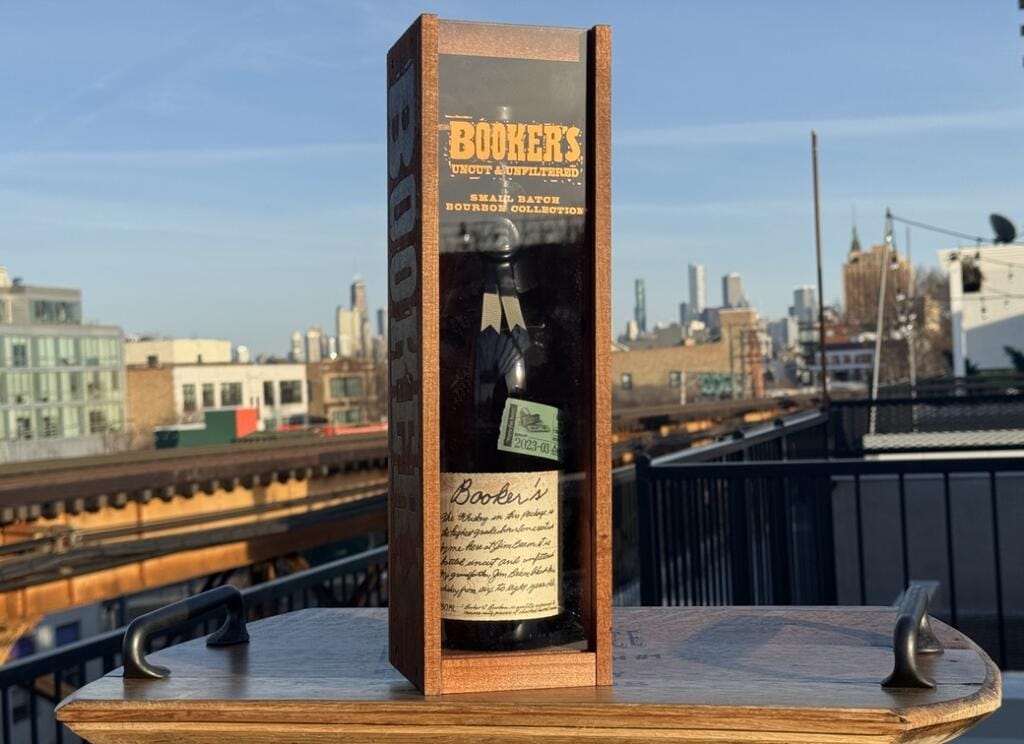
The most notable thing about Booker’s is that is comes in a small wooden box with a plexiglass front. It reminds me of the class of a Scotch box, but with the rustic flair of Kentucky. This was the most obnoxious thing for the previously mentioned bartender when I first tried Booker’s — but to be honest, it’s not a big hurdle. The box is actually very well made, and even has an insert to closely hold the bottle in place. It’s one of the more unique bottles on my shelf right now, and I am not mad about it.
What did annoy me was the thick wax in which the cork was dipped. This is a personal pet peeve – I do not need any bottle dipped in wax (and yes, my annoyance extends to the OG offender: Maker’s Mark). I get it, you want to be our quirky friend, but I am just not into wax play.
The only benefit of the wax is the thick seal and ribbon on the neck, which adds a bit of flair to the whole ordeal.
The bottle itself is not anything exciting. It resembles your garden variety chardonnay bottle, something we’ve seen before (I am looking at you Noah’s Mill), which just happens to be filled with delicious cask strength whiskey. The majority of the bottle is covered in a yellowed label with black writing, in what I expect was Booker’s handwriting. It reads:
“The whiskey in this package is the highest graded bourbon created by me here at Jim Beam. It is bottled uncut and unfiltered. My grandfather, Jim Beam, liked his whiskey from six to eight years old.”
There is also a second label in pea green that describes the batch. I have the “Mighty Fine Batch”, bottled in March of 2023 at 63.3%
Generally, I like the overall presentation… but seriously, I don’t need the wax.
Neat
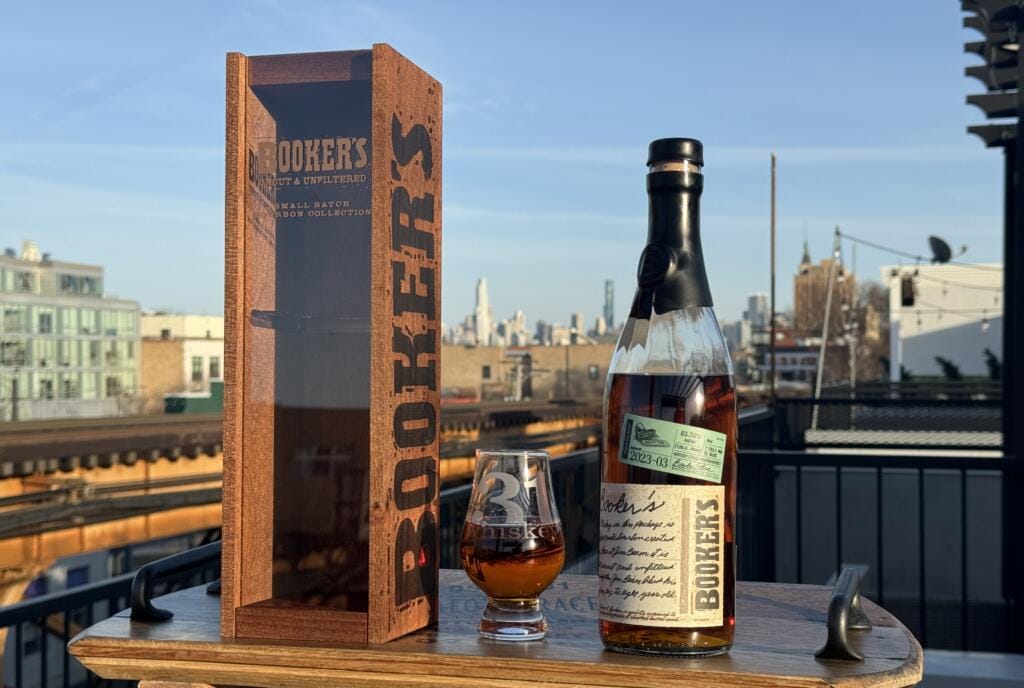
There is a lot going on when you first take a deep whiff of this whiskey… I do not recommend it. Without warning, you will get a lot of heat off the bat thanks to this being bottled at cask strength, so it’s best to start slow.
When you take a more gentle sniff, you get a sweet and slightly yeasty aroma of fresh bread. There is a mild smoke aroma, almost like walking past smokehouse. And there are also some fruity notes that you can pick up, including a light grape and orange notes.
After appreciating the aroma for a second and giving your senses a moment to recover, it’s time for the first sip, and wow – right off the bat, this whiskey swings for the fence. It’s a bold flavor with some big bite at the front, very spicy, and comes with a lot of heat and pepper.
Once your taste buds starting to come back to planet Earth, you can pick up the rich flavor of maple syrup on the tip of your tongue, along with hints of orange, raisin, and oatmeal, which lingers.
I love a bold bourbon, but this toes the line of being too much. The first sip dulled my tongue and had to let it reset before I continued the tasting. All of the flavors come at you in a short window, and you have to allow the heat wash over like a tidal wave. I am not sure if I got used to the whiskey by the end of the glass, or if it opened up as the evening went on. Regardless, I do love a bold whiskey, and this might be the boldest that I’ve had.
On Ice
All it took was a little bit of water to get the five-alarm blaze under control. And why not – it was Booker’s own advice to cut the bourbon with a splash or two of water to really open up the flavor. Even the famous Pappy Van Winkle preferred his own whiskey on the rocks.
Once iced down, all of the mild flavors that were hidden behind the heat are now at the forefront. There is a bold orange flavor that is more prominent, with a slight hint of maple supporting it. But the best thing about this is the oak — it’s a rich flavor that helps to pull this all together and remind you that it’s spent over seven years in a cask.
There’s a lot to work with here for cocktails… but just taken on its own with some ice, this is absolutely delicious.
Cocktail (Old Fashioned)
Drinking this on the rocks was great, but an old fashioned is a really close second. This is undoubtedly one of the better old fashioneds I’ve ever had.
The fact that this bourbon is so spicy plays really well with the bitters and sugar, adding some orange zest really makes the entire thing pop. The only issue is that it’s almost too sweet thanks to that maple syrup flavor note — so if you decide to make an old fashioned with Booker’s, take it easy with the sugar.
And the best part of this is the slight burn at the end of the drink, which reminds you that you are drinking a great bourbon and not just some mediocre swill.
Fizz (Mule)
This is a good mule (remember, for me there is no such thing as a great mule). The bourbon stands up well to the ginger beer, which is not always easy to do. And while the bright effervescence of the ginger beer is at the forefront, you still can’t forget that you are drinking a bourbon drink.
The orange, oak, and maple flavors all shine through, making for a resulting cocktail is rich, flavorful, and clearly a bourbon drink.
If I were to ever willingly drink a Kentucky mule for non-review purposes, this would be my go-to bourbon every time… except for the fact that I’d just prefer it on the rocks instead.
Overall Rating
From the moment I first tasted Booker’s Kentucky Straight Bourbon Whiskey at a cozy dive bar, I was captivated. Finding a bottle of my own felt like striking gold, and after giving it the full Thirty-One Whiskey treatment, it has truly lived up to every expectation.
While I found it most delightful on the rocks, this bourbon shines no matter how you enjoy it: neat, in a cocktail, or with just a splash of water. It even makes one of my least favorite cocktails (the mule) good. It’s one of those rare bourbons that delivers an exceptional experience in every form.
| Booker’s Kentucky Straight Bourbon Whiskey Production Location: Kentucky, United States Classification: Straight Bourbon Whiskey Aging: 7.08 Years Proof: 63.3% ABV Price: $95.55 / 750 ml Overall Rating:  |

All reviews are evaluated within the context of their specific spirit classification as specified above. Click here to check out similar spirits we have reviewed.
Overall Rating: 5/5
I found it delicious at the local dive bar, and this is even better when you find it on your shelf at home.