
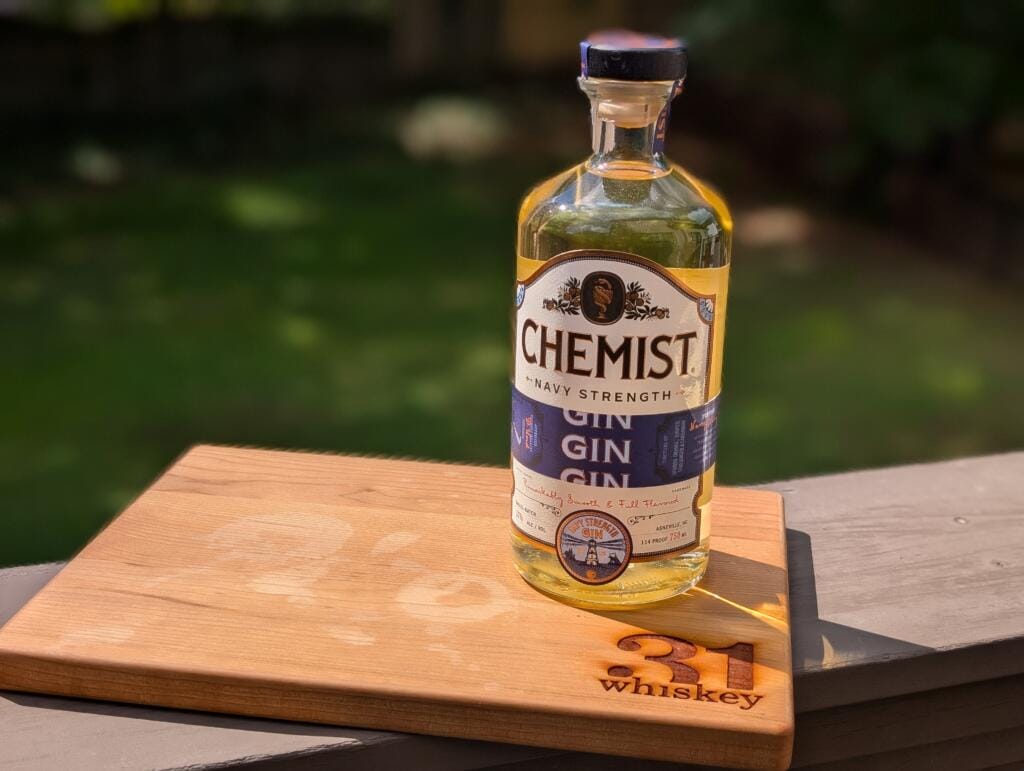
The folks in Asheville are still cleaning up from Hurricane Helene months later, and I wanted to check in with our favorite Asheville-based distillery. We’ve reviewed their whiskey before, but what they are really known for is their gin — the perfect spirit to put you in the holiday mood. Today we’re testing out their Navy Strength Gin, a variation of their standard gin that adds just a bit more booze and some extra special flavors.
History
Danielle Word Donaldson graduated from Furman University with a degree in chemistry and, after completing graduate school in 2014, was working through her residency at Asheville VA Medical Center to become a pharmacist in Asheville, North Carolina.
Over the years, Donaldson’s mother Debbie Word had become fascinated with the local history of that region of Appalachia — and specifically, the moonshining tradition that was popular there. That curiosity eventually prompted Word to ask her daughter the fateful question: “how hard is distilling?”
Together with Donaldson’s technical background in chemistry and Word’s historical knowledge about the area, the pair began moonshining in their garage. Donaldson bought her mom a “cute little five gallon still” for Christmas in 2014 as their passion started to grow, and eventually the pair decided that this was something that they wanted to investigate as a family business. While Donaldson finished up her residency, her mother traveled to Perthshire, Scotland to work with a local distillery and learn everything she could about the business.
In 2018, the mother-daughter duo opened the doors to Chemist Spirits in Asheville. The business pays homage to the important role that chemists and pharmacists play in our society, and lean into that early 20th century chemist vibe with their marketing and branding.
Originally focusing on gin production, the distillery has also expanded into whiskey and other distilled spirits but definitely remains more well-known for their gin. Their product line includes a collaboration with the Biltmore Estate to create a rose gin, and the quality of their spirits led them to be chosen as the official gin for the 2022 Daytime Emmy Awards.
Product
- Learn More: What Is Gin?
This distillery opened shop to focus on gin production, and it seems like they purposefully chose the more difficult production methods in an effort to get the flavor profile they wanted.
As a gin, this spirit starts out as a large vat of neutral spirits (aka flavorless mass-produced alcohol). The flavors are added during a second distillation process, when a mixture of botanicals and other elements are added in just the right combination to provide the resulting profile.
This distillery uses a vapor infusion process for their spirits, which is a finnicky effort that tends to result in lighter and more complex flavors than other methods. Basically, the raw alcohol is heated in a still and the hot alcohol vapors are passed through a basket containing all of the botanical elements. The heat and moisture cause the essential oils and other compounds in those botanicals to be picked up and infused into the alcohol, which is then cooled down and turned back into a liquid in a condenser. That condensed liquid is then proofed down and bottled for sale.
In this case, according to sources, the elements infused into the gin are:
- Cardamom
- Spanish orange
- Galangal
- Ginger root
- Tangerine peel
- Peppermint leaf
- Orris root
- Rose hips
- Rose petals
- Juniper
- Coriander
- Bilberry
- Lemon peel
- Sweet orange peel
- Bitter orange peel
- Green anise
- Lemon verbena
- Grapefruit peel
- Cassia cinnamon
- Angelica root
- Grains of paradise
Interesting to note is that Chemist makes a number of gins, and their American Gin is considered the “base” or “standard” spirit in their line. This really only differs from that standard gin with the addition of four elements: cardamom, Spanish orange, galangal, and ginger root.
Given that this is a “Navy Strength” gin, it is bottled at a higher proof than usual. This higher proportion of alcohol has a tendency to convey more of the flavors from the botanicals, and also makes for a more expensive end product.
Fun facts: the term “Navy Strength” comes from the practice of providing British navy ships with alcohol for their long voyages, both to keep up the morale of the ship’s company as well as to disinfect the stagnant water and keep those sailors from becoming sick. Tradition has it that in order to pass muster for provisioners on early ships, the spirits needed to have a high enough alcohol content gunpowder would still ignite if soaked in that spirit — hence, the name.
Packaging
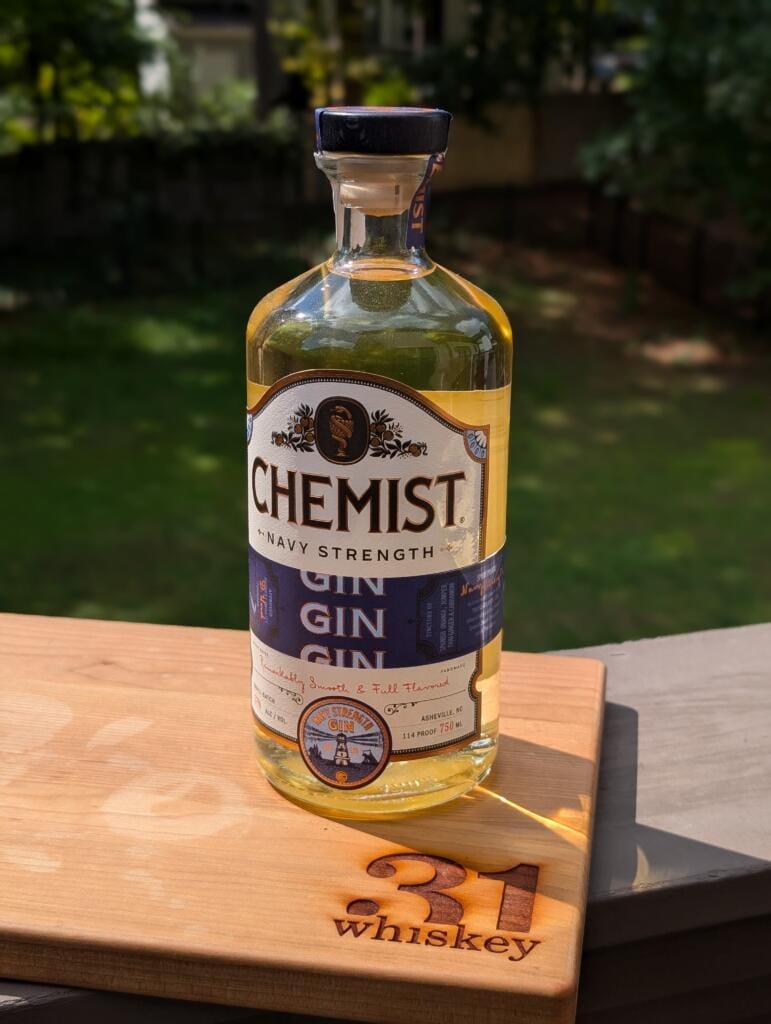
The vibe that this team is going for is turn-of-the-century pharmacist, and I think they hit the nail on the head.
It starts with the bottle shape, which is reminiscent of the medicine bottles from that time period: large round bodies, short necks, and capped off with a wood stopper. I’ll note that this specific bottle doesn’t have any fancy personalizations on it for the distillery. Other examples of spirits from Chemist have embossed lettering in the bottle, but this one seems like a potentially older and less customized example.
Moving on to the label, I don’t think they could have done a better job. The style is period perfect, with metallic gold ink outlining the black lettering and a stylized Bowl of Hygieia (daughter of Asclepius, the god of medicine, whose image is associated with pharmacists) at the top of the label. It seems like the way that Chemist distinguishes their brands is with a belly band around the bottle — in this case, a deep purple colored band that identifies this as their Navy Strength Gin.
10/10 on the design.
Neat
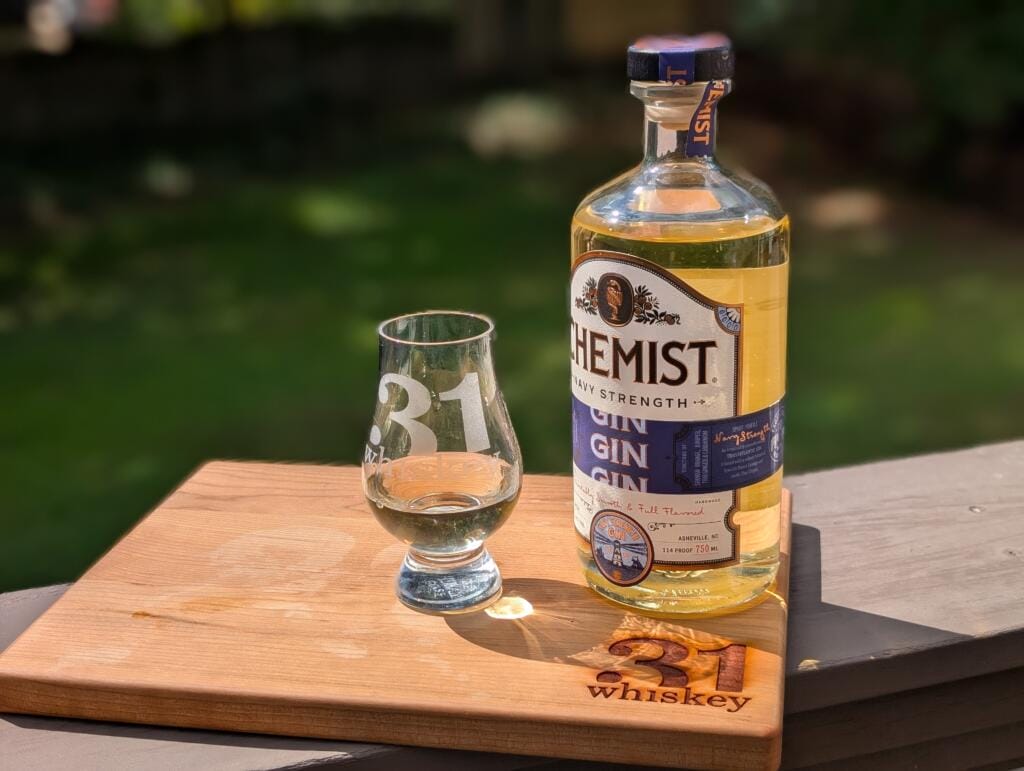
There’s an interesting light golden color to the liquid, which I think is a result of the vapor infusion process. Since the vapor is carrying the essential oils and other compounds straight into the condenser, more components come along for the ride — unlike a “cleaner” maceration and distillation technique that’s more like making a boozy tea first with the botanicals and then distilling that resulting slurry.
Coming off the glass are a bouquet of lighter floral notes with some citrus support. The first thing I’m getting is juniper, which is typical for a gin, but it isn’t nearly as strong as you’d expect from other versions of the spirit. Here, it’s more like someone wiped the glass with pine needles and gave it that hint of aroma instead of just shoving them straight up your nose like the London Dry versions do. Supporting the juniper is some aromatic orange peel, cardamom, lemon, grapefruit, and a little peppermint for some minty freshness on the end.
Taking a sip, I’ll note first that there’s barely any juniper whatsoever in the actual flavor of the spirit. Again, it’s like someone wiped the glass with pine needles and left just a hint of that behind. The flavor does get stronger with repeated trips to the glass, but at first blush this is a more citrus-forward spirit than you might expect.
The very first thing I’m getting is orange, which makes sense since there’s like three different types of orange in here. That’s supported and given a bit of depth by the cardamom and orris root, which adds a spicy and interesting aspect to the flavor profile. From there, I start getting some of the tangy and zesty flavors from the coriander and ginger, before the lemon starts to join the party on the finish.
On Ice
Ice can wreak havoc with a gin — the spirit is naturally skewed towards the lighter and more aromatic elements of the flavor spectrum, which just happen to be the kinds of flavors that get absolutely destroyed with the addition of some ice. But thankfully, in this case, I think there’s enough depth and saturation to the right flavors that what’s left is still delicious.
Specifically, the flavors that are coming through clearest here are the roots, the spices, and the citrus. I’m getting a strong showing from the orris root and coriander, with the orange and lemon citrus flavors adding complexity. There’s even a bit of ginger still in there making itself known.
A large number of the lighter elements have taken a back seat, but there’s enough flavor left and with a sufficiently good balance to make this still enjoyable.
Cocktail (Gin & Tonic)
There should probably be no surprise that the flavor profile is roughly the same as we saw on the rocks, just with a little extra bit of fizz. But what really makes all the difference here is the traditional slice of lime.
There’s a ton of citrus fruit in the ingredients list, but I didn’t see lime anywhere in there. And I think that’s a missed opportunity. That little bit of tangy goodness is enough to add some extra balance to the orris root and other spices, and helps accentuate the other citrus in the spirit.
I’d say this is definitely worth a try.
Cocktail (Negroni)
The negroni isn’t really my favorite cocktail. As much as Dan complains about the Kentucky Mule test for our whiskey reviews, this is a similar (self-inflicted) annoyance to me during our gin reviews. But this is the best test I’ve found to determine whether the flavors in the gin can stand up to more aggressive mixers — and in this case, I think there are definitely some glimmers of hope.
First off, the balance is good. There’s not quite as much bitterness as I’d usually detect, which I think is thanks in part to the orris root and orange components of the gin. Those are the same flavors that seem to peek their heads out from time to time as I sip this cocktail, with some of the spices like ginger and coriander providing a more interesting texture than I’d usually expect.
It’s still not a cocktail I’d return to, but I think this gin does a better job than usual in this test.
Overall Rating
I really do enjoy when I see a well-executed gin, and especially one where the flavor profile is a little different than normal. I’d put this squarely in the “American Gin” family, with a lesser focus on juniper as a main ingredient and instead choosing to focus on citrus, spices, and a surprising showing from ginger that I haven’t seen many other places. Tie that all together in a great looking bottle and I’m a happy customer.
If you live in a state where you can buy this, I recommend it. Not only are you supporting a quality boutique distillery from still-recovering Asheville, but it’s a legitimately delicious product.
| Chemist Spirits Navy Strength Gin Produced By: Chemist Spirits Production Location: North Carolina, United StatesClassification: Gin Aging: No Age Statement (NAS) Proof: 57% ABV Price: $44.95 / 750 ml Overall Rating:  |
Overall Rating: 5/5
Citrusy, tangy, spicy, zesty — and still somehow deliciously balanced. Delicate and amazing flavors when taken neat, and performs surprisingly well in just about every cocktail we tried.