
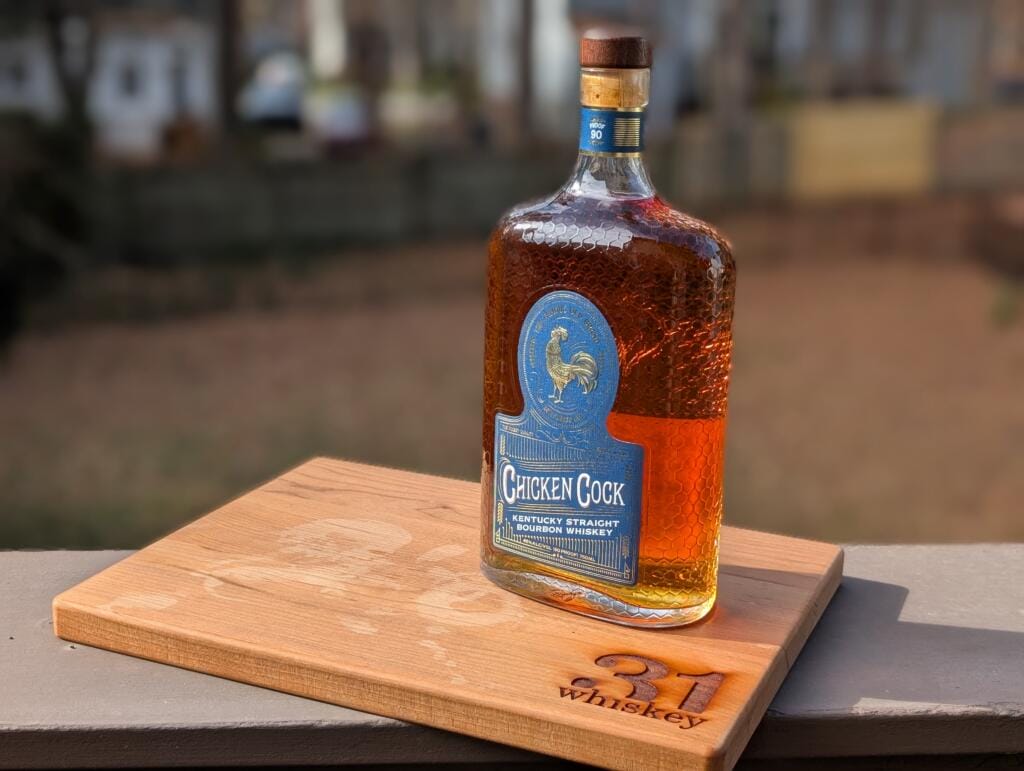
As someone with the surname ‘Leghorn’, I feel a unique kinship to the chickens. “Foghorn” has been my nickname since as far back as I could remember. My mother decorated my childhood home with more roosters than you could shake a proverbial stick at, right down to the salt and pepper shakers on the table. So when I started seeing Instagram ads for a brand of whiskey called Chicken Cock, I felt like it was destiny that I needed to review this bottle of bourbon.
History
James A. Miller was a farmer in 1830’s Kentucky who, like many other farmers with excess crops to sell at the end of the year, decided to turn those spare bushels of corn into whiskey. He began distilling Kentucky bourbon and selling it as “Miller’s Old Bourbon”, learning the ropes of the business and gaining enough popularity that in 1855 he was able to purchase a partially completed distillery in Paris, Kentucky and build his base of operations there.
Miller wouldn’t live to see his distillery flourish, passing away unexpectedly in 1860 at the age of 44, but his former clerk George G. White took over in his stead and continued to build the business. In 1862, White started marketing the spirit as “James A. Miller’s Chicken Cock Whiskey”, with the phrase “chicken cock” then a popular term for defiance and pride. The spirit was distributed nationwide and even into Canada under the Chicken Cock brand.
The distillery would continue operating until a massive explosion and fire at the facility in 1890 caused an unrecoverable level of damage. Rather than paying to rebuild the demolished building, White decided to sell the brand to Kentucky Distillers & Warehouse Co, a conglomerate of distilleries who purchased brands and produced them for sale and distribution nationally. The company moved production to one of their common large distillation plants while the Paris distillery was rebuilt, where production would continue through to the start of prohibition.
Once prohibition was enacted, the brand was sold to American Medicinal Spirits Company, who had a license to produce medicinal whiskey and keep the brand alive through that dark period. Near the end of prohibition the brand was again sold to National Distillers, who saw the light at the end of the tunnel and tried to position themselves to take advantage of the expected whiskey boom that would happen once prohibition was repealed. The company was probably most famous for its trio of “olds”: Old Crow, Old Overholt, and Old Grand-Dad.
Meanwhile, the Canadian distillery company Distillers Corporation Limited started producing a version of Canadian whiskey called “Chickencock Pure Rye Whiskey”. This spirit was bottled in glass bottles and then smuggled in sealed tin cans across the Canadian border into the United States and became a common staple at speakeasies — especially in New York City, where it was made the official house whiskey of the famous Cotton Club. Later in 1946, National Distillers would win a lawsuit against their poutine preferring pals across the border and be compensated for the unauthorized use of their trademark.
I just want to highlight that, despite the modern Chicken Cock’s website prominently highlighting this prohibition era spirit and the Cotton Club connection, neither the original American brand nor the newer incarnation had anything whatsoever to do with that bootlegging operation (other than being granted ownership of the brand name as part of the 1946 settlement from the infringing Canadian distillery). We bring it up here because it’s a large section of the modern company’s marketing materials and does deserve some explanation.
Unfortunately for National Distillers, once prohibition ended, their gamble didn’t pay off. American drinkers disfavored straight bourbon, instead preferring the lighter blended whiskey and scotch. Chicken Cock was temporarily redesigned to be a blended whiskey to try and chase that market, but it would be economically unsuccessful and production ended sometime in the 1950’s. National Distillers itself went under at this time, with the brands being sold to Jim Beam.
The brand would lay dormant until 2011, when Matti Anttila founded Grain & Barrel Spirits and decided to revive the brand. Originally an investment banker, Anttila had built a business buying and importing Brazilian liquor into the United States and wanted to expand his operations in the States. He purchased the brand name and, together in partnership with the Bardstown Bourbon Company, in 2017 started once again putting out whiskey bottles bearing the Chicken Cock brand.
Product
- Learn More: What Is Bourbon Whiskey?
To be clear: there is no Chicken Cock distillery. The company sources 100% of their whiskey from another company, and simply bottles it under their brand name. In this case, they partner with the Bardstown Bourbon Company to produce their whiskey for them.
This whiskey starts as a combination of grains — specifically, a pile of 70% corn, 21% rye, and 9% malted barley. Those grains are milled, cooked, and fermented to create a mildly alcoholic liquid that is then distilled in a column still to produce raw “white” whiskey. In this case, the whiskey is then placed into new charred American oak barrels with a medium level of char for a period of at least four years before the barrels are emptied in batches, combined together, proofed down, and bottled for sale.
It’s a pretty standard, straightforward process with nothing unusual and no bells and whistles going on.
Packaging
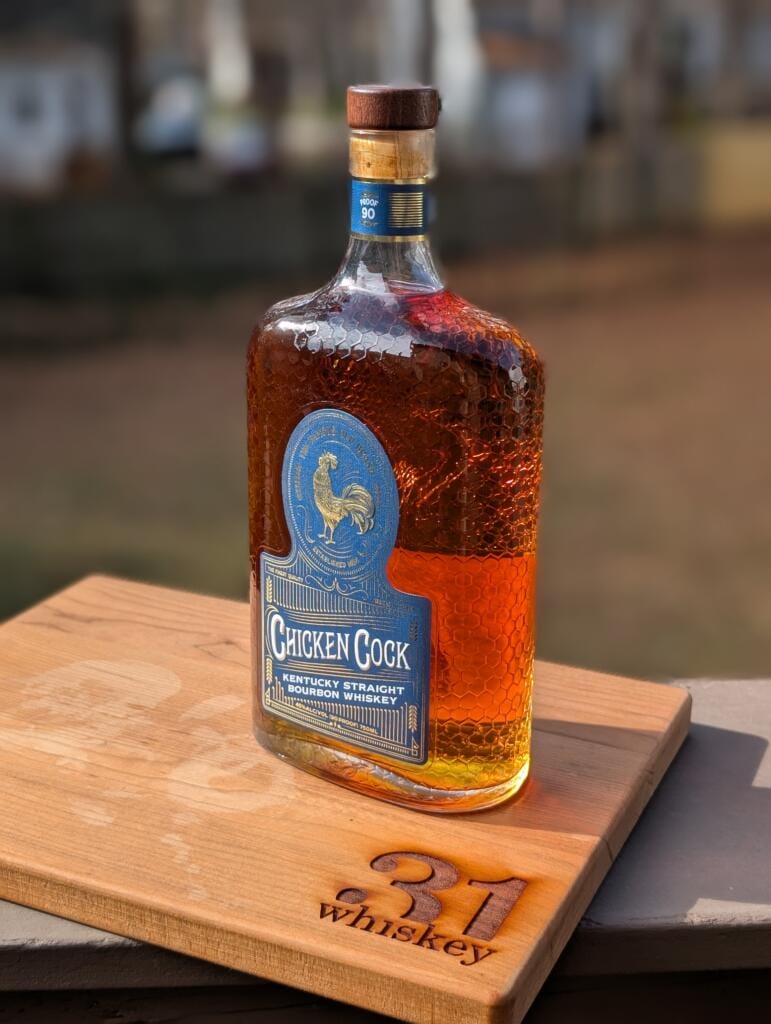
Taken at face value, this is a pretty nice bottle. But it doesn’t quite match the context of the historical image the brand is trying to build.
This bottle is roughly flask shaped, sporting a wide body with a narrow depth, square-ish in shape, with rounded edges. The back of the bottle is concave, giving it that appearance that it could fit against your leg comfortably. However, this bottle is WAY too big to actually be used that way. It doesn’t fit in a pocket, so the only real benefit that function has is making it look slightly interesting… I guess?
On the surface of the bottle is a honeycomb pattern of hexagons imprinted into the surface. It’s an interesting and eye-catching design that helps the bottle stand out without obscuring the whiskey inside too much, and I can appreciate that.
On the front of the bottle is a small label with the Chicken Cock brand information and an illustration of a chicken. For this bottle, the background of the label is blue and the illustration and text is in metallic gold ink — the colors seem to change between different versions of the whiskey to help differentiate them among the product lines.
What’s annoying here is that this bottle isn’t consistent or similar to the historical versions from this same brand. The font and general style of the “Chicken Cock” name might be similar, but that’s it. They’ve ignored the more colorful labels and approachable style of the brand’s history and instead designed something that feels more 1920’s in style.
I’m also going to voice my annoyance here that the label proclaims this to be “The Famous Old Brand” and “Established 1856”. That’s outright false — this is a company founded in 2011 that simply grabbed a random brand from the dumpster of history and slapped it on a shiny new bottle. Even the distillery where they source their whiskey isn’t old enough to drink yet.
All that makes this feel like a naked cash grab that doesn’t actually pay homage to the history of the brand or the craftsmanship of the whiskey.
Neat
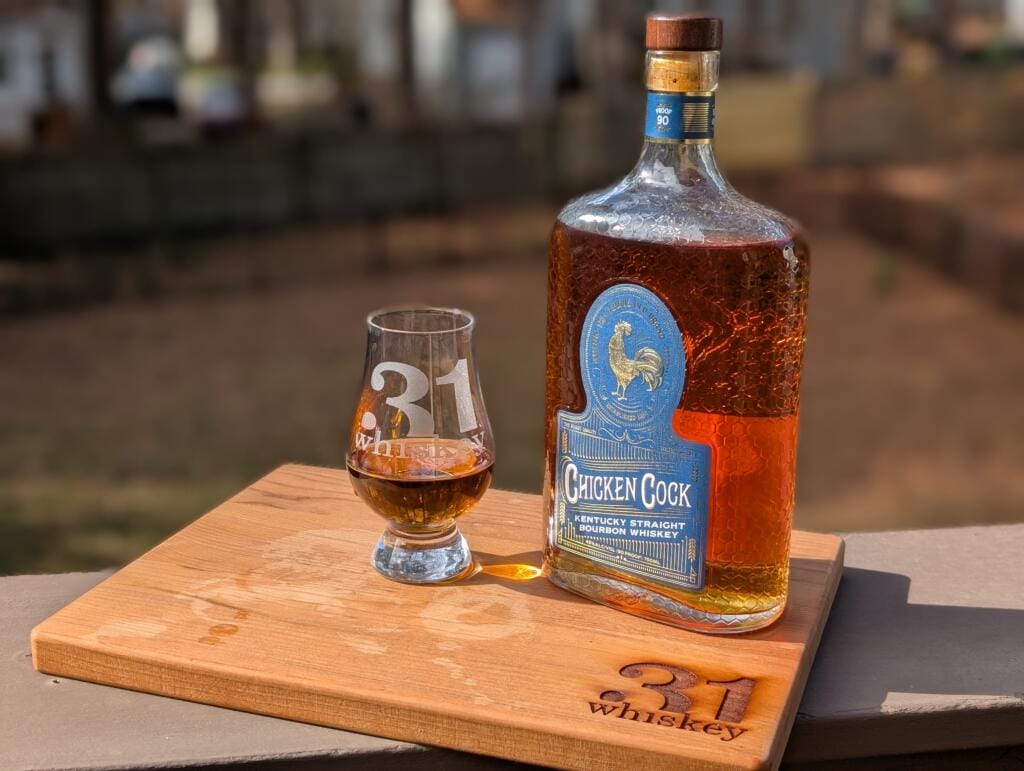
The liquid has a beautiful rusty amber color to it, with no cloudiness or impurities. Coming off the glass I’m getting some nice notes of brown sugar, caramel, vanilla, cedar chips, and a bit of orange peel for added citrusy zest. In the background seems to be a hint of chocolate that gives the aroma some added depth.
Those same aromas translate into the flavor of the spirit, and in roughly the same order and level of saturation as before, but with a couple added guest stars. Right off the bat I get a heavy hit of brown sugar sweetness, followed quickly by vanilla and some baking spices like cinnamon. As the flavor develops, I start getting some hints of crisp apple and orange citrus, but those flavors are never quite clear enough to be anything more than some shadows among the trees.
On the finish, I find some of that chocolate richness, combined with a bit of black pepper spice (likely from the rye content). That, combined with some brown sugar notes, is what lingers once the rest of the flavors have tapered off.
It’s a smooth ride with a bit of depth, and just enough twists and turns to keep it interesting.
On Ice
With the added ice, as we usually see, all the complexity in the spirit gets compacted down to the bare minimum. Gone is the citrus and apple, instead we’re just left with the bolder flavors.
I do want to note that this isn’t bad for a bourbon on the rocks. The brown sugar, vanilla, and cedar chips are all present, with some hints of chocolate and black pepper spice closer to the finish adding depth and complexity. It’s a good mix of rather standard bourbon notes that is unlikely to disappoint.
Cocktail (Old Fashioned)
I generally prefer darker, richer bourbons in an old fashioned than the lighter and sweeter editions, and that’s exactly what we have here. The brown sugar and chocolate elements are providing plenty of that depth and saturation in the flavor profile, which nicely balances out the herbal notes in the angostura bitters. Add just a dash of sugar and you’ve got a pretty good old fashioned.
What this is missing is the orange citrus, the apple, and the black pepper spice. None of that is translating into the cocktail from the spirit itself, so instead you’re going to need to add it either through using orange bitters or a slice of the real deal. Without that bit of fruity lift, the drink might be a hint too flat to really enjoy.
Fizz (Mule)
This is good, but it could have been great.
What we’re getting in the flavor profile is a good balance: the darker, richer elements are providing just the right level of offset for the bright and tangy lime juice and ginger beer, which makes for a very drinkable cocktail.
The problem is that there’s no real complexity. It’s fine — but there’s no pizzazz to it. I’d love to see more of the black pepper spice coming through or some of the orange citrus flavors playing a bigger role, but none of that is happening here. That’s what would have really elevated this to the next level.
Overall Rating
Before we get to the whiskey, I have to address the chicken in the room: the branding and marketing.
It annoys me when a newer company tries to trade on the history of the brand name they are using — especially when there are seemingly zero ties between the new company and the old one. This whiskey is produced in a different location, using a different process, in a different bottle, with completely different owners. But they still are trying to leverage the history of their brand for marketing purposes — which is made even more annoying, since they also try to rope in the Canadian bootlegging operation and the prohibition era Cotton Club connection, which had nothing whatsoever to do with the original spirit. That, in my opinion, is a reach too far.
As for the actual product in the bottle, this is fine. I don’t think I’ve ever had a whiskey from the Bardstown Bourbon Company that I didn’t love, and looking at the contents of the bottle alone, I’m definitely not disappointed. This is a well crafted bourbon that has some delicious flavors and a well rounded profile no matter how you take it, but it seems to be “mediocre” by their own standards. They might be cursed by their own success, but I’ve seen some great stuff come out of their distillery, and this seems like it’s a lower quality than I’m used to seeing. There’s nothing really interesting or unique going on here — it’s just a good bourbon.
And that, I think, is the nail in the coffin. If this was taking a swing at some interesting distillation process or unique flavor profile, I would actually like it better. But this is just a mediocre bourbon dressed up in the carcass of a long forgotten brand — and not even really paying due respect to that brand’s history.
| Chicken Cock Kentucky Straight Bourbon Whiskey Production Location: Kentucky, United States Classification: Straight Bourbon Whiskey Aging: 4 Years Proof: 45% ABV Price: $59.99 / 750 ml Overall Rating:    |

All reviews are evaluated within the context of their specific spirit classification as specified above. Click here to check out similar spirits we have reviewed.
Overall Rating: 2.5/5
A fine bourbon, but one that is trying to leverage an unearned history to try and pry way too many dollars from your pocket.