
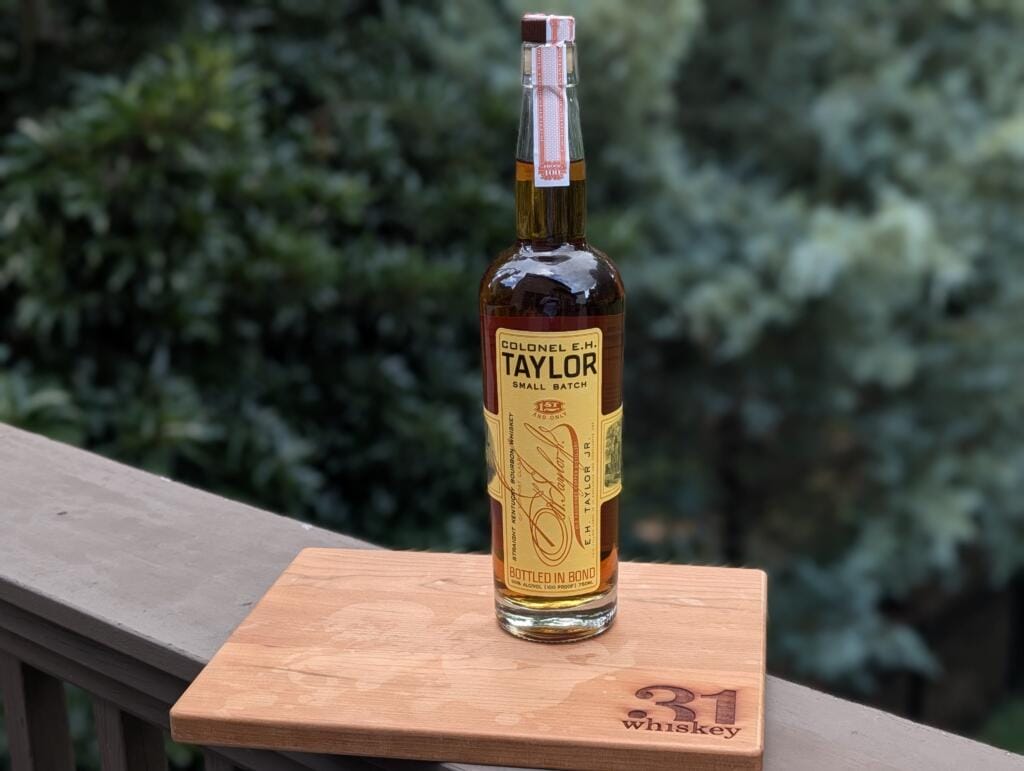
This has been a holy grail bottle for me for years. I started this website in 2018, and in the entire time since, Colonel E.H. Taylor Small Batch has been a rumor — a thing that theoretically existed on shelves somewhere, in the same way that a coelacanth theoretically exists somewhere in the Indian Ocean. Then I took a trip back to Austin, Texas, walked into a liquor store out of habit rather than hope, and found the shelves absolutely lousy with the stuff. Taylor. Blanton’s. A whole conga line of bottles that spent the last decade living exclusively in raffle emails and Instagram drop announcements.
Between a wobbly economy, the tariff mess, and a genuine cooling of the bourbon boom, the unicorns have wandered back into the paddock. I don’t know how long that lasts, though… so in celebration of a window that may not stay open, I bought the bottle I’d been chasing since before this site had a logo.
History
Colonel Edmund Haynes Taylor, Jr. is the closest thing bourbon has to a founding father, and unlike most brand-name colonels, he was a real person who did real things.
Taylor was a Frankfort banker and politician before he was a distiller — he served as the city’s mayor for sixteen years, from 1871 to 1887. In 1869, he bought the property that would become the O.F.C. Distillery (O.F.C standing for Old Fire Copper, a nod to his obsession with copper equipment). He poured money into it: copper fermenters, column stills, and steam-heated climate-controlled aging warehouses, all of which were genuinely novel at the time — and all of which are now standard practice in how bourbon is made.
Then he went broke. Overextended and short on cash, Taylor lost control of O.F.C. in 1878 to George T. Stagg, a whiskey salesman from St. Louis who had been buying his barrels. The two men formed E.H. Taylor, Jr. & Co. with Stagg as president, and by most accounts they loathed each other. Taylor eventually traded out of the partnership entirely, taking another Stagg-owned property with him, and in 1887 opened the distillery he actually wanted to build: Old Taylor, a Scottish-style limestone castle with sunken gardens and a springhouse shaped like a key, because he believed the limestone water was the key to good bourbon. It was the first American distillery designed from the ground up as a destination rather than a factory. Every distillery gift shop you’ve ever stood in is downstream of that decision.
Taylor’s other legacy is the reason the words “bottled in bond” are on this label. In the late 1800s, a distressing amount of what got sold as bourbon was rectified swill colored with iodine or tobacco and cut with whatever was cheap. Taylor lobbied hard for the Bottled-in-Bond Act of 1897, which put federal supervision on the whole process and effectively created the first American consumer protection standard for a food product. He’ truly earned the “father of the modern bourbon industry” title.
Here’s the part the marketing copy glides past. Old Taylor — the actual castle Taylor built and named after himself — closed in 1972, sat rotting for forty years, and has been restored as Castle & Key, which is a different company making different whiskey. The Old Taylor brand name knocked around National Distillers and then Beam for decades. Sazerac bought it from Beam Global in 2009 and launched the modern Colonel E.H. Taylor, Jr. line out of Buffalo Trace in 2011.
Buffalo Trace is, of course, the O.F.C. Distillery — the one Taylor founded and then lost to Stagg. So the whiskey in this bottle really is made on the ground Taylor broke, which is more than most heritage revivals can claim. It’s just made at the distillery he got run out of, under a brand name he attached to a completely different building, by a company in New Orleans that bought the name a century after he died. The history is real… but the tidy narrative is assembled.
Product
- Learn More: What Is Bourbon Whiskey?
This is Buffalo Trace’s Mash Bill #1, which the distillery will confirm by name and absolutely will not break down by percentage. What’s publicly understood is that it’s their low-rye recipe: heavily corn dominant, believed to be under ten percent rye, with a small amount of malted barley to supply the enzymes that convert starch to sugar. That same recipe is the backbone of Buffalo Trace itself, Eagle Rare, Benchmark, and the Stagg line. It is not the higher-rye Mash Bill #2 that goes into Blanton’s and Elmer T. Lee — and as the mule section will show, you can taste the missing rye.
The grains get milled, cooked, and fermented using the sour mash process, where a portion of the spent mash from the previous distillation gets added back into the new batch. That’s not a flavor gimmick, it’s chemistry: the leftover mash is acidic, and dropping the pH of the new mash keeps unwanted bacteria from setting up shop while giving the yeast a consistent environment to work in. It’s the whiskey equivalent of a sourdough starter, and every major Kentucky producer does it.
From there it goes through a column still and a doubler (a continuous still that strips the alcohol out of the fermented beer), followed by a second pass through a pot-style vessel to tighten things up. That’s standard Kentucky practice, and it’s worth noting that Taylor himself is a big reason it’s standard. He was an early evangelist for copper equipment and column distillation at a time when a lot of the industry was still doing things by feel.
The new spirit gets cut with water and filled into new charred oak barrels. Federal law caps barrel entry proof at 125, and Buffalo Trace fills at or near that ceiling. Higher entry proof means less water in the barrel, which pulls different compounds out of the wood than a lower-proof fill — more of the wood sugars and vanillins, generally a bolder and drier result than something like Maker’s Mark going in at 110. (And given the caramel and cedar showing up on the nose here, that tracks.)
Then it sits. Bottled in bond requires a minimum of four years in a federally supervised warehouse, which is the legal floor here since there’s no age statement on the bottle. The widely repeated figure among people who track this stuff is closer to seven years, drawn from the upper floors of a brick rickhouse — but Buffalo Trace has never confirmed it, so treat it as informed rumor rather than fact.
The aging location is the part of this whiskey’s story that’s actually true rather than assembled. Sazerac says these barrels come from the 19th-century warehouses Taylor built — specifically, Warehouse C, a brick structure he put up in 1881 and reportedly considered his best work. Sources disagree on the exact year (you’ll sometimes see 1885 cited instead of 1881) but the building is real, it’s still standing on the Buffalo Trace grounds, and it’s still full of barrels. Brick holds and releases heat differently than the metal-clad warehouses elsewhere on the property, which means a different temperature swing across the seasons and therefore a different rate of exchange between whiskey and wood. Whether you can taste Warehouse C specifically is a question I’m not going to pretend to answer. But it’s a genuine production variable, not a story someone made up in a marketing meeting.
Selected barrels are then blended and proofed down to exactly 100, because bottled in bond gives you no choice about that number. It’s also worth flagging that “small batch” is the one term on this label with no legal definition whatsoever. Across the industry, it has meant anything from a dozen barrels to several hundred, which makes it essentially a stylistic promise instead of a specification.
Packaging
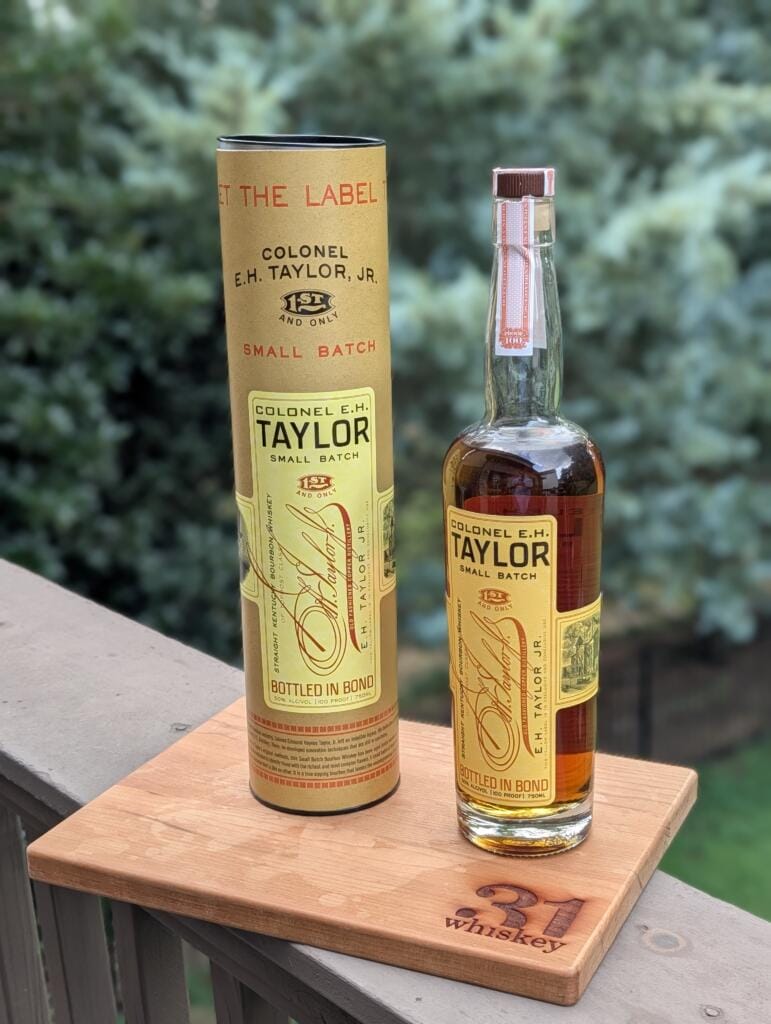
This is one of the better-looking bottles on the shelf, and almost all of it comes down to restraint.
The bottle is a tall, slender cylinder in clear glass with a gently rounded shoulder, a long neck, and a heavy base. It’s a shape that reads more like a 19th-century apothecary bottle than a modern spirits package, which is the point. Everything above the shoulder is bare glass, so a good third of the bottle is nothing but the whiskey inside doing its own advertising. That dark rusty amber against clear glass is the best design element here and it didn’t cost Sazerac anything.
The closure is a wood-topped cork, wrapped in a red and white paper strip that runs up over the cap and down the other side of the neck. That strip is a costume. It’s styled after the federal tax strip that used to be draped over every bottle of American whiskey to show the tax had been paid (green ones specifically for bonded whiskey), a requirement that went away in 1985 when the strip stamp system was repealed. There’s no legal reason for it to be there. It’s pure period cosplay, but it works. I’d rather have a fake tax strip that references a real regulation than a fake founding date.
The label is a warm yellow-gold, and it’s sized correctly: a band around the middle third of the bottle, plus a small secondary panel wrapping around the side with a line engraving of the distillery. Compare that to the Heaven Hill Bottled In Bond bottle, where roughly eighty percent of the glass disappears under a mural of a rickhouse. Here you can see what you’re buying.
The typography is doing period work without tipping into saloon-font parody. “TAYLOR” dominates in a tall condensed serif, with the Colonel’s actual signature reproduced in red script across the middle. There’s an oval seal reading “1st and only” and running vertically up the sides in tiny type: “Straight Kentucky Bourbon Whiskey”, “Old Fashioned Copper Distillery of First Class”, and a line stating that this yellow label is in exclusive and conclusive use. That last one is a wonderfully 1890s thing to print on a bottle: it’s a trademark assertion, aimed at an era when knocking off a respectable distiller’s label was a standard business practice and Taylor was suing people over exactly that. Nobody in 2026 needs that sentence, but I enjoy that it’s there.
Then there’s the tube. This ships in a heavy cardboard canister with embossed black metal caps top and bottom, which is a presentation you almost never see outside of scotch. The tube is a full reproduction of the bottle label — same yellow, same typography, same signature — with a period slogan curling around the top in red that you can only read a few words of from any single angle, and a paragraph of Taylor history around the base. It protects the bottle, and it makes opening the thing feel like an occasion. The tin lid comes off with a satisfying pop and the bottle slides out like it’s being introduced to the room.
Shelf appeal is high and it’s earned honestly. This is a package that evokes age and history without inventing any, which puts it well ahead of most of what it’s sitting next to.
Neat
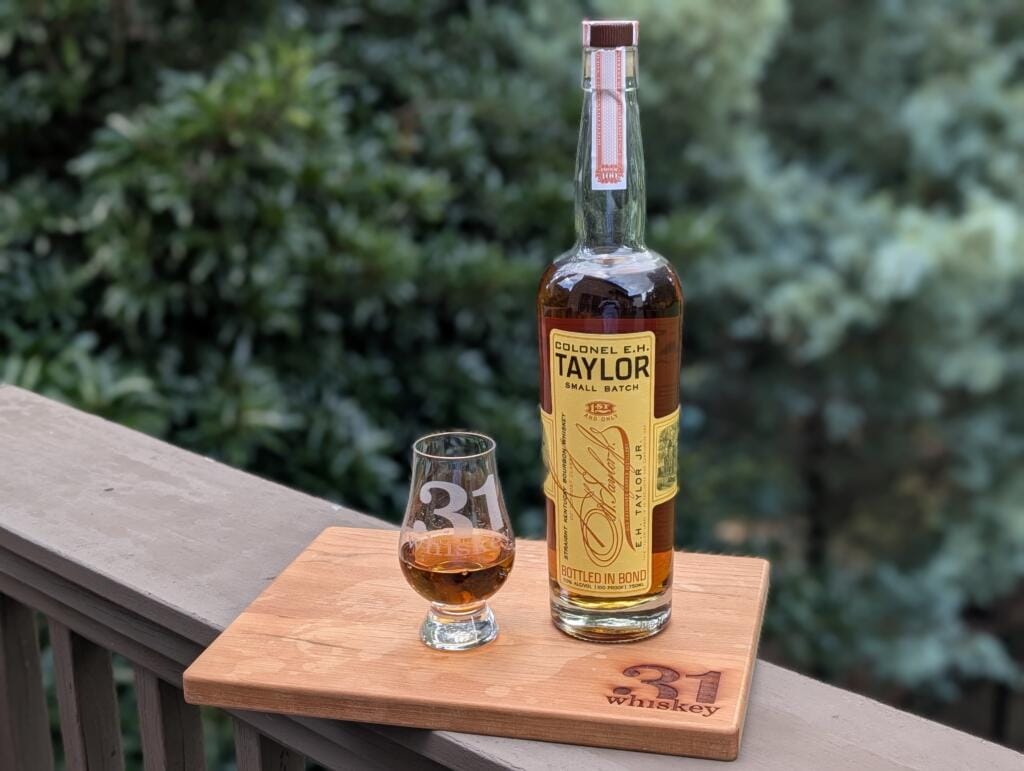
The liquid is a deep, dark amber that reads more rusty brown than golden — the color you’d want if you were casting a bourbon in a movie. There’s a good weight in the glass for 100 proof, with almost no wateriness.
The aroma is textbook: brown sugar and vanilla lead, followed by cedar chips (not generic “oak”, either — this is the specific sharp-sweet smell of a fresh bag of pet store cedar bedding). Underneath, there’s dark chocolate and a whisper of cinnamon. Nothing here is going to make you put the glass down and go get someone else to smell it for validation. It’s just correct, and it’s saturated — the notes are dense and present rather than thin and suggestive.
The first sip does run a little hot. At 100 proof, it’s not the face-melting experience of a barrel proof pour, but the alcohol does front-run the flavor on that initial taste and you lose the first sip to calibration. Thankfully, though, every sip after that behaves. Brown sugar and vanilla up front, oak arriving squarely in the middle of the profile, then dark chocolate and caramel taking over the back half. The finish is medium-long, chocolate-forward, and completely clean with no bitterness, no sharp edges, no off notes hiding behind the sweetness.
There’s nothing unique here in terms of the flavor profile; this just seems to be a well executed and textbook example of a bourbon.
On Ice
Usually a couple of ice cubes act as a filter, washing out the lighter flavors and muting whatever was too rich or too aggressive when neat. For a well-balanced whiskey, that’s typically a downgrade — for reference, just look at what happened to Blanton’s: the ice took the charred wood out back and left a more mellow, less interesting drink behind.
But that’s not what happens here. Somehow, this gets richer.
The profile turns sweeter, with vanilla, brown sugar, and caramel all stepping forward, and the dark chocolate note gets noticeably more prominent on the finish. There’s a background hum of cinnamon and baking spice that doesn’t push. The alcohol bite drops away almost entirely, as expected. What’s unexpected is that the dark chocolate picks up a slight bitter edge on the finish that wasn’t there before — and rather than being a flaw, it gives the whole thing a backbone it was missing neat. It reads less like a diluted bourbon and more like the same bourbon at a different temperature.
Shrugging off ice without losing anything is a rare trick… and getting better for it is rarer still.
Cocktail (Old Fashioned)
This is the most textbook old fashioned I have made in a very long time — but I need to explain why that’s a slightly backhanded compliment.
Everything lands. The sweetness of the whiskey and the sugar don’t compete, the aromatic and herbaceous side of the bitters sits in exactly the right relationship to the brown sugar and vanilla, and the dark chocolate note supplies depth underneath the whole thing so the drink has a floor instead of just a top. The oak from the midpoint gives the bitters something to grab. Nothing is fighting. Nothing is hollow.
That might simultaneously be the best compliment and the biggest downside to this cocktail: it’s a perfect old fashioned… but not an interesting one.
Fizz (Mule)
The mule is the stress test, because ginger beer and lime are loud, and a bourbon has to have something to say (otherwise, you might as well have used vodka).
Thankfully, this has something to say. The dark chocolate does the heavy lifting, dropping a low, dark note underneath a cocktail that is otherwise relentlessly bright and cheerful. It grounds the drink and makes it more interesting than a mule has any right to be.
What’s missing, though, is texture. A bourbon with real rye content usually throws some black pepper spice at the end, and that little bit of grit is what elevates a good mule into a great one. Mash Bill #1 just doesn’t have that rye in the tank (as I alluded to earlier, the pepper shows up right on cue in Blanton’s thanks to the higher-rye Mash Bill #2). What you get here is smooth and even all the way through… like creamy peanut butter where you wanted crunchy. It’s still good, it’s just sanded down.
Overall Rating
This might be the platonic ideal of a bourbon. Every flavor a bourbon is supposed to have is present, correctly proportioned, and fully saturated. It’s excellent neat, it improves on ice, it makes a reference-grade old fashioned, and it holds its own in a mule. There is no format where this bottle embarrasses itself, which is more than I can say for many others on the shelf.
But there is nothing unique about it whatsoever.
I keep thinking that this should be in the NIT Standard Reference Materials library. The National Institute of Standards and Technology maintains a catalog of more than 1,300 Standard Reference Materials — physical samples of things, certified to a known composition, that laboratories buy so they can check whether their instruments are telling the truth. Some of them are what you’d expect: lead in paint, ethanol in water. Some of them are gloriously mundane: SRM 2387 is a jar of creamy peanut butter. Somebody at a federal agency in Gaithersburg is responsible for making sure the nation’s peanut butter is measured against a peanut butter of known and unimpeachable character.
That is what this bourbon is. Not the best bourbon, but the reference bourbon — the one you’d hand to a lab and say “calibrate against this”. If your brown sugar reads high or your oak reads low, the problem is your instrument. But nobody gets excited about a jar of SRM 2387 peanut butter, because getting excited is not the job — being correct is the job.
There’s an irony in there that I enjoy more than I should: NIST will sell you a certified ethanol-water solution, but it has never issued a reference bourbon. Buffalo Trace has, accidentally, and they’re charging less for it than the peanut butter.
Which brings up the thing that has distorted this whiskey for a decade. Scarcity turned Colonel E.H. Taylor into a trophy, and trophies get judged on how hard they were to obtain rather than what’s actually in them. We evaluate against MSRP here, not the secondary market, and that principle cuts both ways: at retail, this is an easy recommendation… but at the two-hundred-dollar shelf prices some stores were pinning on it during the drought, it was an absurd one. If you’re paying a premium in 2026 for a bottle currently sitting three deep in Austin, you’re not buying whiskey… you’re buying a memory of scarcity.
For comparison inside the archive: this sits roughly level with Blanton’s, which is more distinctive in a mule and has far better packaging but is less consistent across formats. It’s in a different universe from Heaven Hill’s Bottled In Bond, which is what happens when a distillery puts its own name on a bonded bourbon and phones it in. And if you want a Mash Bill #1 bourbon with more going on for less money, Eagle Rare has a real ten-year age statement and more complexity per dollar. That’s the bottle I’d reach for if I could only have one. This is the bottle I’d hand to someone who asked me what bourbon is supposed to taste like.
| Buffalo Trace Colonel E.H. Taylor Small Batch Bottled in Bond Straight Kentucky Bourbon Whiskey Production Location: Kentucky, United States Classification: Straight Bourbon Whiskey Special Type: Bottled In Bond Aging: No Age Statement (NAS) Proof: 50% ABV Price: $54.99 / 750 ml Overall Rating:   |
Overall Rating: 4/5
The Colonel wrote the rulebook, and this is a flawless recitation of it — just don’t expect any improvisation.