
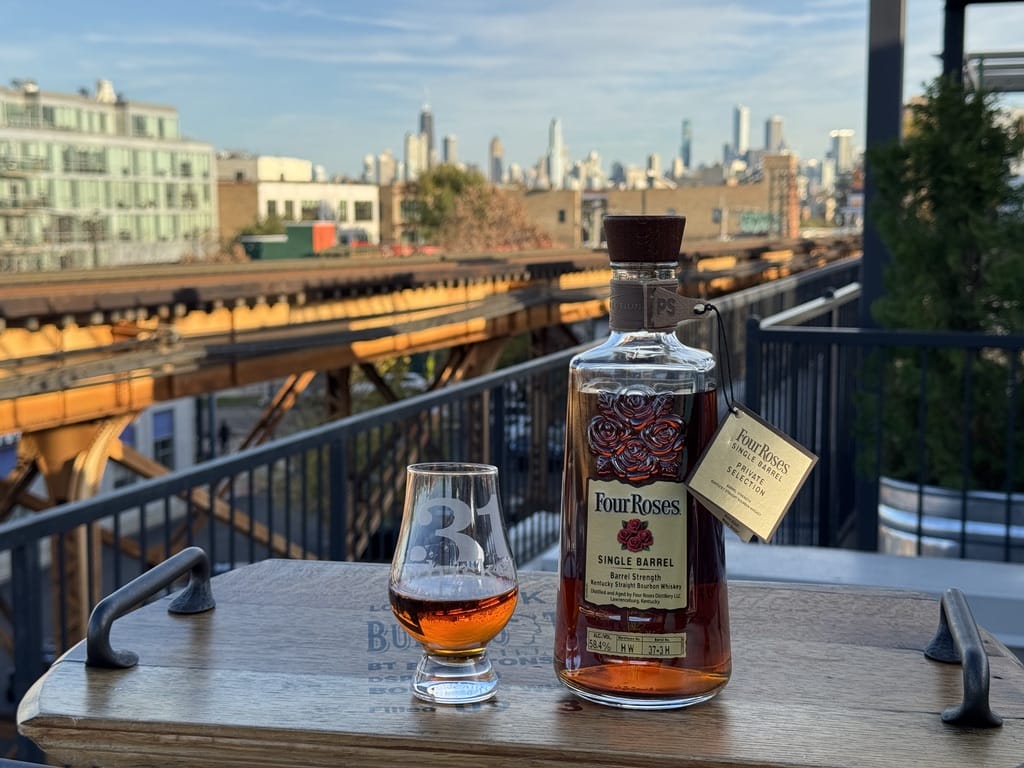
We have reviewed over 600 spirits here at Thirty-One Whiskey, which means that larger, well-known distilleries will often have multiple products go through our testing process. As I often do while browsing the shelves of my local bottle shop I had the site open to ensure we’ve not reviewed a bottle already (nothing worse than finding something awesome, only to discover to my expense account’s dismay we’ve already reviewed it). So I initially assumed that we’d reviewed something as ubiquitous as Four Roses’ product line, but surprisingly we’ve only reviewed one so far! Naturally, I was grabbing this bottle and giving it a try.
History
While the whiskey that was to eventually become Four Roses may have been bottled and sold in the United States as early as 1860, the business itself dates to 1888 when Paul Jones Jr. trademarked the brand.
In 1910, the Frankfort Distilling Co. built and opened the Old Prentice distillery in Lawrenceburg, Kentucky. The company was sold to Paul Jones’ whiskey company in 1922, who assumed the Frankfort Distilling Co. name and started producing their Four Roses whiskey in the newly acquired distillery. Throughout prohibition, the company continued to operate and was one of only six distilleries granted a permit to make and sell medicinal alcohol. As a historical side note, the Frankfort Distilling Co picked a rather unfortunate trademark for their prohibition era whiskey: a swastika (prior to the Nazi usage of the image, but still… historically unfortunate). When prohibition ended in 1933, they would build yet another brand new distillery and move Four Roses production there.
In 1943, the Seagram company would purchase the Four Roses brand. Started as a Canadian distillery in 1857, Seagrams has grown to become one of the biggest spirits companies in Canada. During prohibition in the United States, the owners of the company reportedly participated in bootlegging operations to bring their product into the US, and as a result paid $1.5 million in fines in 1930 (significantly less than the $60 million the US government asked for).
Despite being the top selling brand of whiskey in the United States, Seagram’s discontinued distribution of Four Roses in the United States at the end of the 1950’s and shifted the brand’s focus overseas. For the American market, they instead chose to focus on their Benchmark and Eagle Rare brands.
Four Roses was one of the first brands to be carved out and sold during Seagram’s long and drawn out divestiture of brands in their fight to stay alive. Oddly, the brand was first purchased by the French media company Vivendi Universal in 1989, who then sold it in 2001 to the massive French alcoholic beverage company Pernod Ricard, and then to their British counterpart Diageo.
In 2002, the Kirin Brewery Company based in Japan purchased the Four Roses brand, and once again started distributing it for sale domestically in the United States.
Product
- Learn More: What Is Bourbon Whiskey?
The Four Roses production process is different from the way other distilleries do things (in a good way). Technically it’s a blended whiskey, but the blending process is more transparent than usual.
Four Roses makes 10 distinct recipes of whiskey. They start with two different mash bills: either 60% corn, 35% rye, and 5% malted barley, or 75% corn, 20% rye, and 5% malted barley. Once the mash is cooked, the mixture is fermented using one of five different distinct strains of yeast. Each of these distinct concoctions is then distilled and barreled separately in charred new oak barrels (charred somewhere between a #3 and a #4 char).
After enough time to satisfy the “Straight bourbon whiskey” appellation (roughly 6 to 8 years according to some sources), the barrels are blended together in batches of approximately 250 barrels to create the “small batch” production run that’s put in the bottle and shipped out.
This bottle uses recipe OBSQ, which means they use the B mash bill (60% corn, 35% rye, and 5% malted barley) and the Q yeast, which is supposed to give the bourbon a floral essence. After the distillation process, the whiskey is placed in a barrel and aged for 10 years and 4 months, at which point the barrel was selected and bottled for Garfield’s Beverage in July 2024, eventually making its way into the hands of yours truly.
Packaging
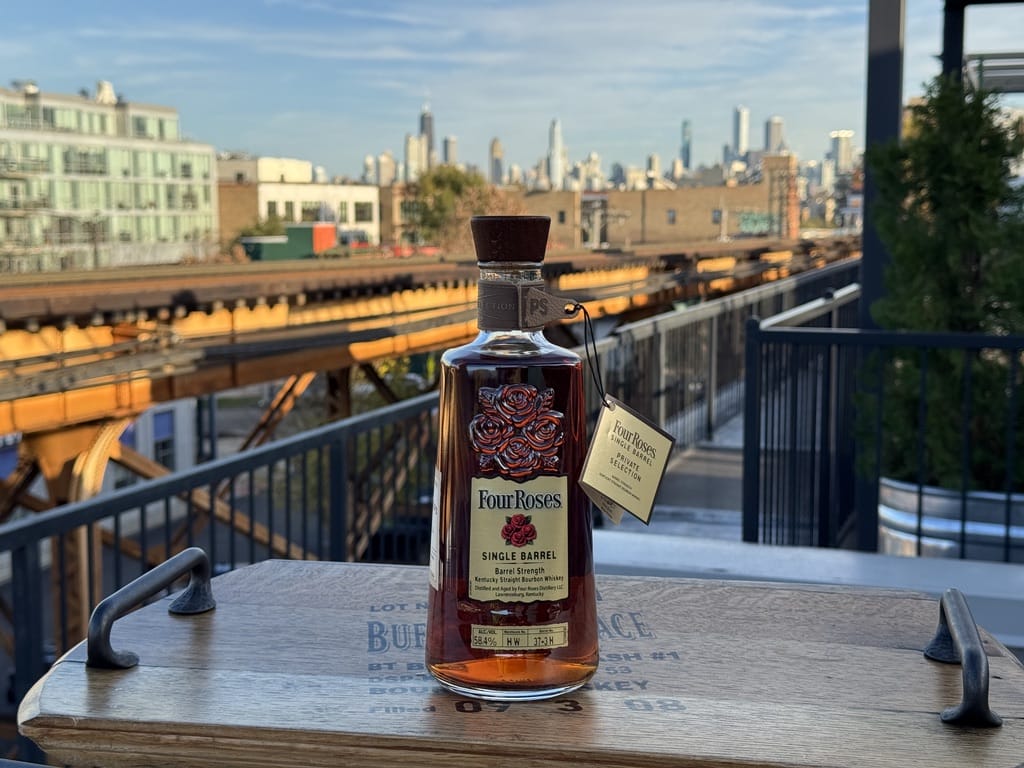
What we have here is a modern take on a bourbon bottle. It’s got all the same parts, but there’s some interesting geometry going on that makes it stand out.
At this base, the bottle is a circle, but as you move upwards the shape begins to morph into a square by the time you reach the shoulder. The shoulder is flat and ends with a very stubby neck, leaving you with a unique looking bottle that is very easy to grab and pour from while still standing out.
Embossed on the top front of the bottle is the Four Roses logo. There is a minimal amount of labeling, but still enough to make sure you have all the details of the bottle. In the single barrel case, it includes the rickhouse designation and barrel number along with another label on the side indicating the recipe and who it was bottled for.
There are a couple of features that really stand out to me. First is the strap of leather around the neck calling this bottle out as part of their private selection. Attached to the strap is a small booklet containing the 10 different distilling recipes and how to read the recipe codes. The second feature of note is the recessed stopper — rather than a round knob of wood attached to a cork, the wood is hollowed out from the center. The cork is in this hollowed out section, meaning when inserted into the bottle the cork fills the inner diameter of the neck, and the wood surrounds the outer diameter. I don’t think I’ve ever seen a stopper like this before.
Neat
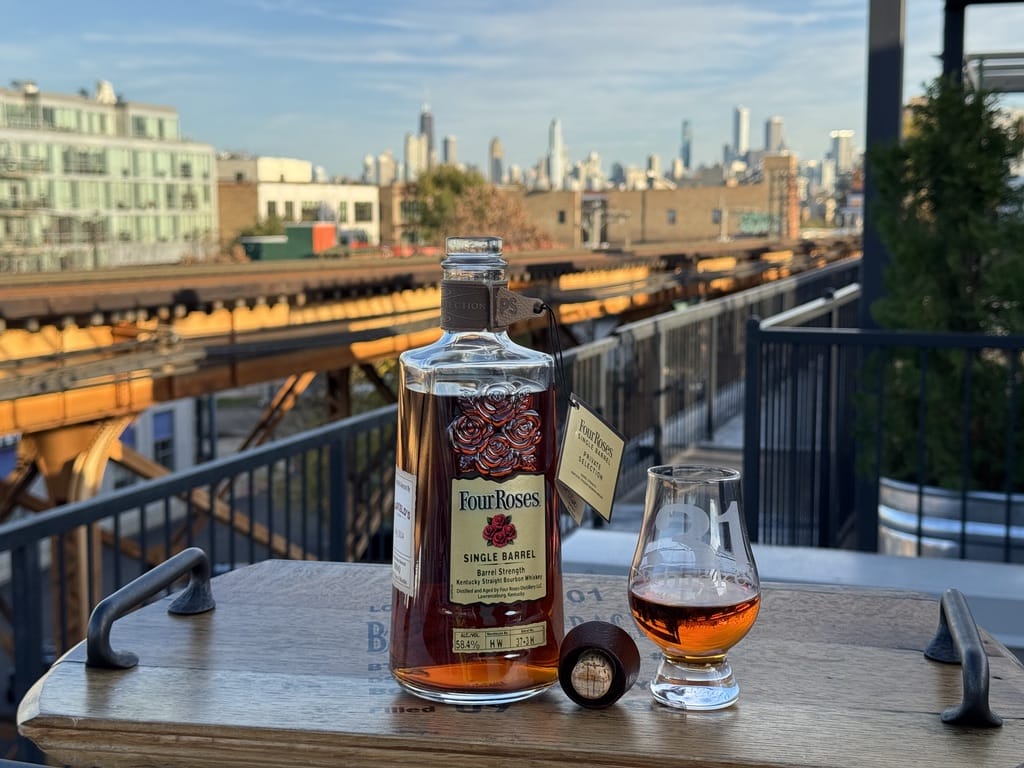
There are two things that immediately jump out to me: the very dark umber color of the whiskey and the strong aroma of straight alcohol. Once you get past that raw alcohol scent (honestly, it took me a few minutes until enough nose hairs had been singed off) you can start to pick up notes of lemon, molasses, and a mild charred oak.
And sure enough… I can taste where that strong alcohol aroma comes from. This stuff tastes just as strong — so much so, I nearly choked on my first sip. 58.4% ABV ain’t no joke.
Higher alcohol content usually means stronger flavors and that’s especially true here — the flavors in this are almost overwhelming. Drinking this neat is what I imagine trying to suck a few drops of whiskey from a barrel stave might taste like. There is a very bitter flavor that lingers on the tongue, bitter like the way burnt rubber smells.
And that’s it, those are the flavors. There is no sweetness — only bitterness, heat, and burnt wood. This stuff makes Malort seem tame.
On Ice
We often see ice diluting flavors and smoothing out some of the rougher parts of a whiskey… and let me tell you, I was praying to the whiskey gods that we got some relief here. Thankfully, they heard my prayers.
The ice helps to mellow this out and open up the flavor profile. There is some sweetness trying to peek through in the form of a bitter toffee, and you also get notes of lemon, dark chocolate, clove, and baking spices. All of which was missing when taken neat, but toning down the alcohol and mellowing out the whiskey a bit has done wonders. This is also clearly a high rye bourbon, as it still has a very spicy finish that lingers along with a strong oak flavor.
There is a lot going on here, but it’s actually really nice after having some time to chill and open up a bit.
Cocktail (Old Fashioned)
Not surprisingly, this makes for a booze-forward old fashioned. This bourbon is the star of the cocktail and creates some great flavors — even if it is still a little rough around the edges.
The angostura bitters pair really well with the bourbon, bringing a licorice vibe to the drink, while that sugar helps to bring some much needed sweetness and tame the brash rye notes. The orange seems to accentuate the existing citrus notes, giving a stronger lemon flavor to the drink.
That’s all great, but you still cannot get away from that harsh lingering finish. Even in a cocktail, it’s still there.
Personally, I love a bold old fashioned. And since I’m not sure I can stomach this neat (again — once was more than enough) and it’s still rough on the rocks, I can see most of this bottle being dedicated to impudent old fashioneds.
Fizz (Mule)
Again, this bourbon stands strong against the effervescent brightness of the ginger beer. So much so, it tastes like I am drinking this bourbon on the rocks with only a small splash of ginger.
The biggest positive here is the same as the orange in the old fashioned: the ginger beer seems to bring out the rich citrus flavors of this bourbon — but the bitterness is still incredibly pervasive. You just cannot get away from it — even the oak flavor seems to overpower the ginger beer (which is a really difficult task, honestly). It’s too bold of a bourbon to make a balanced Kentucky mule.
Overall Rating
I mean, woah — this is a bitter, bold, and long drawn-out bourbon. I was really not expecting this bottle to be single barrel Malort.
In my option, this is only really drinkable in an old fashioned, or maybe on the rocks… which is not a lot versatility for a $110 bottle of bourbon. I can appreciate a good barrel strength bourbon, but this one needs to be seriously toned down before it can be enjoyed.
| Four Roses Single Barrel Barrel Strength Kentucky Straight Bourbon Whiskey Production Location: Kentucky, United States Classification: Straight Bourbon Whiskey Aging: No Age Statement (NAS) Proof: 58.4% ABV Price: $109.99 / 750 ml Overall Rating:   |
Overall Rating: 2/5
This bourbon will punch you in the face harder than Malort, unless you pair it with sugar and some bitters.