
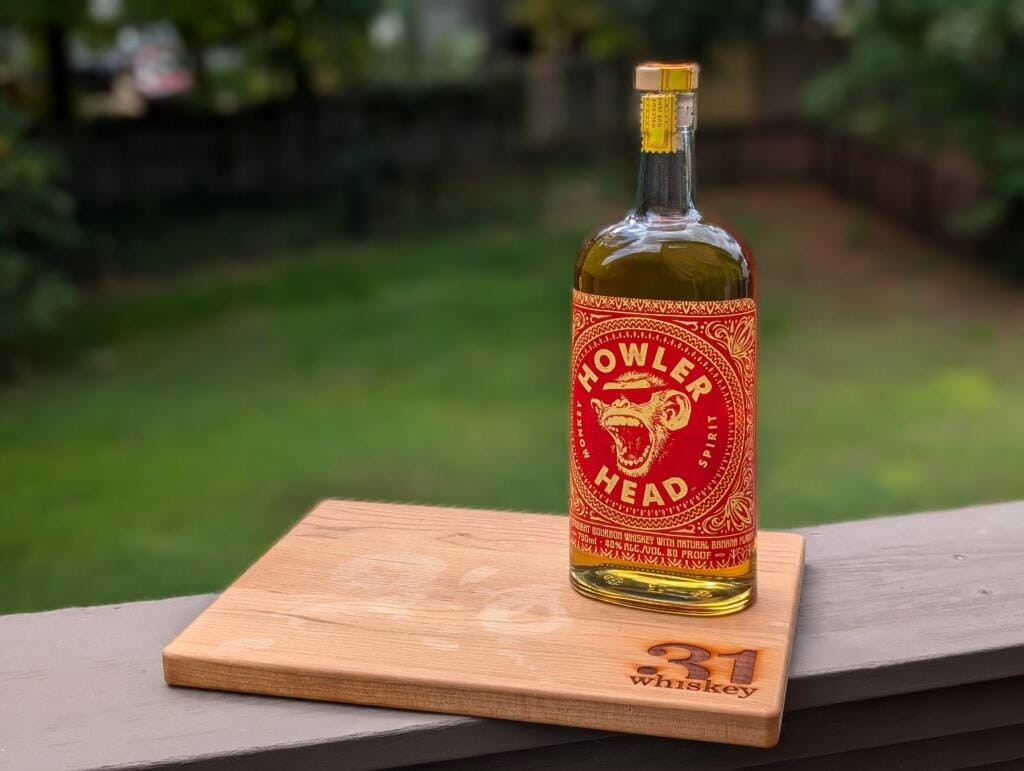
We’re finishing out spooky season here on the site, aka a month spent reviewing bottom shelf spirits that scare us (and our taste buds). And I figured this year we’d go out by solving a mystery: there’s a bottle that I’ve been seeing on the shelves of my local liquor store that honestly has me more confused than anything. While I guarantee that I’m not the target audience for it, I figured that this would be the perfect time to give it a proper review.
History
Catalyst Spirits was founded in December 2021 with the intention of building brands within the spirits industry. The business doesn’t seem to focus on the actual distillation process, but instead builds brands and products to meet what they think are the market demands and sources the spirits from other producers. The business is led by CEO Simon Hunt, who went into the spirits business after a stint in the Royal Marines and since has worked as head of marketing for Diageo, CEO of Malibu Kahlua, and a long 13-year stretch as CEO of William Grant & Sons.
One of their first products was Howler Head, a banana flavored whiskey with distinctive packaging. Catalyst Spirits partnered with the UFC to make their product the UFC’s official flavored whiskey, with accompanying product placements during their fights and brand ambassadors in the form of UFC fighters. Thanks to this partnership, Howler Head’s popularity took off, shipping 50,000 nine-litre cases and raking in $6.7 million in sales.
One year after opening its doors, and based on the success of the Howler Head brand, the Italian based Campari Group purchased a 15% stake in the company for $15 million (a $100 million valuation for the young company) with the intention to continue producing additional “digitally-native” brands.
Product
Howler Head Bourbon is a flavored bourbon, which means that it starts out as a proper whiskey and then has natural flavors added to it prior to bottling.
Specifically, this claims to have started live as a Kentucky Straight Bourbon Whiskey. That’s notable because that kind of whiskey is generally considered to be good quality spirits, and if you’re going to make a flavored whiskey most people would instead reach for lower quality (cheaper) ingredients. Good on them for instead starting with a quality base.
By law, Kentucky Straight Bourbon Whiskey needs to be made in Kentucky and start with a grain bill of at least 51% corn (likely 70% Kentucky corn, 21% rye, and 9% malted barley based on some sleuthing further in this section). That grain is milled, cooked, and fermented to create a mildly alcoholic liquid that is then distilled to make the raw “white” whiskey. From there, as a “straight bourbon” the whiskey is placed into brand new charred oak barrels for a period of no less than four years (it could be two years if they note that on the label, but I don’t see any such notation).
Up to this point, the process is pretty normal and straightforward — but just before bottling, something described as “natural banana flavor” is added. Most likely this is some form of banana oil that has been sourced elsewhere that is added into the whiskey in measured amounts.
All of this takes place at an undisclosed distillery, too — Howler Head doesn’t actually make anything themselves, they instead bottle stuff that other people have made. And in fact, it looks to me like they outsource the bottling as well. According to TTB records, it appears that Green River Spirits in Owensboro, Kentucky is the original distiller of this whiskey, with Bluegrass Bottling in Stanford doing the actual packaging.
That leads me to believe that likely what we are seeing is the normal Kentucky Straight Bourbon Whiskey that you’d find produced by Green River, just with some added flavoring. (Hence my thoughts on the grain bill for the whiskey.)
Packaging
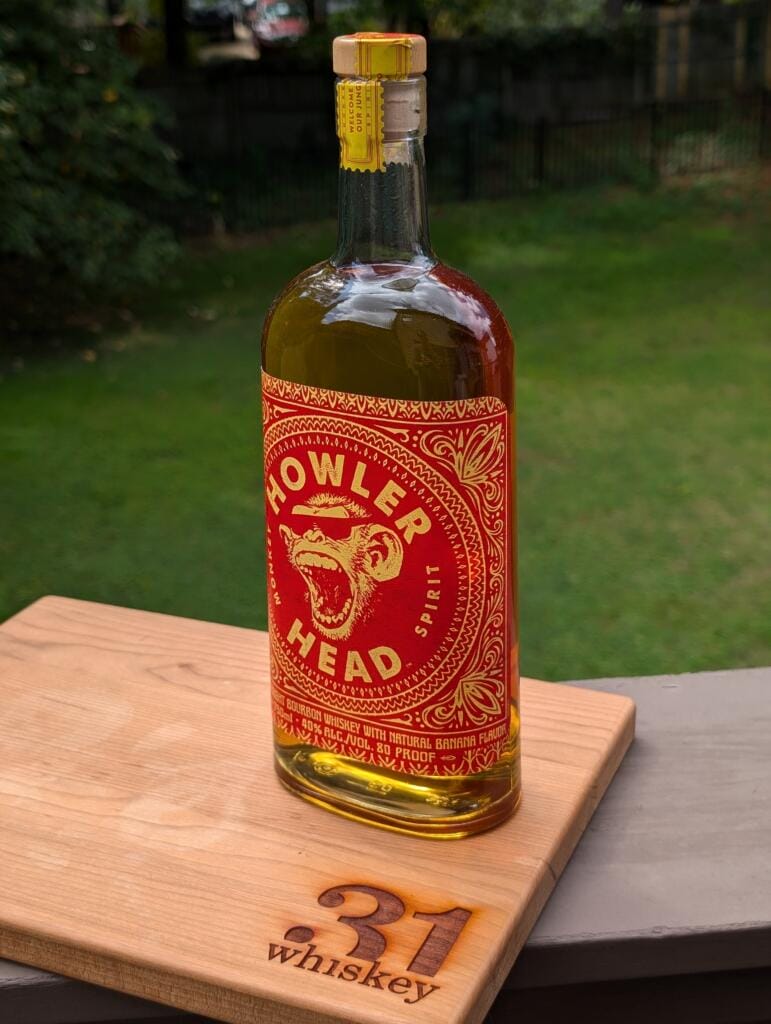
It’s pretty obvious that this brand is 100% about the marketing, and the bottle design is all the confirmation I need.
The bottle itself is glass, and the version that I have here bears no distinctive markings molded into the bottle. It looks like newer versions might have some embossed lettering in the glass, but that’s not evident here — and likely something that would only be fiscally logical after millions in sales. This specific bottle is generic, but the design is important.
Instead of being slender and rounded like most whiskey bottles, the shape is flat and wide. There’s a lot more surface area on the front and back, which does two things: first, it provides tons of real estate to plaster the distinctive Howler Head logo and label onto the bottle; but it also means that this doesn’t fit in a well behind a bar easily. It needs to be placed on the back shelf, where it would be seen by patrons who might ask for it specifically.
Speaking of the label, it takes up almost the entire surface area of that bottle. There’s very little space to see the color and quality of the whiskey inside, mainly because that’s not the point. The company is selling the brand, not the quality of the whiskey. The label is distinctive with yellow designs on a red background, and an aggressive image of a howling monkey bearing its teeth and wearing sunglasses on the front.
I can see why the UFC was the right call for a partnership. This brand is loud and aggressive.
Neat

At first glance, this looks like a normal glass of whiskey — but the instant you get near it, the aroma will let you know that something else is going on here. For those of us born in the last millennium: if you remember those banana hard candies that you’d find in a vending machine for a quarter, it smells exactly like that. All sugary sweetness with a heavy dose of faux-banana. Around the edges, I am getting some brown sugar and vanilla as well.
Taking a sip, this is incredibly sweet and viscous (and probably not in a good way). It reminds me a lot of the unholy level of sweetness that you’d find in Fireball or other trendy spirits — and honestly, the same level I’d expect in cheap watered down maple syrup.
Besides the diabetes-inducing level of sweetness, the flavors are actually pretty good. It’s the same flavors as we saw in the aroma (banana, vanilla, and brown sugar), but there’s nothing overpowering or awful about them. It’s objectively pleasant.
On Ice
Usually, the added ice is where things start to go south with flavored spirits. For example, with a lot of the peanut butter whiskies that we’ve tried, once you add a bit of ice the flavors tend to become more bitter and unbalanced without that added sugar to keep things in line. But in this case, there doesn’t seem to be any icebergs of unpleasantness hiding among those rocks.
What does change is that the banana flavor becomes more prominent. I think this is because the other notes are from the actual whiskey itself (the vanilla and brown sugar) and have a tendency to become muted with a bit of dilution and a drop in temperature. But since the banana flavor is artificially added and already concentrated, it ain’t going anywhere. It stands out a bit more here, with a surprising addition of dark chocolate on the finish that adds some unexpected but welcome complexity.
Cocktail (Old Fashioned)
With this version of an old fashioned, the good news is that you don’t need any additional muddled sugar. There’s plenty in the glass already just from the whiskey. (Adding any more might actually put you into a diabetic coma.)
I was hoping that the dark chocolate I saw when taken on the rocks would provide more character here, and while the cocktail is still interesting and different, I’m still not sure if it’s my cup of tea. This is incredibly sweet and banana-forward, with the bitters barely able to keep up. There is some interaction between the flavors, but in the end the bitters can’t hold their own and seem to disappear behind that overwhelming banana flavor.
Fizz (Mule)
Usually, with a mule, the ginger beer is the biggest personality in the glass and the bourbon is just trying to get a word in edgewise. But here, the banana flavor is practically drowning out that ginger beer — something I’m not used to seeing (to quote Ron Burgundy: “I’m not even mad, I’m impressed”). There’s still some interaction going on here, and it’s not that the banana is completely overpowering, but the balance has definitely shifted.
I do feel like this is the best use of this whiskey that I’ve seen yet. The banana flavor might still be keeping the other elements from really shining through, but that tangy spice from the ginger beer and the acidity from the lime juice is at least adding some depth and balance to what has otherwise been a Jolly Rancher of sweetness.
Overall Rating
We’ve seen a surprising number of flavored whiskies come onto the market in the last couple years, trying to be the new Fireball. In terms of price and composition, this whiskey is probably best compared to Skrewball — and while that is a peanut butter whiskey, the concept is the same. It’s a flavored spirit at roughly the same price range.
Peeling back the marketing and the branding like the peel of a banana and leaving behind just the fruit of the actual spirit, this is objectively a good flavored whiskey. It’s not great (I think this is still WAY too sweet) — but there are no flaws in the flavor profile like we see with the peanut butter versions out there. And it isn’t some kind of macho challenge like Fireball tends to become, where the awfulness is part of the appeal. This actually legitimately works in cocktails, and is drinkable all on its own.
I can’t believe I’m saying it, but this gaudy and horrible looking bottle has actually earned a spot on my liquor shelf.
| Howler Head Monkey Spirit Bourbon Production Location: Kentucky, United States Classification: Flavored Whiskey Aging: No Age Statement (NAS) Proof: 40% ABV Price: $29.99 / 750 ml Overall Rating:   |
Overall Rating: 4/5
An alcoholic version of those banana candies from the vending machine of your childhood (at least, if you’re over the age of 35).