
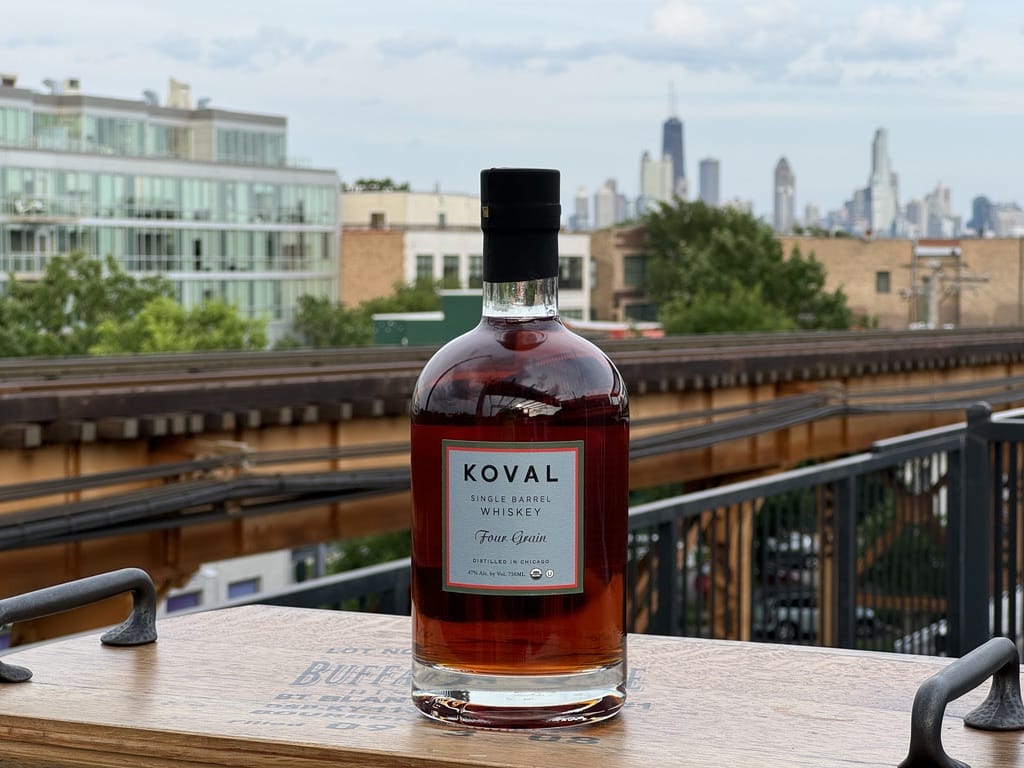
It might seem like we focus our Chicago whiskey coverage on Few Spirits, located just north of the city, but there is another great distillery in the heart of the city: Koval. Located in the Ravenswood neighborhood in an area known as “Malt Row”, Koval has been churning out a lot of interesting products. We’ve previously reviewed their Single Barrel Rye and Single Barrel Bourbon, both of which ranked as four-star spirits. Today we’re looking at their single barrel four grain whiskey to see if it matches up to its siblings.
History
Chicago has a long and storied history when it comes to alcohol, with a particularly bloody period during the 1920’s and 1930’s. When prohibition began, it wiped out all the city’s distilleries and, for the next half century, the city’s alcohol consumption was fueled by imports (of the illegal kind during Prohibition, and the legal kind afterwards) from other states and countries.
That all changed in 2008 when Robert and his wife Sonat Birnecker decided to quit their academic jobs and start the first (legal / official) distillery in Chicago since prohibition. The name “Koval” comes from a yiddish phrase meaning “black sheep”, which is a designation Robert’s grandfather earned when he left the family home in Vienna in the early 1900’s to start a new business in Chicago. The couple decided that the name was appropriate for their new business as well.
Koval seems to embody a truly craft approach, using local ingredients and a highly controlled process focused on producing award-winning spirits. From their website:
Embracing the grain-to-bottle mentality, each step of the spirit-making process is thoughtfully monitored: beginning with contracting local farmers to grow the grain, to on-site milling and mashing, to finally distilling, bottling, and packaging. After numerous international awards and Robert at the helm of consulting for the burgeoning craft industry, KOVAL has grown to be one of America’s leading small batch, independent spirit manufacturers.
https://www.koval-distillery.com/newsite/about-us
The Koval distillery remains privately owned, and focuses on single barrel whiskey production.
Product
All of the grains used in Koval’s whiskey are sourced from local organic and non-GMO farmers. This bottle uses a mashbill of oat, malted barely, rye, and wheat, but the specific proportions used in this product are undisclosed. As a bourbon, though, we do know that at least 51% needs to be corn. Those grains are milled on site, allowing the distillery to carefully monitor the process and get just the right size and consistency of ground grains.
Once the grains are milled, they are cooked to convert the starches into sugars and then fermented by adding yeast to the mixture. The liquid is then distilled in a custom-built Kothe combination pot and column still, designed to be as green as possible during the distillation process by re-capturing the water used during distillation to ensure minimal waste.
After distillation, the raw white whiskey is added to new, heavily charred oak barrels from Minnesota and left to age for an undisclosed period of time. Once the whiskey is ready, the end result from each barrel is proofed down to 94 and poured directly into the bottle. And there’s no blending or mixing — every bottle they produce is a single barrel whiskey, so you are tasting exactly how the liquid in that specific barrel tasted. It’s the ultimate test of skill and craftsmanship when it comes to distilling.
Packaging
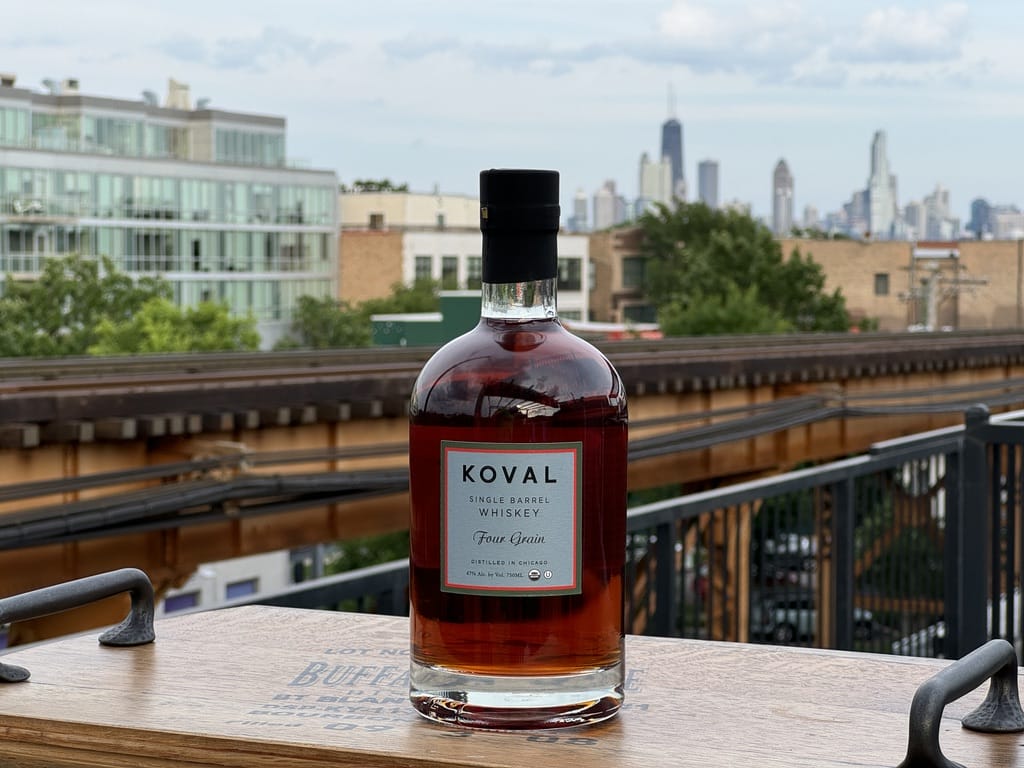
In a review of a different Koval product (Koval Bourbon), Nick was not impressed with the bottle. While I don’t wholly disagree with his assessment of a single bottle, there is something to behold when you see their entire product portfolio lined up across a shelf. In this case, I feel like the whole is greater than the sum of its parts.
The bottle itself is something I am sure you’ve seen before: a short bottle with straight walls, and rounded shoulders tapering to the neck. The stopper is a synthetic black cork that fits tight and gives a satisfying pop when you remove it.
The label is minimalistic. The front carries the distillery name and product type, (and also declares proudly “distilled in Chicago”), all in a clean font, with the only embellishment being the grain type. The rear label calls out the mash bill and barrel number.
Being a local distillery focusing on single-barrel production, local Chicago-area liquor stores (I’ve seen it at both Binny’s and Garfield’s) will often choose a barrel and the entire batch will be labeled with an additional banner indicating that it was bottled specially for that store. That wasn’t the case here, but it’s common enough that you might notice.
Neat

At first, the aroma makes me think that I am drinking a pure rye whiskey — there is a strong heat and black pepper coming from the spirit. I know this is a four-grain mashbill, but nothing from the aroma is carrying those other components as far as I can tell. If I really reach, I might be able to detect the very slightest hint of strawberry among that black pepper. Not the fresh fruit, though — something more closely aligned to an old school scratch and sniff sticker.
Thankfully, there are far more flavors in the liquid than aromas. When I take a sip, the first thing I notice is the rich crisp sweetness from a freshly toasted crème brulee. I am not sure where this sweetness was on the nose, but this is delicious. There are other flavors as well: a hint of orange citrus, walnut, and a banana like you might get in a wheat beer.
On the finish, there is a bold heat from the rye, just like you would get from a traditional rye whiskey. There is also an underlying flavor that can best described as a bowl of Honey Nut Cheerios (without milk, of course — no one wants cream with their bourbon). Clearly the grains are playing a role.
This is a unique flavor that takes some time to get used to — but after a sip or two, you’ll start appreciating how good it is and how much complex flavor you get from this spirit.
On Ice
Usually, with a bit of ice, things tend to mellow out in a spirit. The harsher tones are toned down, although often at the expense of losing the lighter aspects. In this case, though, some of the flavors are actually amped up. Most notably, the crème brulee and vanilla flavors have been cranked up by the ice.
Now, this comes at a cost. The citrus and banana flavors have faded into the background as very faint notes, which makes sense as those likely came from the actual distillation of the mash and not imparted by the barrel maturation process like the crème brulee. There isn’t as much change to the rye notes, with the black pepper and heat no more or less intense.
One very sad (at least in my opinion) change is that I no longer taste my cheerios. I guess that means I can only drink this whiskey for breakfast neat.
Cocktail (Old Fashioned)
Well, this is just okay.
The angostura, orange, and sugar seem to wipe out a lot of the flavors of the whiskey. There are some very minor flavors of crème brulee in the cocktail, but it’s minor at best. If you weren’t looking for it, you wouldn’t taste it.
While the flavors are altered, this does still taste like an old fashioned. Two flavors in particular preserve that notion: the black pepper spice and the orange citrus notes. Both come through and are still powerful enough to mingle with the bitters, adding some nice balance and depth to the cocktail. It isn’t an ideal version, but it is a recognizable, acceptable version of this cocktail.
Fizz (Mule)
I don’t drink soda anymore. I had my era where soda was my beverage of choice – especially going to a college where the campus was a subsidiary of Coke (and yes, even though I grew up in the Midwest, I call it soda and not pop — kick rocks if you have a problem). All of that to say… this cocktail tastes like a flat diet coke to me.
Seriously, this drink is mostly bitter and bland. Even the ginger beer (I am using Goslings, which tends to be extra punchy) has lost is umph. I don’t know what happened here, but it reminds me of the “Homie the Clown” episode of The Simpsons: Homer (as a Krusty) is opening a new franchise. A Hamburgler analog comes in to steal the Krusty burgers. Homer proceeds to pummel this poor character as one of the children in the audience pleads, “sto-ah-ah-ah-op… he’s already dead”.
Needless to say, this cocktail was poured down the drain.
Overall Rating
I find Koval interesting due to their willingness to play fast and loose with their mashbill. In fact, my first bourbon from Koval was made with buckwheat (sadly, I wasn’t yet writing for Thirty One Whiskey when I bought that unique specimen so there’s no official review).
For this bottle, I am really torn… I really enjoy this whiskey neat and on the rocks, but it’s abysmal in cocktails. That said, being a single barrel product, each barrel may be different from the last… so your mileage may vary.
Overall, this is a good bourbon if you are a bourbon fan. It has a unique flavor profile, and is really good if you are looking for something to sip on. Just don’t use it in a cocktail, unless you want to be very disappointed.
And as an aside: if you ever have the chance, visit the Koval tasting room. It’s a great space with has some fantastic cocktails. If you happen to be in Ravenswood, I highly recommend it.
| Koval Single Barrel Four Grain Whiskey Produced By: Koval Production Location: Illinois, United StatesClassification: Whiskey Aging: No Age Statement (NAS) Proof: 47% ABV Price: $52 / 750 ml Overall Rating:   |

All reviews are evaluated within the context of their specific spirit classification as specified above. Click here to check out similar spirits we have reviewed.
Overall Rating: 3/5
Four grains, and they’re all reserved for a solid sipping experience – don’t add them to a cocktail unless you like being disappointed.