
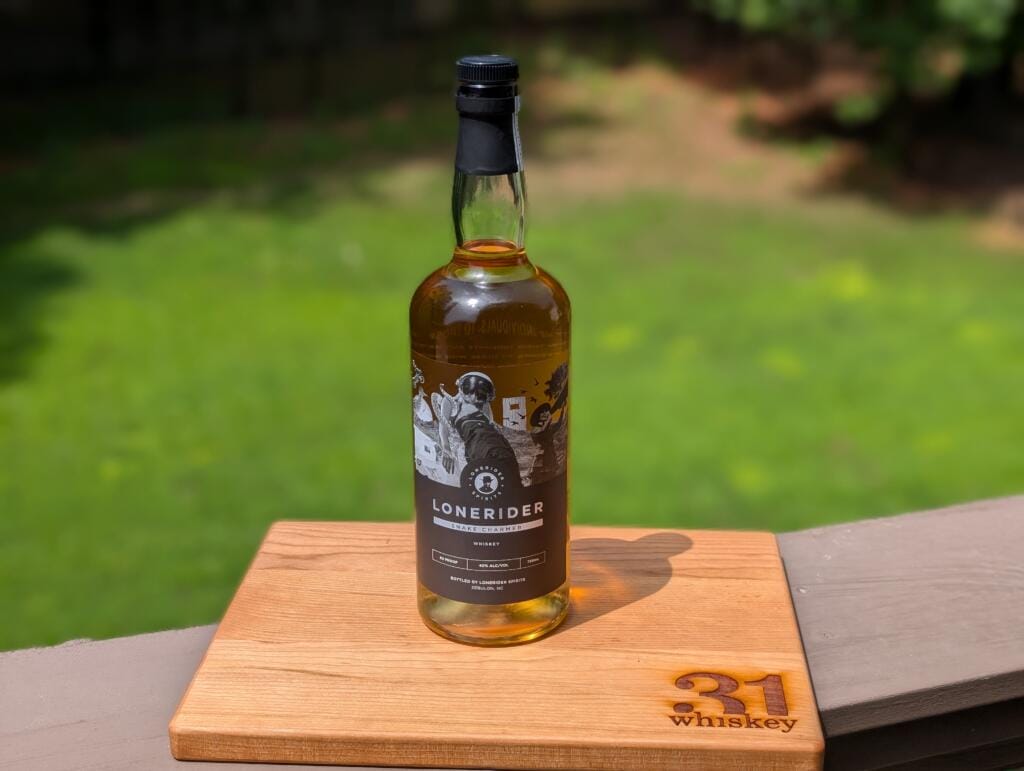
When we lived in Texas, I was primarily a whiskey guy. But since moving to North Carolina, I’ve been loving the craft breweries and delicious beer that this state has to offer — and one of my favorite breweries is actually (unfortunately) located just down the street from us, and that’s Lonerider Brewing Company. Who, as luck would have it, actually also produce a line of whiskey. And so today we’re going to look at their “shootin’ whiskey”: the Snake Oil.
History
Sumit Vohra started his career as many in the Raleigh-Durham metro area do: working in tech. He spent over seven years working for Cisco, a large manufacturer of computer networking equipment, before deciding that what he really wanted to do with his life was strike out on his own and be an entrepreneur. After graduating from UNC with an MBA in 2007, two years later he had put together enough resources to open Lonerider Brewing Company in Raleigh (located just down the road from the RDU airport).
Since opening, the Lonerider Brewing Company has expanded in popularity and throughput, producing 20,000 barrels of beer per year that are distributed in nine states and overseas. The brewery is listed among the top 150 breweries in the United States (and on a personal note, makes the best hefeweizen I’ve ever tasted).
A decade after opening their first brewery, the company decided to ride the craft spirits wave as well and open a dedicated distillery called Lonerider Spirits. While they do technically have a still and make some spirits, the majority of their product (at least initially) has been sourced from other undisclosed local North Carolina distilleries and only bottled by Lonerider.
Product
There’s a discrepancy I want to call out on the name of this product: online and in marketing materials this is referred to as the “Snake Oil” line of whiskey, but on the bottle (at least the one I have) this is marked as “Snake Charmer”. From what I can tell, it’s the exact same thing and described in the exact same way (and in no way associated with Rob from Love Island as far as I know), but I do want to note that misalignment.
Since this is a sourced whiskey, there really isn’t much we can know for sure about what’s in the bottle. The only requirement is that the spirit needs to be made from grains (corn, barley, wheat, etc), but since there isn’t a more descriptive statement we can’t tell what proportion of each kind of grain was used. Corn is the most likely main ingredient, since it’s the cheapest and most prevalent in the whiskey distilling world.
To make whiskey, those grains are crushed, cooked, and fermented to create a mildly alcoholic liquid called a “distiller’s beer”. In fact, up until this point, this is the exact same process Lonerider uses for their beers. Where these two drinks diverge is that the beer is pretty much done at this point, but the whiskey has a long journey still to make.
After fermentation, the alcoholic liquid is distilled to concentrate the alcohol content and selectively capture the flavor elements that the distillery wants to highlight. Technically, at this point you’ve got a whiskey, and everything afterwards is referred to as “maturation” or “finishing” of the spirit.
With the Snake Oil whiskey, the bottle claims that this is aged for a minimum of one day. It doesn’t specify aged in what, so I assume that these were previously used bourbon barrels that are being cheaply re-purposed. Also absent are any mentions of additives, coloring, or flavoring that may have made its way into the bottle.
Packaging
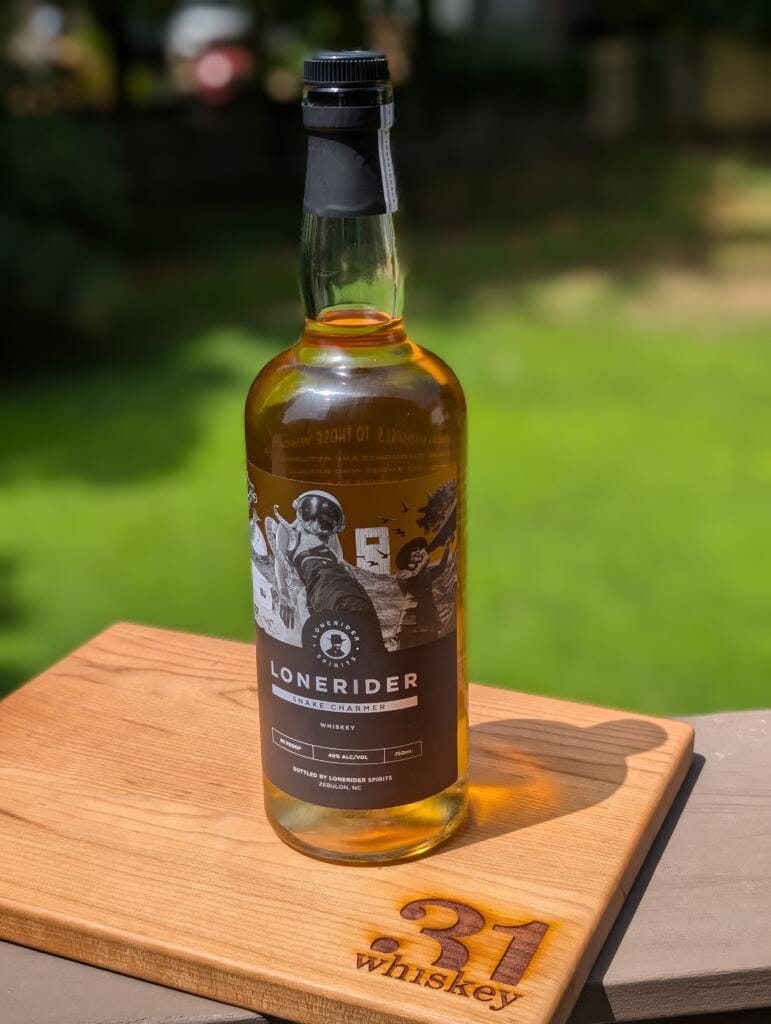
The bottle shape and design is pretty standard for a small distillery: a cylindrical body, rounded shoulder, and medium length neck that are capped off by a synthetic stopper. It’s the same bottle we’ve seen time and again, which isn’t a bad thing — it’s a classic shape that blends in well with other spirits on the shelf.
Where this starts to get some character is the label. It’s a distinct art style; a collage of images with a pop-punk vibe, and a departure from the normal branding that they use on their cans (which is an illustrated semi-cartoonish western style). It’s a distinctive choice, especially with the jet black background for the majority of the label, but there’s enough negative space where the color of the whiskey shines through to keep it from feeling oppressive or cluttered. I think it strikes the right balance.
Personally, the art style and branding isn’t clicking with me. It’s such a departure from their other brand identity that it feels like a completely different company. And I don’t see where they pick up on this vibe from the local community. It’s a jarring shift in tone that I don’t personally resonate with, but it’s not bad on its own.
Neat
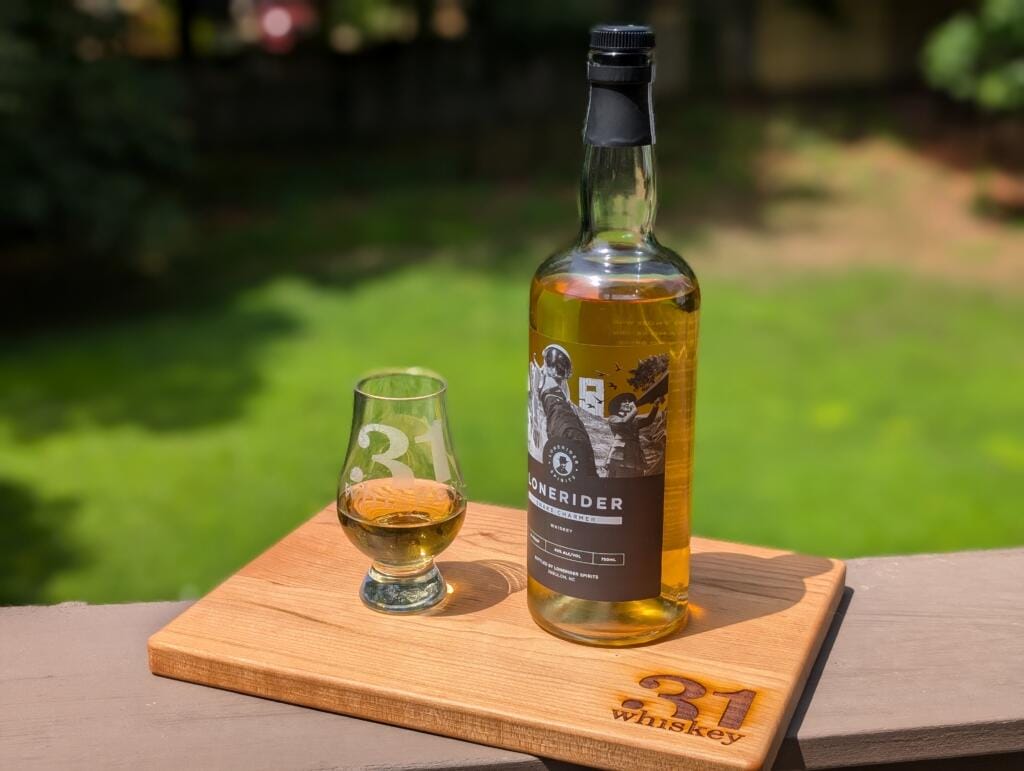
The liquid in the glass is a pale straw color, like that of a lightly aged scotch whisky. Similarly, coming off the glass are aromas of immaturity — raw corn and a bit of butterscotch, combined with industrial alcohol and vanilla.
I was expecting to get more of an industrial note in the flavor profile, but surprisingly this is actually rather clean and smooth. I’m still getting the raw corn and the butterscotch combined with a hint of vanilla, but there’s not any kind of burn or bite to be seen. Instead, there’s just a bit of a warm texture, kind of like the spice you’d expect from a rye whiskey but without the black peppery bitterness.
This is a pretty nice whiskey taken neat — it’s simple but smooth, light flavors without bite or bitterness.
On Ice
Normally, I’m concerned when a lighter whiskey gets poured on the rocks. The flavors have a tendency to disappear and leave behind something bland and uninteresting. But in this case, I think it actually improves the overall flavor profile.
The biggest change is that the raw corn component to the flavor profile has disappeared. It was adding a bit of a grassy or aromatic element before, and now that seems to have slipped well into the background. What’s front and center now are the butterscotch and vanilla flavors, with only a hint of the corn left if you really squint.
It’s not bland or unbalanced, still just as smooth, and the improvement from losing the raw corn note is appreciated.
Cocktail (Old Fashioned)
My concern coming into this cocktail is that there weren’t many flavors in the spirit that would hold up to the elements in the bitters, and that’s exactly what ended up happened. There’s no balance here, just a big glass of bitters.
To be frank, that’s not entirely bad — there are plenty of bitters-forward cocktails out there and I do enjoy them. But in this case, I’m looking for the flavors in the spirit to provide at least some balance and interesting notes. Instead, what we have are flavors that seem to run and hide, providing nothing to the experience.
Fizz (Mule)
Just like we saw in the old fashioned, the flavor profile of this whiskey really isn’t up to the challenge of making a good cocktail. There just isn’t enough depth or saturation to make it happen; instead, the mixers are running the show and the spirit itself is a supporting character at best. In this case, I think I see a hint of sweetness coming through and trying to add some balance to the citrus and tangy elements, but the actual flavors aren’t powerful enough to really make a contribution.
This is probably best compared to a Moscow mule with a hint of simple syrup: just a hint of sweetness trying to balance things out, but not nearly enough to really make a difference in the flavor profile.
Overall Rating
The promise of a brew-stillery is that they might use the same liquid from their beer as a base for their whiskey. I really hope that I’m around long enough to see that happen, but in the meantime, the sourced spirits are a good indication of the distillery’s flavor preference and approach to spirits. And in this case, I think this is a nicely executed light whiskey, but it doesn’t pack enough punch to hold up in cocktails.
Taken neat, the flavor profile is simple, and reminds me of a light whiskey such as Austin 101 or a lightly aged whiskey like Abasolo’s Mexican take. There are only a few flavors present and none of them particularly potent, which makes this a fine sipping or shooting whiskey. I just wish it had a touch more complexity and intensity, which would take it from “fine” to “good”.
I really look forward to seeing what else this distillery has to offer, especially (fingers crossed) once they get up and running making their own stuff. But in the meantime, I’ll probably stick to their excellent beer.
| Lonerider Spirits Snake Oil Whiskey Produced By: Lonerider Spirits Production Location: North Carolina, United StatesClassification: Whiskey Aging: No Age Statement (NAS) Proof: 40% ABV Price: $19.95 / 750 ml Overall Rating:   |
Overall Rating: 2/5
A well executed lighter and less complex whiskey, but too bland for the label (or the price tag) it sports.