
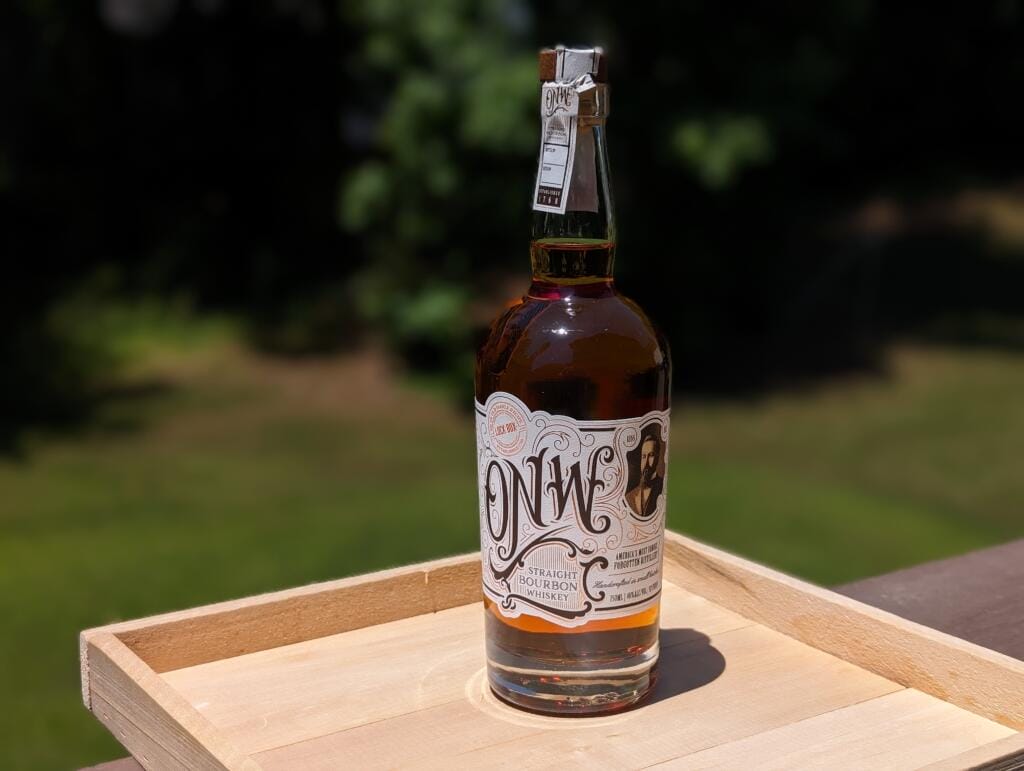
As a new resident of the state, I’ve been slowly working my way through all of the North Carolina spirits that catch my eye. So far we’ve reviewed a rum, a gin, and a single malt whiskey — but today we’re diving head first into the world of NC bourbon. And we’re starting with a distillery that has an unfair advantage (at least to a guy named Nick): Old Nick Williams Straight Bourbon Whiskey.
History
This gets a little bit messy, but stay with me. And as a word of wisdom for future generations: please don’t name your son after your father. It makes reading histories a touch confusing, especially when a family keeps doing that for like four generations.
The Williams family originated in the land of unpronounceable words (Wales, in the UK), with John Williams being born on January 26, 1679. In his twenties, he traveled to the new world, first stopping in Virginia before eventually ending up in North Carolina. His grandson Joseph Williams (the elder) was born in 1748, and at the age of eighteen he was granted 8,000 acres of land near Lewisville, North Carolina.
In 1768, Joseph Williams started a small family distillery, intending to make spirits for medicinal use as well as personal enjoyment. The family focused on making a quality product — they were making whiskey for themselves, not for sale, so the pressure to cut costs and increase profits was far from their minds. Whiskey production was interrupted by the American Revolution, where Joseph served as a colonel in George Washington’s army, but resumed after he returned home.
One of Joseph’s sons, Nicholas Lanier Williams, took over the distillery in 1827 after his father’s death. Nicholas decided to move the distillery to a new larger and more modern facility which he named after his father: the “Joseph Williams Distillery”. There he continued to produce whiskey for the local North Carolina population, and was eventually joined by his son Joseph (the younger). Sometime in the late 1800’s, this younger Joseph Williams created a specific strain of whiskey and decided to name it “Old Nick” in honor of his father.
Nicholas Glen Williams (thankfully referred to as Glen Williams for clarity’s sake) took over the family distillery on his father’s death on November 9, 1887. Glen was determined to make the family business successful, first renaming it to a more recognizable “Old Nick Williams Distillery” (after their now locally famous whiskey) and investing significantly in an expansion to their facility. The new brand was officially launched at the 1893 Chicago World’s Fair and then went international the following year at the Paris Exposition.
Business was booming. Demand swelled — and to supplement this local production, he also started importing raw whiskey from other distilleries, maturing it, and selling it under his own brand. The distillery was so important and influential locally that they literally created a town (Williams, North Carolina) so that they could continue operating when a new state law required all distilleries to be within an incorporated township.
Life was grand right up until the beginning of prohibition in the United States. North Carolina enacted a local prohibition ordinance in 1908 — earlier than the rest of the country — which made it illegal to sell spirits within the state border. While they initially tried to ship their whiskey across state lines for sale, time eventually ran out for Glen Williams. He died on November 25, 1913, leaving behind a widow, a 1,400 acre farm, a shuttered distillery, nine children, and 28,000 gallons of now-illegal whiskey. The family destroyed the remaining stocks of spirits and tried to move on with their lives.
After the end of prohibition, members of the Williams family tried to restart the distillery a couple times, most notably in Virginia, but it wasn’t until 2014 when brothers Van and John Williams discovered a trove of family documents related to the operation of the old distillery in their ancestral home that they were able to succeed. They rebuilt a brand new facility in 2014 near the site of the old distillery — on Williams Road, just southwest of Lewisville, North Carolina. And in 2015, the very first bottle of Old Nick Williams whiskey rolled onto store shelves in nearly a century, made in the exact same place by the exact same family as before.
Product
- Learn More: What Is Bourbon Whiskey?
I really have to hand it to these folks. Most “historical” distilleries that trade on a forgotten family tradition either source their spirits from elsewhere or produce them in some trendy hipster distillery in a downtown district. In this case, the Williams family is actually getting as close to the original version as possible.
All of the liquid in this glass was distilled on location at (well, reasonably near) the original Old Nick Williams distillery, using the original formula. Thanks to the trove of documents they found in an old family vault, the Williamses are able to use the same grain bill as their ancestors: 60% corn, 35% wheat, and 5% barley. Those grains are milled, cooked, and fermented to create a mildly alcoholic liquid.
Not everything is as it was back in the days of the Revolution, however. For the distillation process (the concentration and selective capturing of the alcohol in the liquid), they decided to step into the 21st century. The family uses a combination of copper pot stills and a stainless steel column or “continuous” still, which help preserve some of the character in the spirit while still allowing for a higher volume of production.
Once distilled, the spirits are placed into new charred oak barrels for a minimum of two years before being blended and bottled for sale. That’s what makes this a “straight” bourbon: any shorter time in a barrel and it wouldn’t qualify.
Packaging

So far, I’m a fan of everything I’ve seen. The history is great and the production process seems solid… but the bottle is a huge letdown, in my opinion.
The bottle itself is fine and fairly standard for a small craft distillery: generally cylindrical, flaring from the base to the shoulder, rounding smartly, and then extending into a medium length neck. It looks identical to the bottles Still Austin uses, for example. It’s not entirely bad, but it just seems like a missed opportunity to do something different.
What really doesn’t vibe with me is the label. It seems to be trying to evoke that turn-of-the-century vibe, much like Joseph Magnus (another brand of whiskey made by a family returning to its distilling roots). But in this case, the dark ink on a white background somehow just feels cluttered and disorganized.
I get what they are going for here. I like the concept, but I think their shot was a bit wide of the mark.
Neat
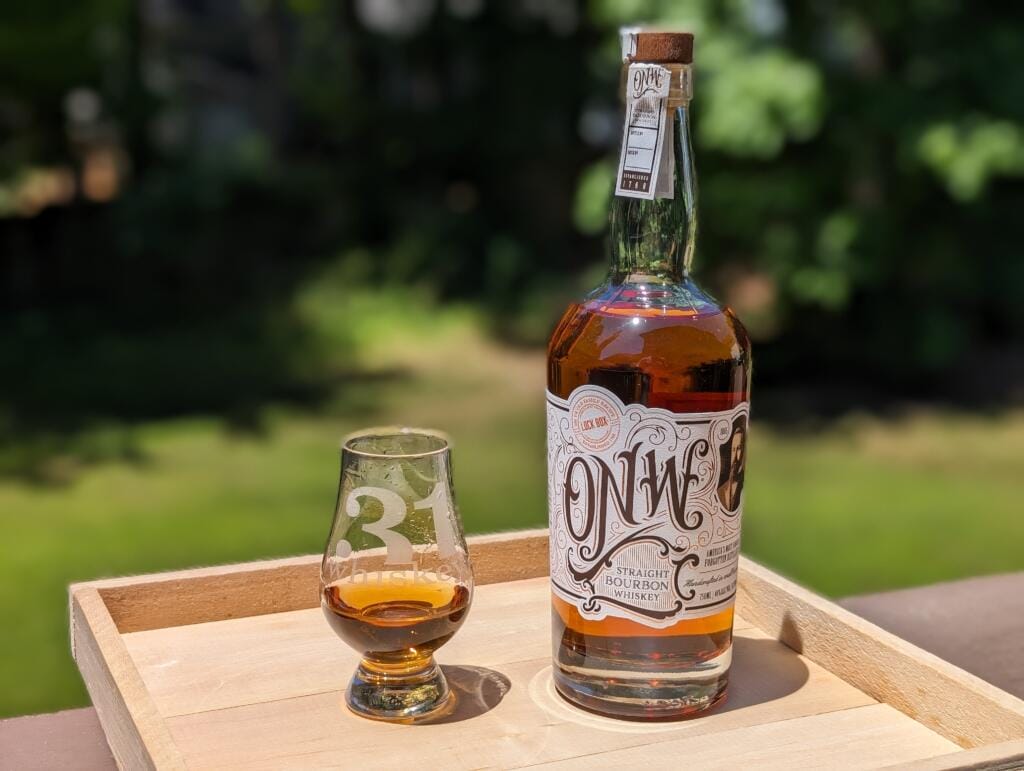
There’s a surprising amount of color for something that has only been in a barrel for two years. It’s a rusty gold, with some orange tint and crystal clear liquid. And coming off the liquid are the usual aromas you’d expect from a bourbon: cedar chips, caramel, butterscotch, and a tiny hint of vanilla. All well executed and nicely combined.
Of all the spirits I’ve tasted recently, this one reminds me the most of walking into my father’s woodshop. There’s an instant hit of cedar chips and cedar sawdust that is clear and recognizable, and really sets the tone for the flavor profile. Moving a little further along, I start to get some orange citrus notes followed by more familiar vanilla and caramel tones. On the finish, there are more butterscotch flavors complete with that creamy kind of texture.
I gotta admit, I didn’t see this one coming. The heavy cedar flavor is one that was a bit surprising, but is actually a refreshing and aromatic take on the spirit. Repeated trips to the well allowed me to discover some dark chocolate hiding in the corners adding a bit of depth as well, which explains how it’s able to be so well balanced. Add in the sweetness from the butterscotch, and this seems to be a winner when taken neat.
On Ice
When taken neat, I like bourbons that are lighter and aromatic. But the same flavors that make those bourbons delicious often don’t stand up so well once the ice hits the glass, leaving something behind that is typically a bit disjointed and less flavorful. And that’s what we have here.
The cedar flavor is still present, which is a bit of a surprise actually. Usually, that aromatic component is the first thing chucked out the window in these situations. But instead, the more traditionally bourbon flavors here are the ones taking a back seat. All but gone are the caramel, vanilla, and butterscotch and what you’re left with now is a dark chocolate that has sat in a cedar chest for a while.
That said, this isn’t terrible. There’s nothing patently unpalatable, and the flavors are still interesting. It just isn’t quite as good as what we saw when taken neat.
Cocktail (Old Fashioned)
When it comes to an old fashioned, I enjoy a darker and richer whiskey. That’s the best way to set this up for success, in my opinion, as it gives the aromatics of the bitters something to work with and counterbalance. Lighter spirits typically don’t work as well… but in this case, I might have to make an exception.
What I was expecting was an overly aromatic cocktail that had no depth. But I forgot to include that little hint of dark chocolate in my mental calculation. Instead, this is a cocktail that is definitely lighter and more aromatic than usual, but which still remains just balanced and grounded enough to keep it delicious and on the rails.
I do think there’s some room for improvement here. The aromatics are great, but there’s room in the lower registers if we want to add something to the mix. I think some chocolate bitters would be a good option here, or swapping some cocktail cherry syrup instead of a bit of simple syrup would give it just enough added character to really bring this to the next level. But even as-is, this is still pretty darn good.
Fizz (Mule)
So far, this has surpassed expectations. The whiskey has been great, and even in some of the tests where I didn’t expect much, it seems to have done much better than similar spirits. But I think this is the moment where the wheels fall off the wagon.
There may have been enough dark chocolate to counteract the bitters in an old fashioned, but the ginger beer and the lime juice are much more powerful than bitters. This is really just an overly bright and bitter cocktail with some cedar flavor thrown in for good measure. There’s something in here above and beyond a Moscow mule, certainly, but it isn’t as enjoyable as something with a bit more depth and character.
In this case, I feel like the spirit is acting more like a jalapeno infused tequila than it is a bourbon.
Overall Rating
I want to start out by praising once more the Williams family. They didn’t take the easy way out here — they actually created a distillery on the family land, used a historic family recipe, and distill and bottle themselves. Most “family” distilleries that are restarted after that brief prohibition era hiatus choose to import their spirits and set up shop far from their original location, but this is one case where they strive to get as close as they possibly can. To me, that gives them a +1/2 star modifier on our rating scale just for doing things right.
They don’t necessarily need it, though: their whiskey is pretty darn all right on it’s own.
From the very first sip, you’ll notice that this is a young whiskey. There aren’t nearly as many maturation flavors in here, instead we’re getting most of the flavor from the aromatics that comes from the distillation process. That’s the source of the cedar chips and the other “heads-y” components, lighter flavors that typify the American bourbon style. The difference is that usually those lighter flavors are balanced out by the richer, darker flavors from the oak barrel maturation process.
That portion seems to be missing here. Whether due to as shorter time period, a more temperate climate, or some other factor, there doesn’t seem to be that same rich and delicious barrel aging flavor preset in this bottle. Taken neat or in an old fashioned it isn’t missed quite as much, but once the cocktails start getting complex you really notice its absence.
That said, I’ll still keep this bottle around. This one is a keeper: lighter and more interesting than usual, and I’ll take that as a win.
| Old Nick Williams ONW Straight Bourbon Whiskey Produced By: Old Nick Williams Production Location: North Carolina, United StatesClassification: Straight Bourbon Whiskey Aging: No Age Statement (NAS) Proof: 46% ABV Price: $37.35 / 750 ml Overall Rating:   |
Overall Rating: 4/5
A lighter, more aromatic take on a straight bourbon whiskey.