
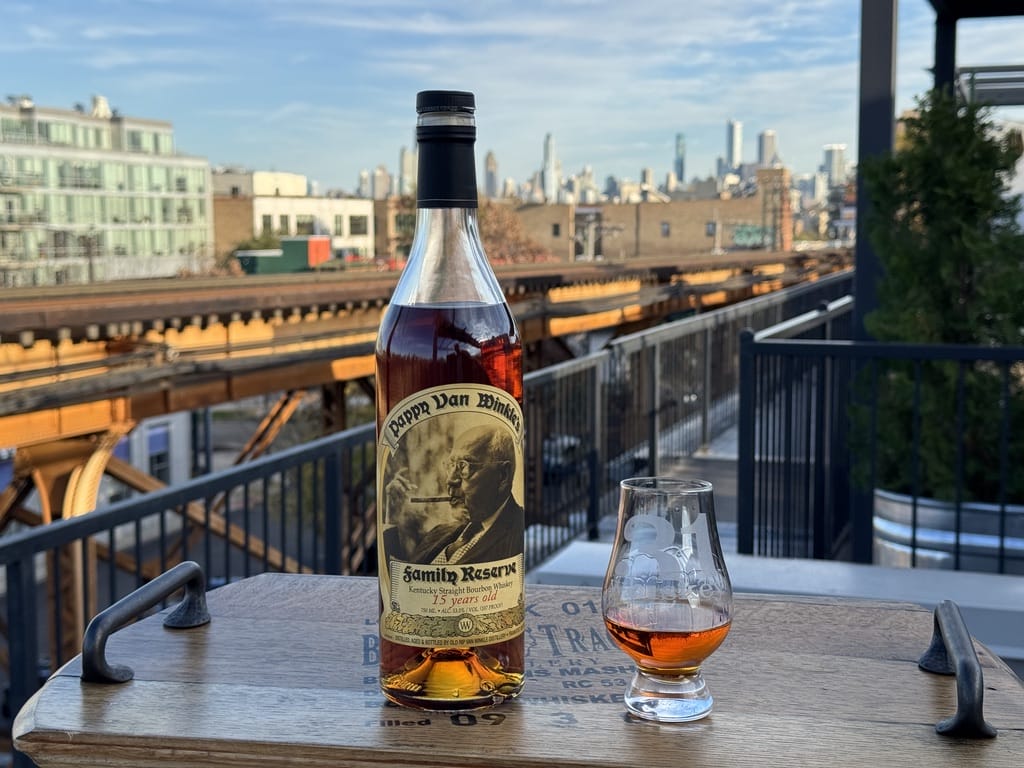
If you ask Google what the most sought-after bourbon is, there’s a good chance Pappy Van Winkle will top their list. This iconic bourbon is so coveted that aftermarket bottles often fetch over $2,000 — so imagine my surprise when I received an email from my local grocery store letting me know I had won a raffle to purchase a bottle at retail price! Not wanting to risk any error or delay, I wasted no time — I went straight to the store and purchased my bottle that same day.
History

There has been so much written on the history of the Van Winkle brand of bourbon. I know that I’m going to miss things and probably won’t do it justice — so if you really want to learn more, I highly recommend that you pick up a copy of Wright Thompson’s Pappyland: A Story of Family, Fine Bourbon, and the Things That Last. It’s a fantastic read and pairs well with whatever whiskey you decide to sip – I happened to sip Woodford Reserve on a cross country flight during my first read. You can read our review of this book here.
Julian “Pappy” Van Winkle Sr. started his career in 1893 at age 18, working for a spirits distributor named W. L. Weller & Sons. at a company that he and another Weller salesman would purchase outright following 15 years of solid work and investment. Two years after, in 1910, the company purchased the A. Ph. Stitzel Distillery in Louisville, Kentucky to produce their spirits. This distillery had been operating since 1872 using a “sour mash” process where the same yeast strain was transplanted from batch to batch for more consistent results and interesting flavors.
Throughout prohibition, the company remained afloat by being one of the few distilleries in the country licensed to produce “medicinal whiskey” and production continued uninterrupted. After the repeal of prohibition, the company decided to open a new distillery and, on Kentucky Derby Day in 1935, the Stitzel-Weller distillery opened its doors in Shively, Kentucky (just down the road from Louisville).
The distillery was a cathedral to doing whiskey ‘the right way’. Pappy’s famous motto for his distilling operation was “we make fine bourbon at a profit if we can, at a loss if we must, but always make fine bourbon.” That dedication to craft and detail went as far as the door knockers on the front door of the administration building, which were designed as five keys — one for each of the five key components in the process of bourbon production (grains, yeast, fermentation, distilling, aging) and served to remind everyone who walked through the doors about the importance of that process.
Compared to other distilleries, things ran a little differently. The bourbon started with a 51% corn content as required by law but, rather than using rye as the secondary component, the Stitzel-Weller recipe used the more abundant and locally grown wheat. The use of wheat instead of rye was thought to give the whiskey a smoother and richer flavor. The mash was then cooked to release the sugars in the grains — but where other distilleries used commercial high-performance yeast, Pappy continued the Stitzel tradition of a sour mash process using the same locally grown yeast strain. And finally, where other distillers put their whiskey in new oak barrels at the maximum alcohol content allowed by law (to get the most whiskey at the end), Pappy barreled his whiskey at a lower alcohol content to improve the resulting flavor.
Pappy Van Winkle would continue to run the distillery until his death in 1965 — which is coincidentally when things took a turn for the worse in the American whiskey market. During the 1960’s and 1970’s, the US market rejected whiskey in favor of clear spirits like vodka, and the massive stockpiles of whiskey at distilleries like Stitzel-Weller suddenly became worthless. The Van Winkle family would be forced to sell the company in 1972 to a large distilled spirits conglomerate that would eventually become the massive British firm Diageo.
While the distillery continued to operate for around two decades more, the facility eventually closed its doors for good in 1992. The ancient sour mash yeast was lost or destroyed. The equipment was left to rust. And the remaining whiskey, which had been so lovingly produced, was exported and blended with other sources to create the Crown Royal Canadian Whiskey line.
That wasn’t the end of the Pappy Van Winkle line, though. After the sale of his family’s distillery, Julian Van Winkle, Jr. (son of the original Pappy) purchased a small bottling plant nearby and began purchasing back barrels of the famous whiskey his father had produced and selling them under the old family name. As the American whiskey renaissance kicked into high gear over the recent decades, that brand of whiskey has been prized by whiskey snobs worldwide for its incredible quality and flavor. Buyers often pay exorbitant prices on the secondary market for a single bottle of the stuff. Given the dwindling stock of original whiskey and the booming demand, Julian Van Winkle Jr. has since partnered with Sazerac and Buffalo Trace to restart production of their whiskey line, with the new production becoming available in 2020.
Product
- Learn More: What Is Bourbon Whiskey?
The Stitzel-Weller distillery began using a unique mash bill, replacing rye with wheat, which produced a softer, smoother bourbon. This process was started by Weller and was perfected by the Van Winkle family and is why there are several products in the brand that bear these names to this day.
Pappy Van Winkle shares a formula with Weller wheated bourbon, with the only difference being the aging process. We know that the mashbill is the same as Buffalo Trace’s wheated mashbill — and while the exact mash bill is not disclosed, we do know that it must contain at least 51% corn to be called a bourbon and a healthy helping of wheat. Given the focus and abundant internet sleuthing around this whiskey, it’s believed that this mashbill is around 76% corn, 20% wheat, and 4% malted barley.
The grains are mixed, cooked, fermented, and distilled at the Buffalo Trace distillery. That newly made whiskey is then pumped into a new heavy charred oak barrel that has been carefully selected for its quality, and all of those barrels then spend the next decade and a half in a rickhouse until the bourbon is bottled.
This process has always been very controlled and meticulous. As Pappy Van Winkle Sr. said: “We make fine bourbon at a profit if we can, at a loss if we must, but always fine bourbon”.
Packaging
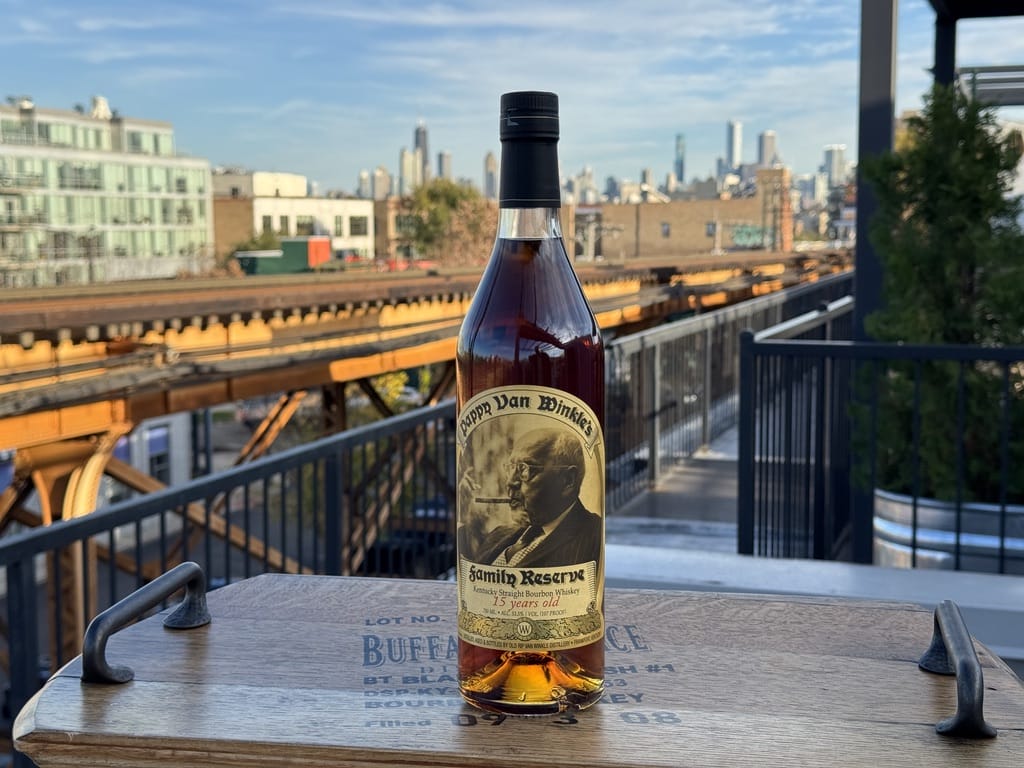
This may be one of the most simple, yet iconic bottles around. There is not a bourbon lover around that could not immediately pick out this bottle from a back bar.
There is nothing inherently special about the bottle (after all, everything that makes it special is inside the bottle). It’s a basic bottle shape that’s seen throughout the spirits and wine world: a clear glass, medium height bottle with a gently curved shoulder and a long neck. The stopper is wrapped in black foil and topped with a simple plastic synthetic cork.
For as simplistic as the bottle shape is, the label is truly iconic. Featured prominently is a portrait of an older Pappy looking dapper in a three-piece suit and smoking a cigar. Arched above the portrait is his name, with the description of the whiskey below. Adding a pop of color, the age of the whiskey is in red print.
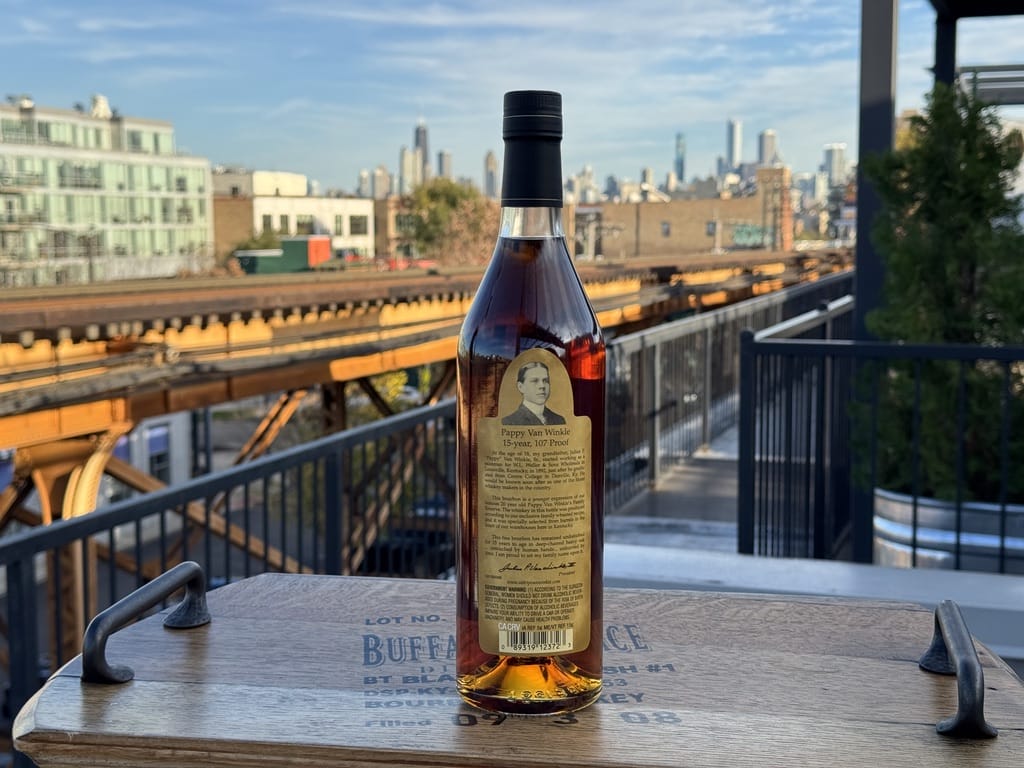
The back of the bottle has another portrait of Van Winkle — this time as a much younger man and a brief history from Julian III. The history ends with, “this fine bourbon has remained undisturbed for 15 years to age in deep-charred heavy oak… untouched by human hands… unhurried by time. I am proud to set my family name upon it”.
Neat
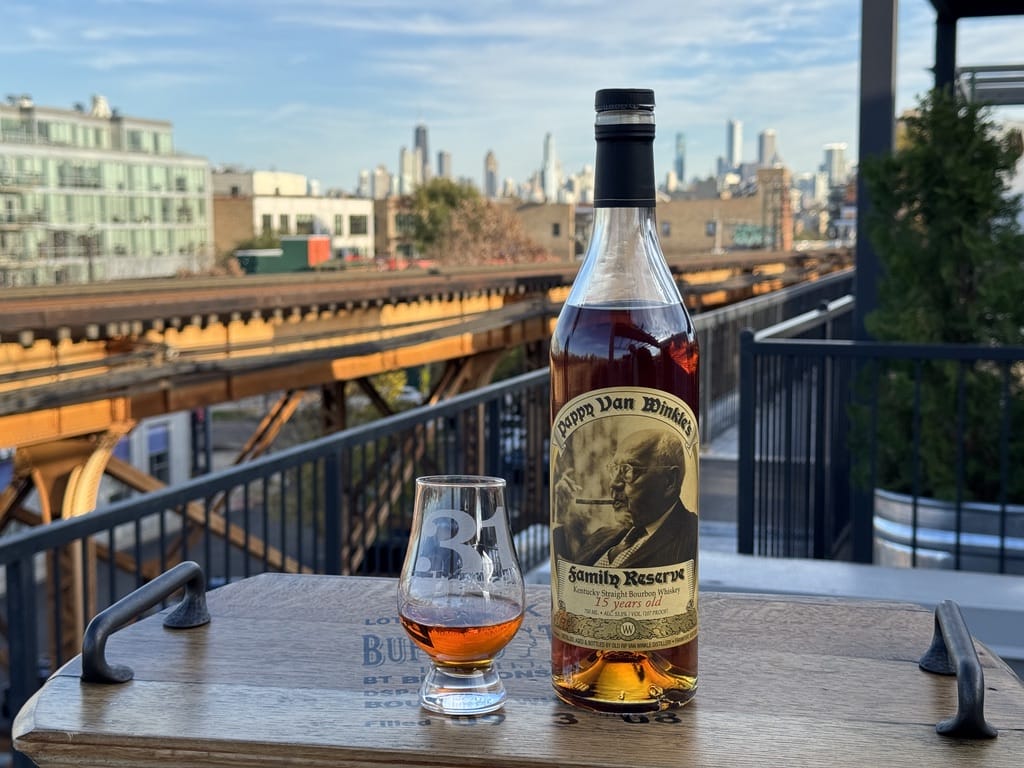
The first thing I notice about Pappy 15-year is a bouquet of sweet notes. There are hints of molasses, brown sugar, and vanilla — it almost reminds me more of a cola than a bourbon. Behind that initial sweet aroma, you can pick up a lot of rick oak from the 15 years spent aging in a heavily charred barrel. I also noticed some funky earthy notes that can be best described as the smell you get from a cigar lounge (i.e., rich leather loungers that have spent a lot of time with cigar smoke). I really appreciate the complexity of you get just from the nose of this bourbon.
The first flavor I can taste is that bold note of charred oak, with a little bit of funkiness from the barrel char and time that have worked their magic on the bourbon. It’s a very earthy bourbon, heavy on the oak with good depth and richness. Warm vanilla provides plenty of sweetness, and I’m also picking up a cherry note with hints of nutmeg to round out the flavor profile.
This drinks just like I would expect a wheated bourbon to. There is almost no burn with a symphony of flavors to enjoy.
The finish of this bourbon brings you back to that smokey leather flavor, evoking the warmth of a vintage study filled with well-worn books and aged furniture. I can imagine this is exactly where Pappy is sitting as he smokes his cigar in the bottle art.
On Ice
As we often talk about, adding ice to a bourbon often will change the flavor profile… and Pappy is no different.
The first thing I notice is a sharp brown sugar punch that comes to you at the very beginning of the sip. It’s surprising, since you could pick up some brown sugar aromas on the note, but none of that flavor really came through when taken neat. That said, there’s a surprising lack of sweetness, with less of the vanilla flavor coming through and just more of a warm richness to the profile.
The biggest change I’ve noticed is that a bright citrus flavor blooms after adding some ice — especially notes of lemon and lime that pairs very well with the brown sugar and that funky, oaky, earthy, leathery finish that adds so much depth.
This is great on the rocks, but not quite as complex as I originally saw things when taken neat.
How Pappy Drank It
There was a passage from Pappyland that stood out to me:
I love being with Julian or his son, Preston, in a bar that fetishizes bourbon. Sadly, I wasn’t there for the best bourbon-fetish bar moment.
Once, in New York, Preston leaned against a bar and ordered a Van Winkle how he drinks it, as Julian drinks it, as Julian Jr. and Pappy drank it: on the rocks with a twist. The bartender snootily told him he didn’t feel right serving such fine bourbon like that. Preston grinned. He paused, for dramatic effect, and then delivered the kill shot: “Well, sir, that sure is disappointing, given that’s how my grandfather and father taught me to drink it, and my family made the stuff after all. Hi, I’m Preston Van Winkle.”
After that, I had to try it the same way. I rimmed the glass with a strip of lemon rind, poured some bourbon over ice, and added just a splash of water.
The lemon twist does something magical to this bourbon and makes the citrus notes just pop. (Yes, I know it’s not magic, you’re just bringing more citrus to the tasting through your olfactory senses… but let’s just agree to call it magical.) It brings the citrus to the front and tempers some of that brown sugar punch I noticed when drinking it neat.
Not sure if it’s the water, the lemon zest, a combination of both, or something else entirely — but either way, you’re left with an incredibly smooth, phenomenal tasting bourbon. The citrus, sweetness, and funky earthiness are suspended in perfect harmony that has been captured in a glass.
Overall Rating
In Pappyland, Thompson writes about sharing a lot of whiskey with Julian III. He writes, “That’s what I learned in my years with the Van Winkle family: sharing this whiskey is intrinsically tied to the spirit with which the whiskey is selected and sold. Julian hates the hoarding of it, the price gouging of it, and not just because people pain him but because that’s not what bourbon was ever about anyway”. That message came back to me as I brought this bottle home – and I took it to heart, as I was able to share my first drink with one of my oldest and closest friends who happened to be visiting.
This is a delicious bourbon. I think it’s worth the steep retail price (at least for me — I would pay $200 for another bottle). However, it’s not worth spending several thousand dollars from an aftermarket seller. From an overall rating perspective, though, I am torn: there are some other terrific bourbons that are readily available for a price that would allow you to get two or three bottles for the price of one Pappy.
If we were only rating on the taste of the bourbon, this would be a 5-star bottle. However, here at 31W we try to look at the overall product and how it performs across multiple facets – including price point and accessibility… and that is why I have to take away a star. It’s disappointing that the average bourbon drinker will not taste this bourbon unless they shell out $80 or more for a 2oz pour.
| Pappy Van Winkle 15 Year Old Kentucky Straight Bourbon Whiskey Production Location: Kentucky, United States Classification: Straight Bourbon Whiskey Aging: 15 Years Proof: 53.5% ABV Price: $199.99 / 750 ml Overall Rating:   |

All reviews are evaluated within the context of their specific spirit classification as specified above. Click here to check out similar spirits we have reviewed.
Overall Rating: 4/5
It’s delicious, but even greatness can’t outshine the irony of being too rare for most to enjoy.
Great article
Sometimes people have to know their limitations. In my case, I know I couldn’t really appreciate all the supposed subtleties of this stuff (or of expensive wines, or gourmet foods, etc.).
I can tell the difference between the truly awful and the not-awful, but much beyond that and it’s all pretty much the same. For example, I’ve had Dom Perignon, but it didn’t strike me as that much better than any other decent champagne or even a good California sparking wine, like Chandon Brut.
And sometimes, the “experts” are limited in their expertise. I remember watching a cooking show about “Making the Ultimate Cheeseburger”. The chef had detailed instructions about selecting the meat, seasoning it, shaping the perfect patty, preparing the fire just so, flipping every umpty-ump seconds, cooking to an exact temperature, preparing the carefully-selected garnishes, and so on. Then he said, “Add the cheese…” and it was plain American cheese! What the heck? All that, just to top with a plastic, vaguely cheese-like substance? Just go order a Whopper, dude.
To each his own, I suppose. Luckily there are plenty of options! Thanks for your review.