
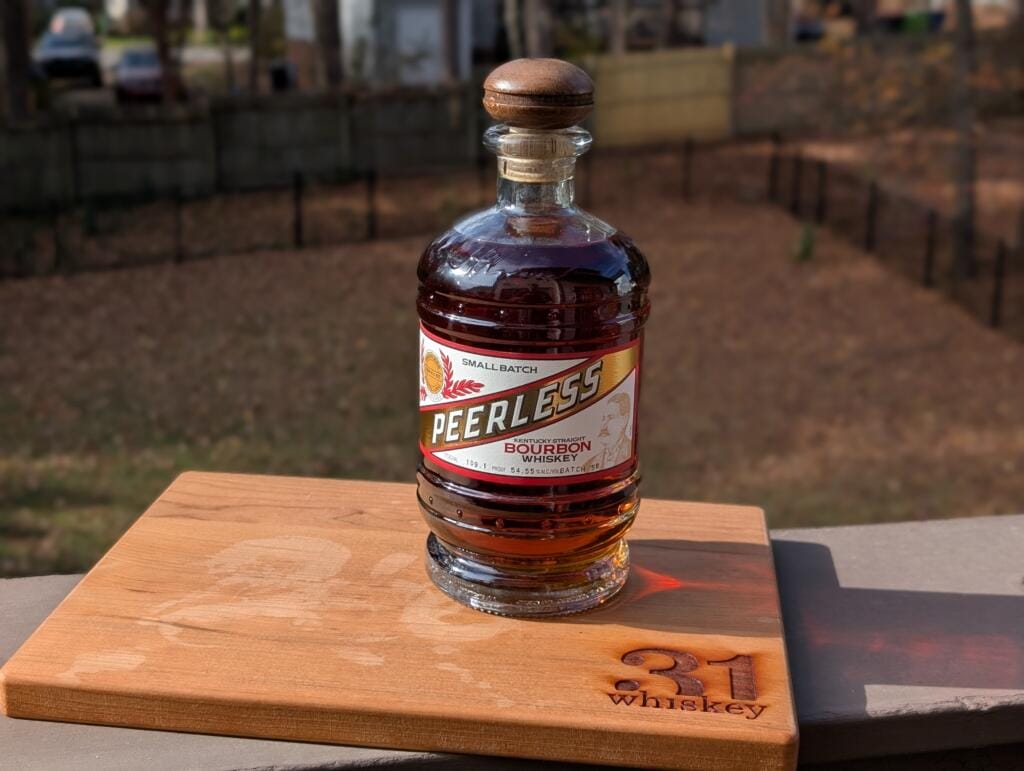
The whiskey boom of the early 2000’s saw the revival of a number of famous historical whiskey brands. Some were naked cash grabs trying to trade in on the past glory of a specific label, but a precious few seem to have been resurrected out of a legitimate love of the craft, and with the aim of doing something different and interesting. The folks at Peerless seem to be in the latter portion of that population, and today we’re checking out their Small Batch Kentucky Straight Bourbon.
History
With the extension of the rail line to Henderson, Kentucky in 1879, the region became a more attractive location for manufacturing businesses. (And naturally for Kentucky, whiskey distilling.) In 1881, two businessmen named Elijah W. Worsham and Capt. J.B. Johnston combined forces to open the E.W. Worsham & Co distillery in downtown Henderson, obtaining distillery license DSP-KY-50 (indicating that it is the 50th distilled spirits plant ever licensed in Kentucky). They produced a brand of whiskey under the name “Peerless” and created about 200 barrels of the stuff per year.
At the same time, a man named Henry Kraver was working his way towards destiny. Originally born in Poland in 1859, he moved with his family to the United States in 1863 and settled in New York City. He was industrious and hard working, starting his career selling newspapers on the street corner when he was seven years old. By the age of nineteen he felt the urge to strike out on his own, and decided to take his life’s savings and ride southbound on a riverboat for as long as his money lasted.
The riverboat finally kicked him out in Henderson, Kentucky as a penniless newcomer to the city. Legend has it that he walked into the first bar he saw, a bar named Puckett’s, where he offered to sweep the floors in exchange for being able to sleep in the attic.
While living in Henderson, he became friends with a wealthy family of bankers who helped him spend five years in St. Louis learning about finance before returning to Henderson where he would build the First National Bank in the city at the age of 32 — a business that would provide the economic engine that powered his rise.
Looking for local investment opportunities, Kraver started funding things like a tobacco warehouse and purchasing Puckett’s saloon where he first started sweeping the floors years earlier. In 1889, he purchased the Worsham distillery, a facility that in the meantime had seen middling success, and renamed it the Peerless Distillery. Through his investments Kraver expanded the facility to a new 50-acre location, producing 200 barrels a day, and supplying his spirits up and down the river through a fleet of riverboats that he also owned and operated.
Business was finally booming for Peerless… just in time for prohibition to kick them right back down. Kraver saw the writing on the wall and closed the facility in 1917, a full two years before prohibition would become the law of the land, using his existing stocks of whiskey and selling them to the two founders of Walgreens to be used as medicinal whiskey. The stills were sold, dismantled, and shipped to Canada for use by United Distillery in Vancouver.
Kraver would continue to have a successful business career, purchasing the Parmer House in Chicago where in 1937 he would have an unfortunate accident that would require the amputation of one of his legs and ultimately resulted in his death in 1938 from complications from that surgery. He was buried back in Henderson, Kentucky alongside his wife.
Fast forward to 2009. Corky Taylor, Kraver’s great grandson, has had a long career in finance and is looking forward to retirement. But life on a beach sipping fruity drinks doesn’t seem to suit the lifelong businessman. Instead, he reads the market and identifies that craft distilleries are a profitable and entertaining business, and decides to reach back into his own family history and revive the Peerless Distillery together with his son Carson.
The father and son team purchased a location in Louisville, and starting in 2014 set out to build a new distillery to honor that family tradition. They built brand new copper stills, designed their bottles, and together with their master distiller Caleb Kilburn perfected their whiskey recipe. They were even able to re-use the original license number from the original distillery (DSP-KY-50) as the license number for the newly reconstructed facility.
On March 4th, 2015, the first drops of newly made Peerless whiskey were placed into a charred oak barrel since production ended nearly a century earlier in 1917. The facility officially opened in June of that year, and in May of 2017 the first bottle of Peerless Whiskey rolled off the production line. Since starting production, their spirit has been named the best new whiskey, achieved many prestigious awards, and become a sought after spirit among collectors and aficionados.
Product
- Learn More: What Is Bourbon Whiskey?
Peerless is a true grain-to-glass distillery in Louisville, Kentucky. They import raw grains and turn that into finished bottles of whiskey, all on-site.
The specific grains that go into this bottle of bourbon aren’t disclosed — but since it’s a bourbon, we do know that at least 51% of the raw ingredients for this spirit come from corn. Those grains are milled, cooked, and fermented to create a mildly alcoholic liquid that can later be distilled through their copper column (or continuous) still.
Something interesting that the modern Peerless does is that they break with tradition when it comes to how to ferment their mash.
The original Peerless was a “sour mash” whiskey, meaning that some of the fermented mash from previous distillation runs would be re-used to kickstart the fermentation on subsequent batches of whiskey. This process helped ensure the right level of acidity and promote consistent yeast strains within the mash for a more consistent flavor, but also comes with a distinct flavor profile that requires a higher level of distillation to remove.
Instead, the modern Peerless is a “sweet mash” bourbon where fresh new lab-grown yeast is added to each batch of cooked grains. This consistent source of identical yeast isn’t something that was available when the original Peerless was operating and instead is a benefit of modern technology. This allows Peerless to distill their whiskey to a lower initial proof when coming off the still, a process which preserves many of the lighter and more complex flavors that you wouldn’t find in a sour mashed bourbon.
Once distilled, the spirit is placed into new charred oak barrels. Due to the lower than usual alcohol content, the water in the whiskey is able to absorb more of the flavors from these barrels over time and produce a different flavor profile than you’d normally see. The process is generally thought to create a higher quality spirit as a result — but since less actual alcohol is produced per barrel, the end result is a whiskey that is significantly more expensive.
Once properly matured, for this small batch version of their bourbon, Peerless combines a handful of barrels together and directly bottles the result. As such, this is a “barrel proof” whiskey straight from the tap — no watering down whatsoever.
Something to note is that this whiskey is not “chill filtered”. Much of the flavor in a whiskey comes from the amino acids and other fatty components that result from the yeast in the fermentation process, and these components can often make a whiskey look cloudy or come out of solution at lower temperatures. Chill filtering is the process of chilling the whiskey and then skimming these fats off the top of the liquid. Peerless doesn’t do that, instead leaving those flavorful elements in the spirit for you to enjoy. It’s just notable for those who might be wondering why their liquid looks cloudy when chilled.
Packaging
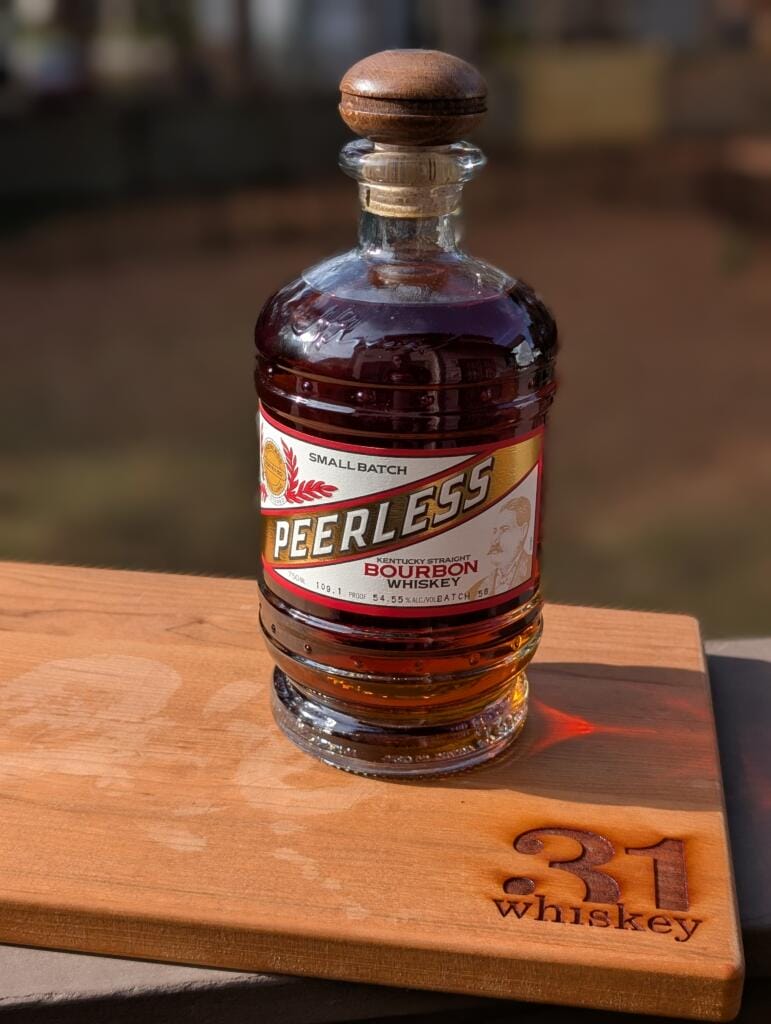
There are some aspects of this bottle that harken back to the history of the name on this distillery, but much of what we see is a modern creation from Carson Taylor (great-great-grandson of Kraver). Specifically, the glass bottle, which is a completely new design.
In general, the glass bottle appears to be designed to mimic the look of a bourbon barrel, complete with a bulbous belly, studded bands around the top and bottom, and a flared base. The neck on the bottle is short and squat, capped off with a wood and cork stopper. It’s a great visual cue for the spirit inside, since this is a “cask strength” whiskey that came straight from the barrel.
Around the outside is where the history picks up. The Peerless branding on the exterior of the bottle is done roughly in the same fashion as the historical branding, seen on liquor bottles from the pre-prohibition era and on stock certificates from as early as 1904 featuring a red banner diagonally placed across the bottle with the word “Peerless” inside. While the historical version simply had a white background and left it at that, this one has some additional embellishments and an illustration of Kraver himself in the bottom right corner.
Overall, it’s a great design. The beautiful liquid inside is clearly visible, the bottle is interesting to look at, and the branding takes some important cues from the original version that ties the history into this modern distillery.
Neat
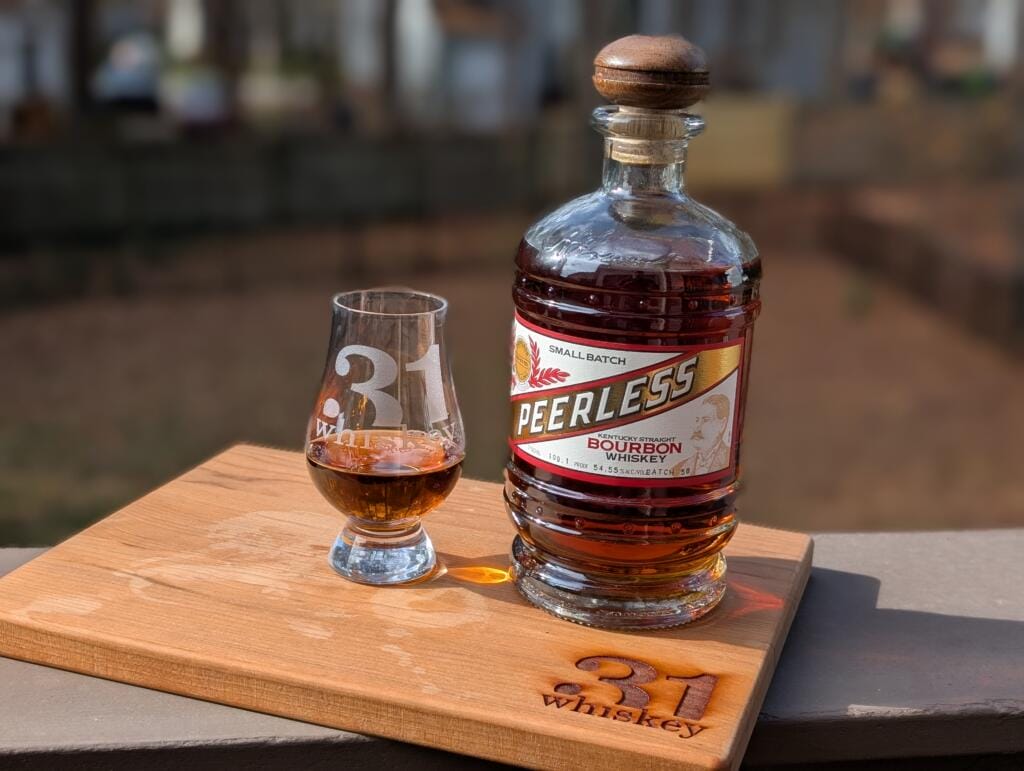
It certainly looks the part: the whiskey has a nice, deep amber color to it, significantly darker than other bourbons I’ve had recently.
The aromas coming off the glass are spot on for what I’d want in a good bourbon. Right up front I’m getting toasted brown sugar and vanilla with some caramel, all good standard bourbon notes, but there’s also some orange peel and citrus going on in the background that’s adding some complexity to the profile. I’m also picking up some hints of cedar chips and dried apricots that round out the experience.
I was honestly surprised by the richness of the flavor profile when I first took a sip. I think a lot of that has to do with the fact that this is a barrel proof spirit and has a higher alcohol content than usual, which does help to really “punch in” those flavors. It does leave some singing of the taste buds on the aftertaste initially, but those weaklings are quickly weeded out and following sips are significantly smoother.
The first thing I taste is a deliciously warm brown sugar reduction, with some vanilla sprinkled in — like a sauce that you’d put on top of a fine dessert, complete with cinnamon spice for some extra pizzazz. That quickly develops some orange peel citrus and cedar chips to provide a balance and an aromatic lift, before some dark chocolate gets added to the mix to bring it back down to earth. On the finish, I’m getting some black pepper spice and more vanilla, which provides a deliciously spicy texture that lingers for a bit after the rest of the flavors have died away.
On Ice
Usually, we see some significant degradation in the flavors of a bourbon once ice gets added to the mix. But that’s usually because the bourbons we’re trying are standard strength — 40% ABV. Mostly water. In this case, the whiskey starts out a little stronger, and I think that gives it a bit of an edge to retain more flavors than usual.
The syrupy brown sugar isn’t quite as luxurious as before, and there’s a bit more tartness to the profile, but it’s still sweet and delicious. I’m getting that toasted brown sugar, orange citrus, and dark chocolate all combined with some cinnamon and black pepper that should provide a nice base for some delicious cocktails in a moment here.
It isn’t unscathed, but it stands up better than most.
Cocktail (Old Fashioned)
When I say I like a richer, deeper version of an old fashioned, this is pretty damn close to what I’m looking for.
The elements that really make this a stand-out cocktail are the toasted brown sugar and dark chocolate, which provide just the right level of sweetness and some richer components to the flavor profile that help balance out the brighter bitters and their herbal components. In the background, I see the orange citrus trying to make an appearance — and while it doesn’t quite shine through the way I’d like, it does help accentuate any orange slices you might add to your drink.
I like it, but this could be better. If we added some dried fruits like apricots or figs to the mix, I think that would really make it perfect. But as-is, this is a wonderfully sippable old fashioned.
Fizz (Mule)
This isn’t the best mule I’ve ever had… but it’s pretty close.
Two things I’m looking for here in particular: first, that there’s a good balance between the flavors in the bourbon and the flavors in the bright and cheerful lime juice and ginger beer, and this has that in spades. It’s a richer, more well balanced cocktail that might seem more at home in a seedy cocktail bar than a pool deck, and honestly that’s my personal preference.
The second thing is some added texture and uniqueness that the spirit brings to the cocktail, usually in the form of black pepper spice from some rye content. I’m getting some hints of that spice coming through, but not nearly as much as if this were a rye whiskey instead of a bourbon (for example). It’s a good level for sure, but not knocking my socks off.
Overall, a delicious and enjoyable cocktail.
Overall Rating
Let’s start with the whiskey and work our way towards the branding.
Taken in a vacuum, this whiskey is phenomenal. Especially for a brand new distillery and a new master distiller, the flavor profile they have been able to pull of is remarkable. Using the sweet mashing process has allowed them to create something more flavorful and with a greater richness than other similar bourbons, and the end result is something that I’d be happy to sip neat or in a cocktail any day of the week. It’s a solid showing for sure.
Usually, this is the part of the review where I harp on the branding and complain that this isn’t the original distillery or the original recipe — but in this case, I think there’s enough of a connection to that history through the owners of the company that it makes sense. A modern version of the Peerless brand of whiskey, created by the descendants of the man who truly made it great, makes absolute sense for what this whiskey was all about even in its heyday. And especially in this case, I feel like there’s enough of the original brand identity coming through in the label that it feels consistent with that old line of whiskey.
This isn’t a case where a modern company is trying to resurrect the exact whiskey from a historical sample, or simply slap an old label on a new bottle of spirits. This really does feel like a brand that is trying to resurrect the vibe of the original company and recreate it in a way that would exist today, and in that sense I think they succeeded.
Compared to others in this same price range, it’s legitimately good. Better than Old Forrester. Better than Blanton’s. Not exactly peerless, but close.
| Peerless Small Batch Kentucky Straight Bourbon Whiskey Produced By: Peerless Production Location: Kentucky, United StatesClassification: Straight Bourbon Whiskey Aging: No Age Statement (NAS) Proof: 54.55% ABV Price: $79.99 / 750 ml Overall Rating:   |

All reviews are evaluated within the context of their specific spirit classification as specified above. Click here to check out similar spirits we have reviewed.
Overall Rating: 4.5/5
Deliciously sweet and complex, with rich flavors that make this amazing to sip neat or in a cocktail.