

When I was in Louisville, the AirBNB that we had rented was just around the corner from Rabbit Hole, but due to poor timing on our part, it was closed for all of the days we were there. Looking back on my notes, I was not very excited about the Rabbit Hole Cavehill I reviewed — but since I was gifted a bottle of Rabbit Hole Heigold to celebrate my recent engagement, I figured the universe was telling me to give it another shot.
History
Pardon the pun, but in 2012 Kaveh Zamanian decided to go down the rabbit hole and founded the aptly named distillery. Striving to create a product that stood out amongst the crowd, he gave up his career as a psychologist in order to create “modern whiskeys that challenge the status quo and offer a new vision of what an authentic whiskey can be”.
Using a unique mash bill for their products, Rabbit Hole is trying to redefine the category of a premium American whiskey. They also find innovative ways to enhance their grains through the use of culinary techniques:
The distillery has also built a reputation for finding efficiencies and innovations in production. They cook grains with the care of “culinary chefs,” after putting much time in the lab into discovering optimal set points in temperature holding, and other cooking components.
“We look at the grain-cooking process as a big part of flavor,” Zamanian says. “It’s actually the only proprietary part of our entire production. We have already established our fingerprints on our products just in the way that we cook our grains.”
It’s great to see a unique process and innovation happening in the Louisville, Kentucky area.
Product
- Learn More: What Is Bourbon Whiskey?
Rabbit Hole Heigold is the high rye bourbon mashbill from Rabbit Hole, with 70% corn, 25% malted rye, and 5% malted barley making up the mixture. The grains area all milled and cooked into a sugary liquid which is then fermented and distilled before being placed into new charred American oak barrels for a period of no less than two years.
The distillery takes pride in the fact that they don’t “chill filter” their whiskey. Chill filtering is a process which removes excess fatty acids and other impurities prior to bottling, which some distilleries use to make a clearer looking spirit that won’t get cloudy when some ice is added, but Rabbit Hole seems to be favoring flavor over appearance.
This bourbon pays tribute to Christian Heigold, a German immigrant who settled in Louisville Kentucky. His profession of being a stonecutter made him a naturally popular resident of the area, but he quickly became known for his ingenuity and craftsmanship. He built his home in 1857 during a period of unrest and violence leading up to the American Civil War, and to prove his patriotism (and hopefully protect the house) he carved intricate and ornate visions of the American founding fathers and other American notables into the facade. The building was so beautiful that, even after most of it was demolished, the facade was preserved and moved to a local park where it has become a historical landmark.
Packaging
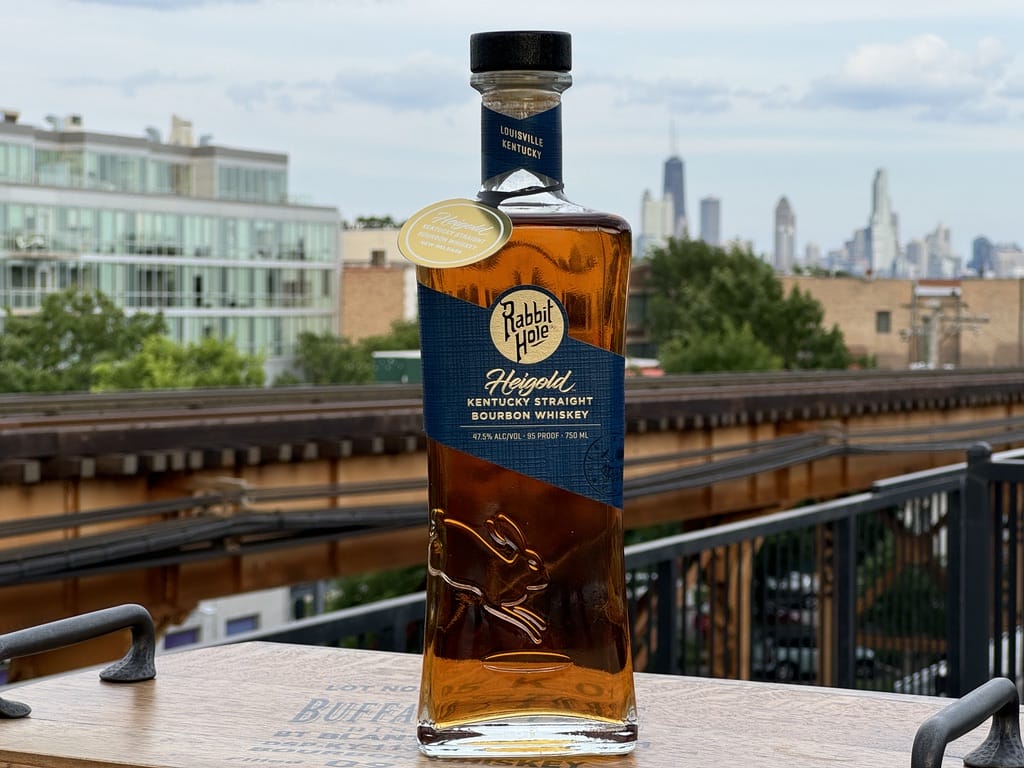
The bottle is eye catching — the 750 ml bottle is tall and rectangular with slight inward curves, and embossed on the lower front of the bottle is a rabbit jumping into a hole (seemingly encouraging you, the drinker, to follow).
The label looks like a blue sash draped diagonally across the bottle, with gold lettering spelling out the name of the distillery and variety. The neck is wrapped the same black label with the location of the distillery (Louisville, Kentucky) at the same diagonal as below, and the whole thing is capped with a synthetic cork stopper.
This bottle would look great at both a home bar or on a bar back. I especially appreciate that the burnished copper spirit shows clearly through the bottle, since the labels are only big enough to be seen but not big enough that they obscure the contents..
Neat
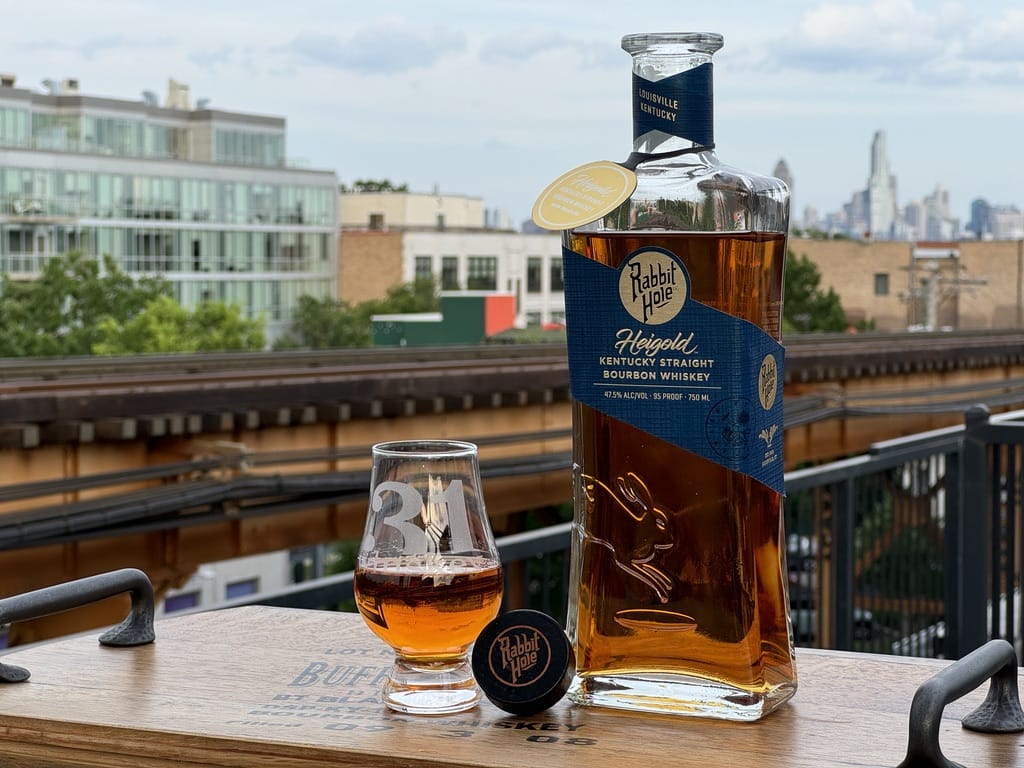
This is a surprisingly citrus-y aroma, with orange and lemon citrus making up the bulk of what I’m smelling. Supporting that are hints of cardamom and some very faint black pepper spice. Despite the vibrant aroma coming from this whiskey, there is very little sweetness that you can pick up.
Interestingly, the citrus forward characteristics from the aroma translate directly into the flavor — orange and lemon citrus are the very first flavors I pick up as soon as I take a sip. There are some notes of baking spices, along with a very dull toffee, but the citrus is what I notice the most. On the finish, there are hints of rich oak, and very minor hits of heat.
Alongside the baking spices, there are also some minor notes of sweetness. The best part about this bourbon is that there is little to no burn — it’s smooth from start to finish.
Overall, the most surprising thing is the utter lack of sweetness. Most bourbons with a 70% proportion of corn in the mashbill I would expect to lead with a very sweet forward profile.
On Ice
Right off the bat, the oak really comes out to play when adding some ice.
This isn’t uncommon — the flavors from the distillation process (typically lighter, sweeter notes) have a tendency to be removed from the equation when a bit of ice gets added to the glass. What’s often left behind are the maturation flavors, typically oak related and richer in character. And since there aren’t any harsher elements, the whole experience starts to mellow out.
You still have the orange and lemon flavors, but you get a lot more of the black pepper and cardamom. Still… there is minimal sweetness in this whiskey. This whiskey is as bitter as my black heart (although I’d like to think my fiance would argue that analogy).
Cocktail (Old Fashioned)
This is a good old fashioned. The sugar finally brings some much need sweetness that the bourbon was lacking, meaning that this cocktail is well balanced and the flavors are not out of whack one way or the other.
The sweetness bolsters everything, while the bitters and orange bring some depth to the bourbon. I am not sold on the use of this specific bourbon for this — it’s good, but not great.
To be fair, if you’ve read other reviews I’ve done, I am always critical of how to use a good bourbon to make cocktails. Sometimes, a $20 bourbon is all it takes, other times a $200+ bottle can make a cocktail that is life changing. In this case, a $70 bottle of bourbon results in a passable cocktail.
Is it good? Absolutely. Do I recommend using it this way? Absolutely not.
Fizz (Mule)
I could copy / paste the entire old-fashioned section here (but I won’t because our editor would yell at me). It’s good… but good is not enough when reviewing a more expensive bourbon.
Just like in the old fashioned, I know there is bourbon in the drink — but what I distinctly taste is the mixer. While the bourbon does not completely collapse under the bright effervescence of the ginger beer, you can definitely tell that it is wavering.
This is not a bad use of the bourbon, per se, but it’s not the best.
Overall Rating
While not a bourbon you want to use in a cocktail, this bottle has a very distinct flavor profile. The flavor neat and on the rocks is enough to warrant a taste, but it’s very middle of the road when it comes to whiskey.
Rabbit Hole is a newer Kentucky distillery on the scene, but every bottle of theirs we’ve reviewed has been a three-out-of-five-star, very average rating — and this bottle didn’t prove to be the exception. Consistently solid but average isn’t bad… but it isn’t anything to get hyped about, either. There seems to be a minor increase in quality as price increases, but it might be apt to wait until their process (and product) matures a little more.
| Rabbit Hole Heigold High Rye Double Malt Kentucky Straight Bourbon Whiskey Production Location: Kentucky, United States Classification: Straight Bourbon Whiskey Aging: No Age Statement (NAS) Proof: 47.5% ABV Price: $69.99 / 750 ml Overall Rating:   |

All reviews are evaluated within the context of their specific spirit classification as specified above. Click here to check out similar spirits we have reviewed.
Overall Rating: 3/5
New and shiny distilleries cannot overcome the basic need for great quality of higher end spirits.