
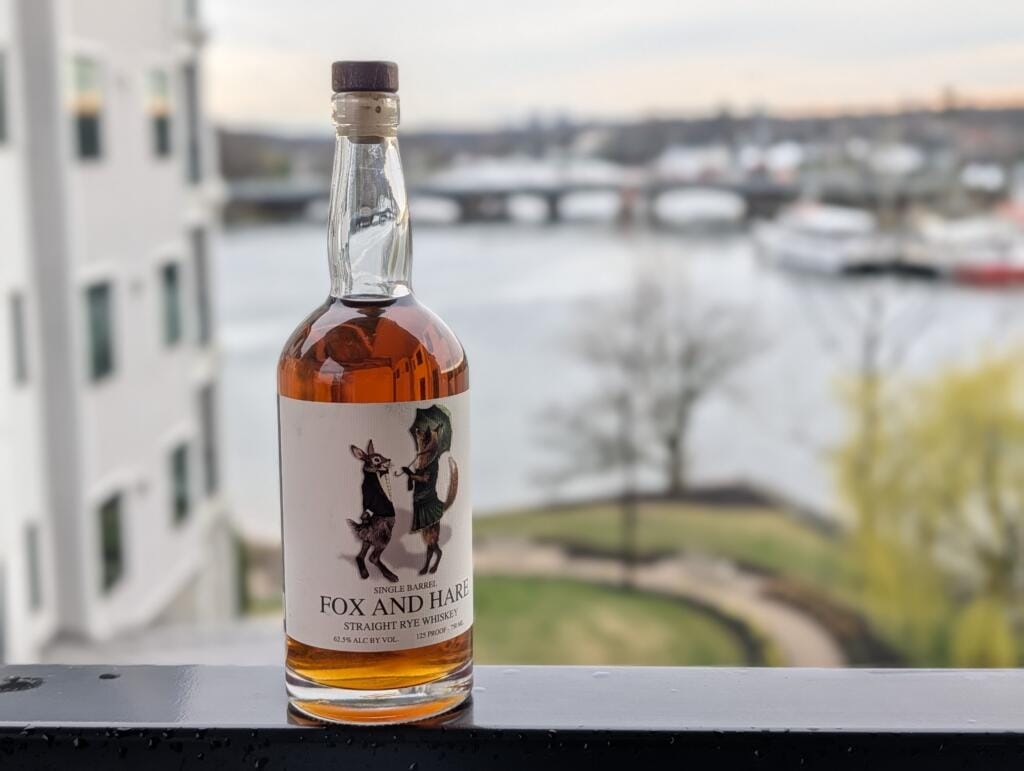
I have this argument with my wife quite frequently: where, exactly, is the line for “upstate” New York? Growing up in Westchester County, my opinion was that anything north of White Plains qualified. Her Orange-County-based-opinion put the line further north. But no matter where your version of that line is… you can feel the difference. Driving north on the Taconic State Parkway, the landscape shifts from manicured lawns to rolling farmland, stone walls, and thick canopies of oak and maple. It’s always beautiful, but nobody — nobody — was thinking about whiskey up there when I was growing up. New York made pizza and BECs, not bourbon and rye.
But that has changed dramatically, something that we’ve been lucky enough to sample and catalog along the way. As of April 2025, New York State is home to 239 licensed craft distillers, an explosion that traces back to the Farm Distillery Act of 2007, which created an accessible licensing path for small agricultural producers. The Hudson Valley, in particular, has become a hotbed: the same farm-to-table ethos that transformed the region’s food scene has migrated to spirits. And sitting right in the middle of that movement, on 113 acres of old beef farmland in Stanfordville, Dutchess County, is Taconic Distillery.
I’ve had my eye on Taconic Distillery for a few years now. Their Fox & Hare Single Barrel Rye, in particular, has been on my “I need to get around to that” list for longer than I care to admit. Well, I finally got around to it — and I’m glad I did.
History
The distillery story starts, as many second-act stories do, with a man who had grown wealthy but disillusioned with the world of finance. Paul Coughlin and his wife Carol Ann had spent years raising three daughters in Greenwich, Connecticut, while Paul built his career in the investment world. But Paul was always an outdoorsman at heart, and for years he’d been making regular trips up to Dutchess County as a member of Tamarack Preserve, a hunting and fishing club on the Millbrook-Amenia border. In 2010, when the Coughlins went looking for property within a ten-mile radius of the preserve, they found 113 acres of a former beef farm in Stanfordville, NY, and purchased it. They named it Rolling Hills Farm and initially used it as a weekend and holiday retreat.
But the Coughlins weren’t the type to sit on 113 acres and do nothing with them. Carol Ann has said the goal was simply to start a business — and the specific inspiration came from New York’s Farm Distillery Act, originally passed in 2007 and supercharged by the Craft New York Act in 2014, which created an accessible licensing path for agricultural producers who wanted to distill spirits using New York-grown ingredients. With their farm, a passion for the outdoors, a love of bourbon, and the particular brand of fearlessness that comes from having successfully navigated Wall Street, the Coughlins got their Farm Distillery license and got to work.
Paul has been refreshingly honest about how little he knew going in. By his own account, he entered the spirits industry with little more than a vague idea and had to learn everything from scratch: distillation, sales, water mineral content, social media marketing, branding, distribution — even how to operate a forklift. The hardest part wasn’t any of that, though. It was walking away from a stable career and a steady paycheck to take on sizeable risk in an industry he’d never worked in.
The operation, originally called Millbrook Distillery, bottled its first batch of Dutchess Private Reserve Bourbon in October 2013. They were working out of a 600-square-foot barn, bottling by hand, and Carol Ann was literally going door-to-door selling to bars, restaurants, and liquor stores in Dutchess County. By 2014, they’d rebranded to Taconic Distillery (named for the Taconic Mountains, a subrange of the Appalachian Mountains that runs along New York’s eastern border) and were already collecting accolades: Best New Bourbon from Hudson Valley Magazine, Best Bourbon from Maxim, and a win in a CBS Radio taste test. They also earned a 90.5 from Jim Murray’s Whisky Bible for their Founder’s Rye Whiskey.
The growth since then has been considerable. That 600-square-foot barn has been replaced by a 5,000-square-foot facility with a continuous column still built by Vendome Copper & Brass Works out of Louisville, a full bottling line, a cozy year-round tasting room, and an expansive patio overlooking rolling Dutchess County farmland. They now produce over ten bourbon blends plus a growing rye portfolio, distribute across a dozen-plus states with a strategic focus on the Northeast, and remain one of the biggest employers in Stanfordville.
What drew Paul to bourbon specifically was the region’s deep connection to the spirit. The Hudson Valley’s relationship with whiskey stretches back centuries — from George and Martha Washington’s home during the American Revolution, through the Great Estates of the Vanderbilts, Roosevelts, and Rockefellers, to the hunting preserves and horse farms that dot the landscape today. For a man who was already spending his weekends at a Hudson Valley hunting preserve, making bourbon on a farm down the road was less a pivot and more a natural extension of who he’d always been.
The Fox & Hare name itself is an ode to both the outdoors and American history. The Coughlins’ foxhound, Copper (named after the color of their bourbon and rye) is a nod to the American foxhound’s colorful role during Prohibition. When the Volstead Act went into effect in 1920, bootleggers trained foxhounds to howl when government agents approached their illegal stills. The dogs became four-legged early warning systems, and the foxhound is credited with bringing the phrase “Man’s Best Friend” to the New World. Taconic leans into that heritage with evident pride — and the Fox & Hare Single Barrel Rye, drawn from the distillery’s oldest barrels, is described as a whiskey meant for sharing with friends and family.
Product
The Fox & Hare Single Barrel Straight Rye Whiskey is drawn from Taconic’s oldest barrels. The mash bill is 95% rye and 5% barley, which is a high-rye recipe that puts it in the same territory as well-known ryes from MGP and others. It’s aged a minimum of six years in new charred American Oak barrels — specifically: Char 3, Cooper’s Select, 53-gallon Independent Stave Company barrels. The “single barrel” designation means each bottle comes from one individual barrel, so there will be some variation in flavor and appearance from barrel to barrel.
Taconic does not chill filter their whiskey, which is a deliberate choice to preserve flavor. Chill filtering is a process where the alcohol is cooled to allow the fat content to rise to the top and be skimmed off, something that produces a spirit that is more visually clear, but less flavorful. They note as a result that their whiskey may occasionally appear cloudy, which they view as proof that they’ve “imparted as much flavor to the whiskey as possible.” They also distill below 160 proof to retain more of the grain character — a lower distillation proof means more congeners and flavor compounds make it into the final product.
This particular expression is bottled at a muscular 125 proof (62.5% ABV), close to “barrel strength” for some other brands.
Packaging
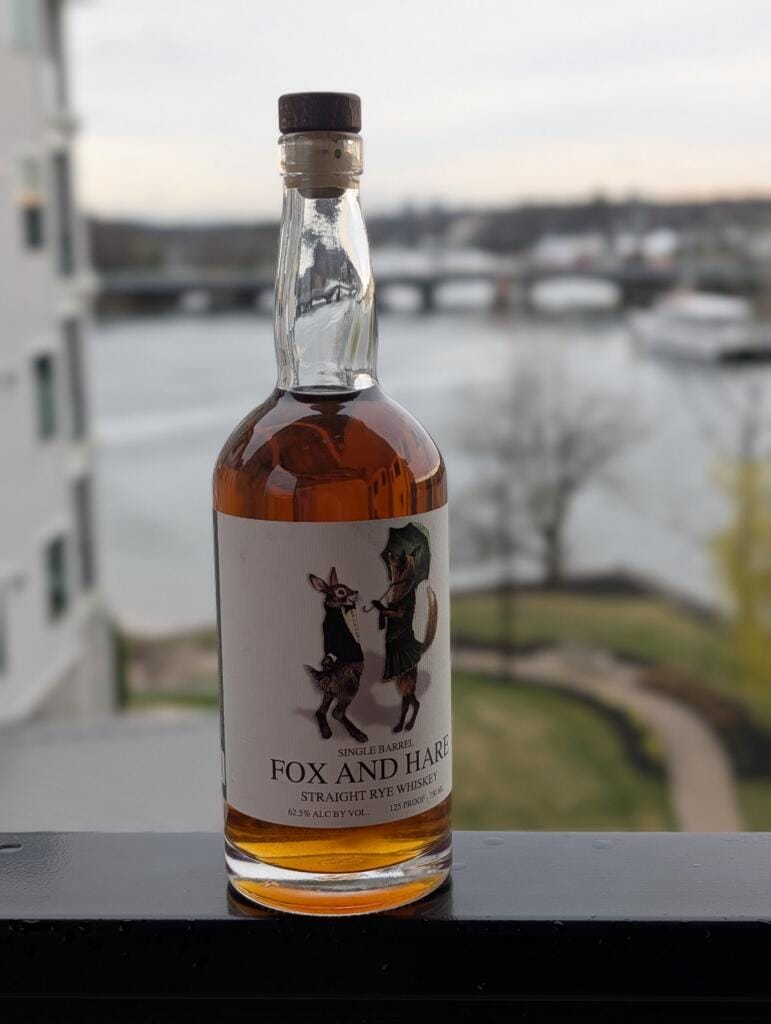
The bottle is a standard 750ml shape – nothing fancy, nothing to write home about. It’s a clear bottle with a label that, while large, still has some space at the top and bottom for the whiskey to shine through. The result is that it manages to maintain a clean appearance but still allow that gorgeous rusty amber liquid do the talking. And talk it does — the color is striking, a deep copper-amber that looks like liquid autumn.
The label’s centerpiece is a storybook-style illustration of the Fox and the Hare, with both characters standing upright in very proper evening attire, facing each other as if mid-conversation. It’s charming and a little irreverent, evoking the look of old Aesop’s Fables engravings more than anything you’d expect on a barrel-proof rye. The imagery is a nod to the Coughlin family’s deep love of the outdoors and to the American foxhound’s storied role in the history of American spirits. It’s the kind of label that catches your eye on a shelf and makes you pick it up to look closer — which, for an $80 bottle from a small Hudson Valley distillery competing for attention, is exactly the point.
Neat
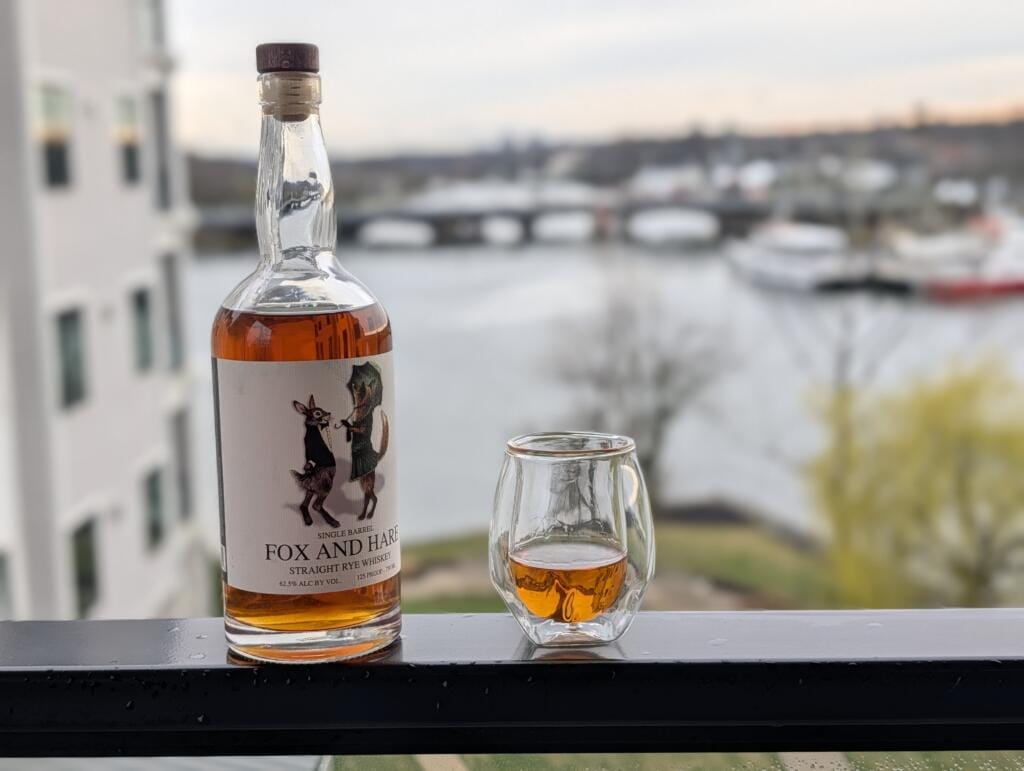
The nose on this rye is inviting and rich. Brown sugar leads the charge, followed closely by toffee and caramel, making for a sweet, dessert-like opening. Behind it comes orange peel citrus, bright and distinct, and then a deeper, richer caramel note underneath that adds gravity to the whole aromatic profile. For a 125 proof whiskey, the nose is remarkably gentle. You’d expect ethanol heat to punch you in the face, but it simply doesn’t.
The first sip delivers brown sugar and vanilla up front, then the rye spice makes its entrance: black pepper, assertive but not aggressive, creating a sweet-and-peppery interplay that’s genuinely enjoyable. There’s a tingle on the tongue that lingers after the finish — a pleasant heat that reminds you this is a barrel-proof spirit without ever crossing into roughness. That’s the remarkable part: even at 62.5% ABV, there is no roughness. None.
The orange citrus that was so prominent on the nose recedes here to just a whisper of it, but what takes its place is something better: a dark chocolate finish that anchors the entire experience. It’s a richer, deeper note that provides a foundation for the rest of the flavor profile, ensuring that the sweetness and spice don’t float away but instead sit in a fully saturated, complete package.
On Ice
Here’s where things get interesting, and where this rye defied my expectations. Normally, ice tones things down — it mutes big flavors and simplifies the profile. With the Fox & Hare, though, ice somehow makes it deeper. The whiskey becomes sweeter and richer on the rocks. Browned caramel and vanilla come forward more prominently, the black pepper remains but becomes a supporting character, and a new note appears: apple. Not tart green apple, mind you… no, this is more akin to a gala apple. It’s a flavor I didn’t detect at all when I was sipping this neat, and it’s a welcome surprise.
The most notable change, though, is the dark chocolate. On ice, it goes from being a finish note to being woven throughout the entire sip. It’s more pronounced, more persistent, and it gives the whole experience a richness that is genuinely surprising for a spirit that’s been diluted by ice.
This doesn’t happen often. Most whiskeys get thinner on ice, but this one got fatter.
Cocktail (Old Fashioned)
Rich and delicious. That’s the short version.
The longer version: the orange citrus flavors that were restrained when sipping neat come roaring back in the Old Fashioned, amplified by the aromatic bitters in a way that feels like the cocktail was specifically designed for this whiskey (or, more likely, that this whiskey was specifically designed for this cocktail). There’s an excellent balance here where the dark chocolate note from the rye interacts beautifully with the bitters, creating a deep, complex backbone, while the brown sugar and vanilla provide sweetness without cloying.
This is a textbook Old Fashioned. The kind where you take a sip, close your eyes, and wonder why you ever drink anything else.
Fizz (Mule)
The mule is where I expected this rye to struggle — ginger beer and lime juice can overwhelm a lot of whiskeys, especially ones with subtle flavor profiles. But the Fox & Hare’s dark chocolate character turns out to be the perfect counterweight to the brightness of ginger beer and the tartness of lime. It’s a balancing act that works beautifully. The brown sugar and vanilla sweetness cuts through the fizz clearly, and the result is refreshing, delicious, and surprisingly complex for a mule.
This isn’t a cocktail where the mixer dominates, as is so often the case with a Kentucky Mule. Here, the rye holds its own and contributes something meaningful to every sip.
Overall Rating
This is an excellent rye whiskey, full stop. What makes it exceptional is its consistency across formats. Neat, it’s complex and approachable despite the barrel-proof strength. On ice, it actually improves — a rare feat. In an Old Fashioned, it shines. In a mule, it holds its own. Try as I might, I can’t seem to find a bad way to drink this whiskey.
At roughly $80 for a 750ml bottle, it’s not cheap… but it’s a single barrel, barrel-proof, six-year-aged straight rye from a small New York distillery. In that context, the price is fair. You’re paying for genuine craft, New York-grown ingredients, and a product from a family-run operation that is clearly doing things right. For anyone in the Northeast who cares about supporting local spirits (and especially for anyone who, like me, grew up in the shadow of the Hudson Valley without ever imagining that world-class whiskey would be made there) this bottle is worth seeking out.
| Taconic Distillery Fox & Hare Single Barrel Rye Whiskey Produced By: Taconic Distillery Production Location: New York, United StatesClassification: Straight Rye Whiskey Aging: 6 Years Proof: 62.5% ABV Price: $80 / 750 ml Overall Rating:   |
Overall Rating: 4.5/5
A barrel-proof rye from the Hudson Valley that gets better the more you throw at it. The fox and the hare are both winning this race.