
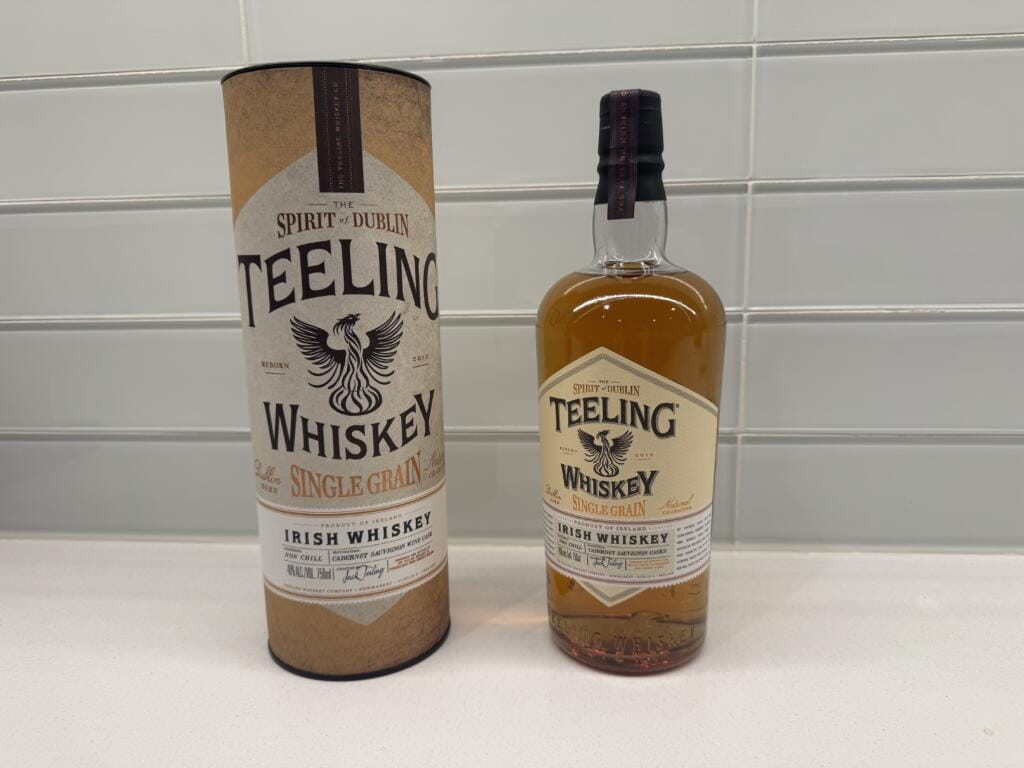
For those who live outside the great city of Chicago, you may not realize that we celebrate St. Patrick’s Day twice. Sure we break out the whiskey on the day itself, but the city also tends to jump the gun and have its full-blown celebration on the Saturday before the 17th. That’s the day when the city goes a bit nuts — they even go so far as to dye the river green for the holiday. This year, the city’s exuberance even got me in the St. Paddy’s spirit, so I decided to pick up a bottle of Single Grain Irish Whiskey from one of my favorite Irish Distilleries, Teeling. Sláinte!
History
The Teeling name was first associated with a Dublin distillery in 1782, when Walter Teeling opened a small operation in the Liberties area of Dublin. At its peak, there were 37 distilleries operating within the city, most of which were concentrated in this area (which became known as the “golden triangle” for the beautiful liquid it produced).

Eventually, this distillery was purchased by William Jameson (related to the more famous Irish whiskey legend John Jameson) to expand his much larger Marrowbone Lane Distillery. The facility was once considered one of the “big four” distilleries in the city, but with the economic downturn of the 1920’s and the introduction of prohibition in the United States, there simply wasn’t enough demand left to support their business. After trying to struggle through for a few years, the facility (including the Teeling distillery) would eventually close in 1923.
In the late 1980’s, John Teeling, a descendant of Walter’s, opened up another facility called Cooley Distillery. This is where the current owners of the new Teeling Distillery come into the picture: Jack and Stephen were introduced to the process by their father John. They ran the Cooley Distillery until 2011 when it was sold to Beam Suntory. Not wanting to fully exit the whiskey space, during negotiations of the sale of their facility, the Teelings were able to reserve 16,000 casks of aged whiskey for themselves — a supply which would be used to jumpstart the new Teeling Whiskey in 2012.

The brothers opened the Teeling Whiskey Distillery in Newmarket Square — the first new distillery in Dublin in over 125 years, and just a short walk from the original family site on Marrowbone Lane. The phoenix on every Teeling bottle captures it perfectly: a family, and a city’s whiskey tradition, risen from the ashes. If you ever happy to find yourself in Dublin, this is a must-do tour.
In late 2023, Bacardi Limited took majority control of the business.
Product
- Learn More: What Is Irish Whiskey?
The Teeling Single Grain Irish Whiskey takes a big step away from the traditional Irish whiskey formula. Rather than using a mash bill found in many Irish distilleries (50% malted barley and 50% unmalted barley), this whiskey takes a page from its American bourbon brothers and uses a mash bill of 95% corn and only 5% malted barley. In theory, this should give the whiskey a much sweeter flavor profile compared to its ancestral version.
The process for making malted barley starts by taking a bunch of barley grain, soaking it in water, and allowing it to partially germinate — this naturally starts releasing enzymes that convert the starchy portions of the grain into sugar. That release of enzymes helps the corn and the rest of the barley to convert their starches into easily fermentable sugars after being ground, added to some warm water, and cooked for a bit to create the initial wort. This wort is then added to the wooden washback tubs where the mixture is heated, and yeast begins to convert sugars to alcohol.
The mildly alcoholic yeasty soup is then added to a series of three pot stills, where it is eventually distilled three times in order to selectively capture the flavor of the spirit and concentrate the alcohol in the liquid.
For finishing, this spirit is aged in a French oak barrel that has previously been used to store some Cabernet Sauvignon wine. For all Irish whiskey, the spirit must be aged for at least three years and all aspects of production must be completed on the island of Ireland… but they never said anything about using fresh barrels! For this specific version of the spirit, there is no age statement — so while we have a good idea about the minimum age of the spirit, we don’t really know how old it actually is.
Packaging
This bottle comes packaged in a cardboard tube, which is very common in higher-end Irish and Scottish whiskey. The protective tube is meant to convey luxury and makes the whiskey immediately more gift-able while also protecting the liquid inside from oxidizing due to exposure to light. For me, these tubes do nothing… but I can understand why some people see an appeal.
The bottle itself is fairly standard within the Teeling products. It’s an average sized round bottle with a very sharp shoulder and medium length neck, sporting a small bulge to help make controlling your pour easier. The bottle is capped with a wood and synthetic cork stopper that is wrapped in black foil.
One of the other Teeling products that I’ve reviewed (Teeling Single Pot Still Irish Whiskey) comes in a black glass bottle, which looks great but prevents you from seeing the whiskey inside. I am glad to see that this bottle is clear, letting us take a gander at the gorgeous light golden whiskey on the inside.
The label is one part of the bottle that I really appreciate. They really lean into their status as the first distillery back to Dublin, with the phrase “Spirit of Dublin” in big bold text right at the top — even standing above the name of the distillery. In addition, the logo is a Phoenix that is emerging from a pot still much like this distillery is revitalizing Dublin.
Neat
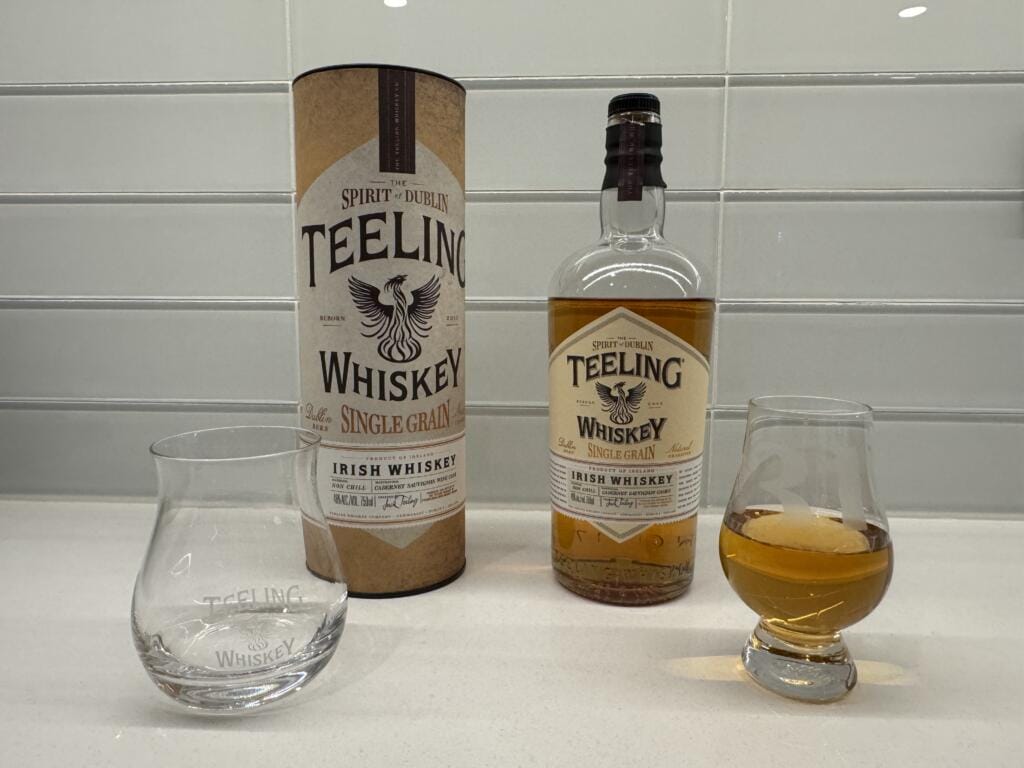
This whiskey has a very soft and mild aroma, similar to other Irish spirits, but you do pick up a lot of sweetness and a very slight scent of oak that is unexpected and pleasant. Everything is very soft — you really have to get in your glass with your nose to pick up some of the scents.
The first sip really showcases that 95% corn. It is noticeably sweet, with a nice caramel and toffee flavor, but not overly sweet — which bodes well for making an Old Fashioned (too much sugar could have caused havoc!)
Beside the sweetness, you can pick up notes of apple, grape, and raisin. I feel like the fruit-forward flavors must be imbued from the Cabernet Sauvignon barrel, which is giving it a strong wine flavor profile. Rounding things out with this whiskey, there is an earthy finish and a hint of cinnamon with almond or anise flavor at the end.
I really like this neat, and I am surprised that I do. When I drink whiskey neat, I tend to lean toward high rye bourbons as I enjoy the more spicy flavors. I’ll admit this is a flavorful, smooth, and easy drinking whiskey that is out of my normal space… and yet I’m here for it.
On Ice
Surprising to probably no one, putting this whiskey on the rocks kills any of that soft and subtle aroma it was putting off before. However, it does seem to open up a more complex flavor profile in the actual taste of the spirit.
The sweetness is still the most prominent flavor, but it’s changed. Rather than having a caramel or toffee note at the front leading the charge, the fruit flavors seem to be the source of the sweetness. It reminds me of a berry compote that is served on top of crème brulee. If there is a dessert whiskey, this might be it.
As you may expect given that description, the fruit flavors are bolder than before. You can pick out individual apple, strawberry, and grape notes, and still get some of the star of anise flavors on the finish — but you lose some of the earthiness and cinnamon spice.
Often, drinking a spirit on ice can cause some of the more delicate flavors to take a back seat, and it just becomes a pale version of itself. But this is almost like drinking a new whiskey.
Cocktail (Old Fashioned)
I’ve never had bitters with sugar water, but I imagine this is what it would taste like.
The Old Fashioned is supposed to be a vehicle for the whiskey — the sugar and bitters are there to complement and frame what’s in the glass, not to bulldoze it. Sadly, though, bulldozing is exactly what happens here. The moment the Angostura and simple syrup enter the picture, every one of those delicate fruit notes from the cab casks just… vanishes. The light, silky texture that made this so interesting neat? Gone. What you’re left with is a vaguely sweet, vaguely bitter drink that could have started life as almost any whiskey — or honestly, no whiskey at all.
I’m not entirely surprised. A lighter, fruit-forward grain whiskey was always going to be a risky candidate for an old fashioned. Save this one for the neat glass. The old fashioned will still be there for a whiskey that actually wants to fight back.
Fizz (Mule)
If you read our reviews regularly, you already know I’m not exactly a mule evangelist on the best of days. But I try to give every whiskey a fair shot, and so into the ginger beer it went.
It was just as bad as I expected. Worse, actually.
At least with the Old Fashioned there was a faint ghost of the original whiskey haunting the glass. I couldn’t pick out the individual notes of the whiskey, but I could at least tell there was something related to whiskey in my glass. The ginger beer doesn’t leave even that. If the Old Fashioned bulldozed, the ginger beer completely steamrolls everything — the fruit notes, the cab cask character, all of it — and what you’re left with is a glass that tastes like it only has ginger beer in it.
The Teeling Single Grain is a whiskey that thrives on subtlety. Subtlety and ginger beer do not get along. Don’t do this to yourself, or to the whiskey.
Overall Rating
Teeling Single Grain retails around $50, at that price point, you’re competing with some serious bottles, so the question becomes whether the novelty of the Napa cab casks justifies the spend. I think the answer is a qualified yes… but with one very important caveat that I’ll get to in a moment.
This is a sweeter whiskey, which is not for everyone. The corn base and the red fruit influence from those cabernet barrels push it firmly in that direction, and if you prefer something drier or peatier, this probably isn’t your bottle. But if you can meet it on its own terms, there’s a lot of personality here. The casks aren’t a gimmick — they’re genuinely doing the heavy lifting, and the result is something that stands apart from virtually everything else on the Irish whiskey shelf. Think of it as the Angel’s Envy of the Irish whiskey world.
Now, that caveat: do not put this in a cocktail. I mean it. The old fashioned was a disappointment, and the mule was an outright disaster. The same delicacy that makes this whiskey so interesting neat is exactly what destroys it the moment you introduce ginger beer or Angostura bitters. This is a neat pour, full stop. If you’re someone who primarily drinks whiskey in cocktails, I’d point you somewhere else entirely and save you the $50.
Is it a go-to? Probably not for most people. It occupies a specific mood and palate: when you want something light, a little fruit-forward, and a little different. On those evenings, it’s exactly right and done exceptionally well. Just don’t expect it to replace whatever is sitting in your regular rotation.
| Teeling Single Grain Irish Whiskey Produced By: Teeling Production Location: IrelandClassification: Whiskey Aging: No Age Statement (NAS) Proof: 46% ABV Price: $50 / 750 ml   |
Overall Rating: 4/5
Turns out the best thing to come out of Napa isn’t wine… it’s the barrels they leave behind.