
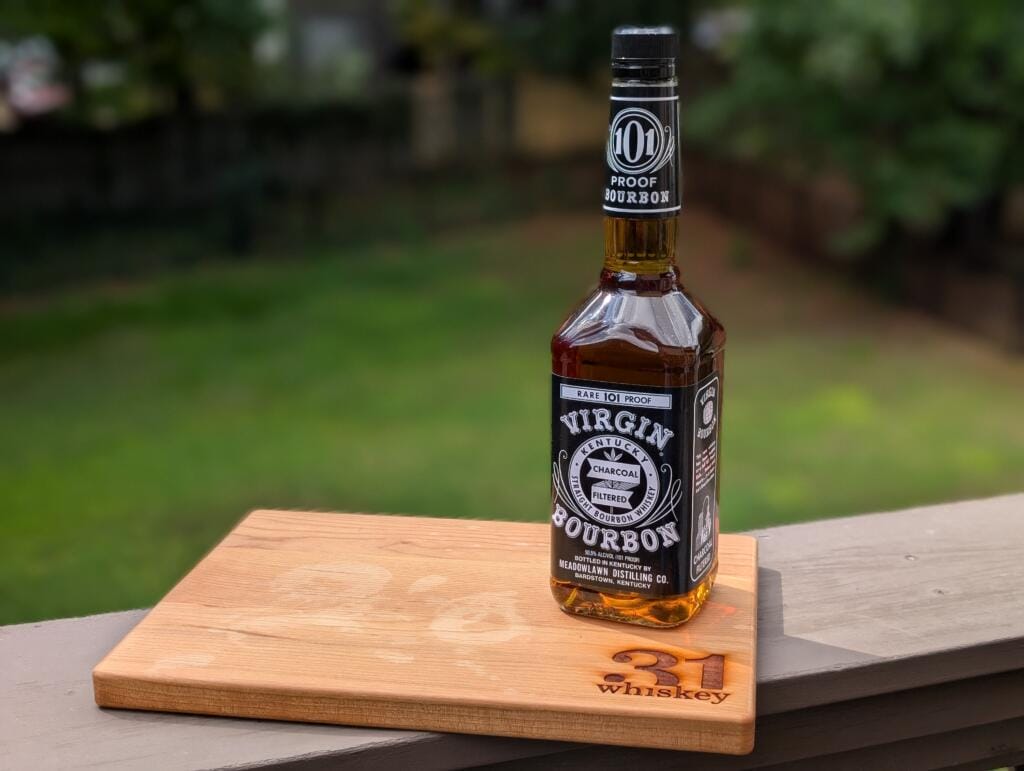
Continuing this year’s spooky season trip through the bottom shelf, I think I’m seeing a pattern emerge: this is the third bottle I’ve tried that is made by Heaven Hill, and I think it’s the second one that uses this exact same bottle — if not the exact same whiskey (just at a higher proof this time). I’m not sure if that says more about me being a sucker for Heaven Hill’s marketing or more about which marketing team buttered up my local liquor store… either way, we’re going to find out how this bottle of Virgin Bourbon Kentucky Straight Bourbon stacks up.
History
Joseph W. Dant was born in Marion County Kentucky in 1820, and at the age of 16 he took an old poplar tree and turned it into a whiskey still. Not exactly the most popular of still making materials, but for newly founded distilleries, the practice was fairly common in those days. Dant operated a true grain-to-glass operation: he grew the grains, selected the best ones from the crop, and distilled them on site into whiskey.
The distillery was a success, selling bottles as far away as New Orleans (which he supplied by floating them down the Mississippi on a raft himself), and by 1850 he had expanded his operation to include a new brand dubbed ‘Yellowstone’. In 1870, he moved to a new, larger distillery that was designed to be gravity fed — the fermentation tanks were located above the stills in the building, allowing the liquid to simply flow from one step in the process to the next without the need for pumps or buckets. After the Bottled in Bond Act of 1897 came into law, he began producing bottled in bond bourbon (one of the first distilleries to do so).
Dant died in 1902 and left the business to his sons, J.B., J.P., and Bernard. J.B. took the Yellowstone brand name and opened a separate distillery where he continued to produce it, while Bernard continued to grow the original distillery. Both companies would be profitable, but with the onset of prohibition both were shuttered and the last stocks of whiskey were purchased by the Stitzel-Weller distillery group.
Once prohibition was repealed, the brothers would try to revive their business but neither distillery would soar to the same heights as it had once seen. The J.W. Dant Distillery was re-opened in 1936 only to be sold in 1941. J.P. Dant leased a distillery in Kentucky during World War II and started producing whiskey under the trade name of the Meadowlawn Distillery Company, named after that region of Kentucky. He sold the distillery and brands in 1945 to Marvin Padgett, who also purchased the “Old Boone” brand from Seagram’s and began producing that whiskey alongside some of his own brands such as Virgin Bourbon.
This new venture didn’t last long — it was sold to Ray Buse in 1959, whose calamitous ownership of the facility included boiler explosions, fires, and being drowned by their own water tank crashing down on the plant. The doors closed for good in 1977 and Buse sold the brands to Heaven Hill Distillery, who still uses the Meadowlawn Distillery Company shell corporation to produce some of these brands to this day.
Product
- Learn More: What Is Bourbon Whiskey?
From what we can gather, this seems to be a re-bottling of Heaven Hill Distillery’s standard bourbon, just at a lower price point that normal.
As a Kentucky straight bourbon whiskey, this is required to start with a mash bill that contains a minimum of 51% corn. Reportedly, the whiskey we’re dealing with is Heaven Hill’s standard mash bill, which should be 78% corn, 10% rye, and 12% malted barley. Those grains are cooked and fermented to create a mildly alcoholic liquid that is then distilled to create the newly made whiskey.
You might notice the term “sour mash” on the bottle — this is a reference to the practice of using the leftover from previous distillation runs to supercharge next vats of fermentation. It’s a traditional technique in Kentucky distilling, typically used to make for a more flavorful and consistent spirit.
After distillation, that newly made whiskey is placed into new charred oak barrels for a period of time to mature. You’d be forgiven for missing the age statement on this bottle, since it’s basically hidden, printed sideways on the small wrapper that’s tacked around the neck of the bottle and just below the UPC code. This bottle claims that the whiskey was matured for thirty-six months, which is frankly fine. It’s halfway between the legal minimum of two years and the customary four years for straight bourbon.
Prior to being placed in the barrel, one additional feature is that this whiskey seems to have been “charcoal filtered”. That’s a process where the raw spirit is filtered through heaps of charcoal, which removes impurities and generally improves the taste. It’s something you’d see as a requirement with a Tennessee whiskey like Jack Daniels, but not something common to Kentucky bourbon.
Packaging
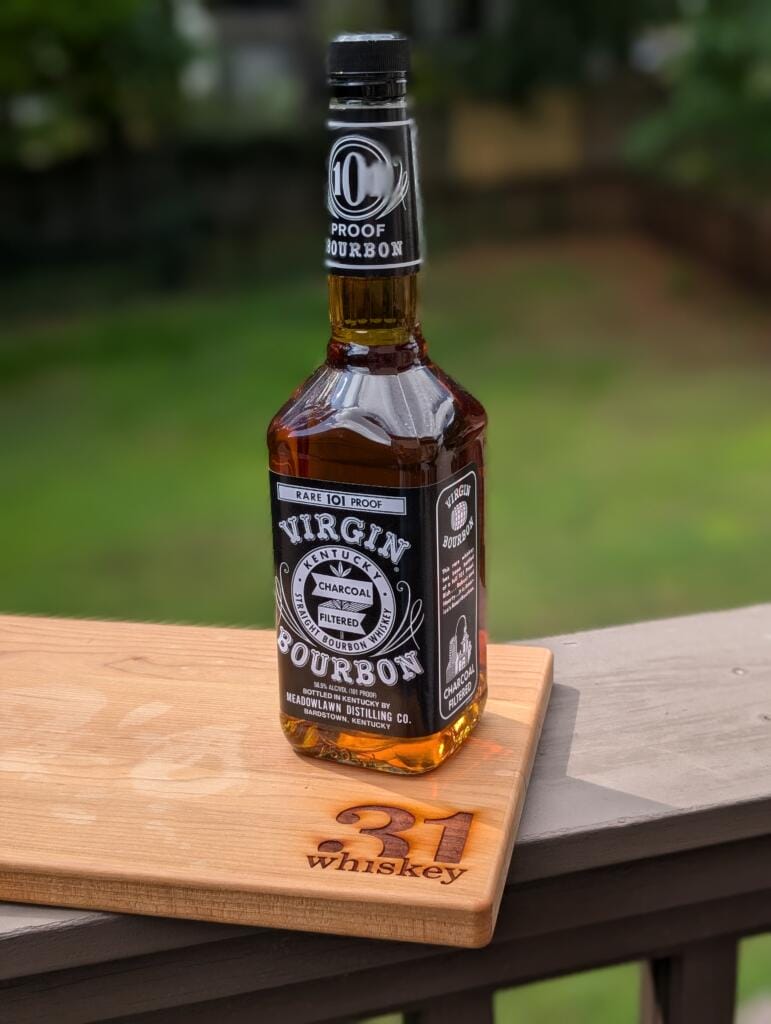
This bottle instantly reminds me of Evan Williams, another Heaven Hill product. And honestly, that might not be the worst thing.
The bottle is a carbon copy, except done a little bit more cheaply. There’s still the rectangular body, rounded shoulder, and long neck, but the embossing of the brand name into the bottle that we saw with Evan Williams is missing here. Instead it’s just flat and boring.
Moving to the label, I feel like we’ve got a situation similar to what we saw with Ezra Brooks. In that case, the company was deliberately trying to mimic Jack Daniels’ style to capitalize on a Jack Daniels shortage in the market. And I feel like the design here is even closer to that of Jack’s, sporting white illustrated lettering on a black background with a very similar vibe.
Neat

This whiskey has a good color in the glass, giving off that rusty amber color that I like to see. The aromas are nice as well, with some rich brown sugar, vanilla, caramel, and apple in the mix. There’s a good level of saturation to those aromas, not too heavy, not too sweet — just right. On closer inspection, there might be a little bit of sourdough bread as well.
I’m honestly pleasantly surprised by the flavors. Right away, I’m getting dark chocolate, brown sugar, apple, and cedar chips with a little bit of an aromatic lift. It’s a richer and more complex arrangement than I had expected at this price point. As the flavors develop, that dark chocolate starts to have a touch of bitterness, but mellows out on the finish with just a hint of baking spices and some vanilla sweetness.
On Ice
I’m frankly surprised at how well this is doing. Given the price tag, I was expecting something way worse than this, something where the addition of a little bit of ice would cause chaos and the end times for my taste buds. But instead, this is actually enjoyable.
What I’m getting on the rocks are more of the darker and richer notes: dark chocolate, brown sugar with a touch of charring on it, and some good vanilla, accentuated by those cedar chips giving it some balance and lift — but without the apple, or (thankfully) the bitterness of that dark chocolate. I’d almost describe it as creamy at this point. A surprisingly nice and enjoyable glass of whiskey.
Cocktail (Old Fashioned)
Those who know me will know that darker, richer versions of an old fashioned cocktail are my jam. Give me something with some chocolate notes and I’m happy. And thankfully, that’s what we have here: something with some significant depth to bring balance to the bitters and make for an enjoyable experience.
What’s missing is the character. There isn’t much else in here besides the brown sugar and the chocolate, and that’s what would really elevate this experience. Some rye content would go a long way here, I think. Or maybe adding some maraschino cherry juice as a mixer.
I’ll also note that it does need a bit of sweetness added. I usually try old fashioneds without sugar first, just as a test. In this case it just didn’t work, and needed a cube of sugar to really make the experience shine.
Fizz (Mule)
There’s something just a little bit off about this, and I think it’s the dark chocolate.
What I’m looking for here is some balance in the flavors, and some extra texture that I wouldn’t get with a vodka. Something unique that only a whiskey can bring.
For the flavors, there is something that this whiskey brings to the table. The brown sugar and dark chocolate do help to balance the ginger beer and lime juice, but that balance isn’t perfect. The dark chocolate is just a little too bitter in my opinion and doesn’t make for a smooth experience like I’d like.
And on the finish, there’s no unique texture that this conveys. I’d love to see something peppery like you’d get with some rye content, but I don’t get any of that here. It’s just a flat, smooth finish.
Overall Rating
I’ll be honest, I’m kind of impressed. This is an inexpensive bottle of whiskey that actually pulls off some nice flavors — and while the end result wasn’t the most characterful experience I’ve ever had, it was more than enough to entertain.
Compared to other spirits in Heaven Hill’s lineup, I get the feeling that what we’re seeing is just a higher proof of the Quality House whiskey that we reviewed previously. But instead of being proofed down to 40% ABV, this one is just a touch over 50% — and that made a huge difference, adding to the saturation of the flavors and the depth that they were able to pull off.
What’s keeping me from giving this the full five stars is the performance in the old fashioned and the mule. It’s good, but it’s either missing some texture or is just a little too bitter. Both are things that can be improved with additives like sugar and cherries, but on spec this bottle falls short of perfect.
| Virgin Bourbon Kentucky Straight Bourbon Whiskey Production Location: Kentucky, United States Classification: Straight Bourbon Whiskey Aging: 3 Years Proof: 50.5% ABV Price: $18.95 / 750 ml   |
Overall Rating: 4/5
A surprisingly rich and flavorful bourbon for the price tag.