
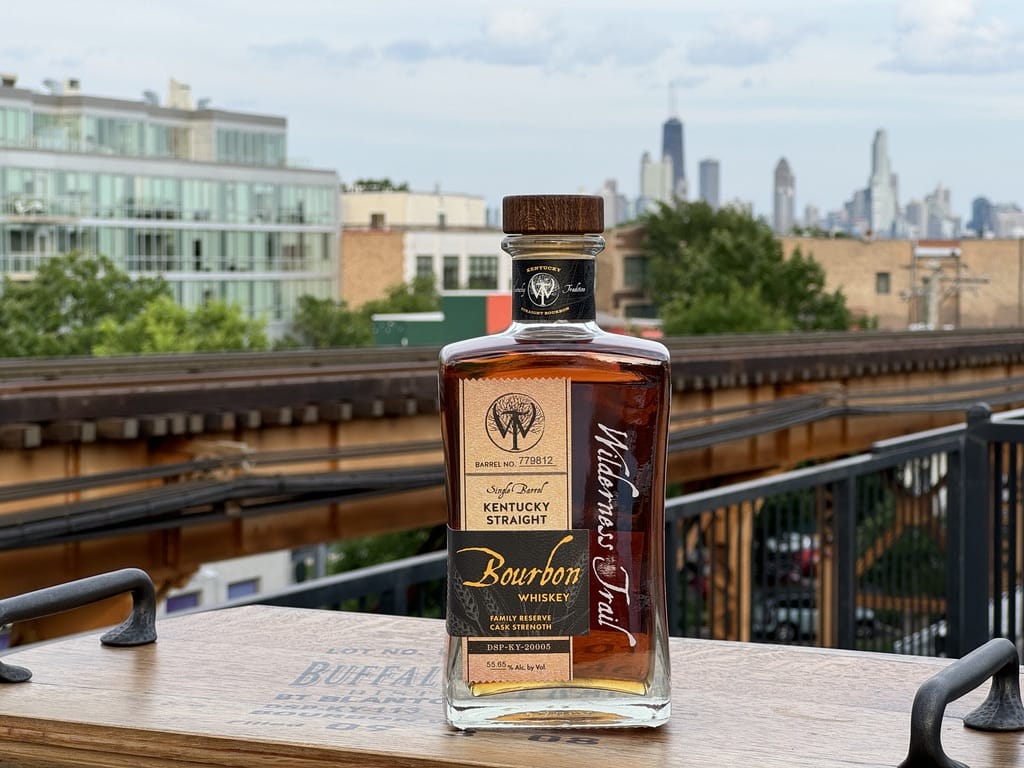
There’s a particular kind of decision you make when you’re about to leave town for a few days — the kind where you’re standing in the liquor store with a bag to pack and a vague sense that whatever you grab should feel appropriate for the destination. I was heading up to northern Wisconsin with the family (deep woods, lakes, the whole thing), so I wanted something that felt right for that setting. Sure enough, Wilderness Trail caught my eye.
I’ll be honest, I mostly went off the name when deciding to purchase this. I didn’t know much about it going in, but that name sounded just right for my trip. Also, I love a bottle completely unfamiliar and new to me. Sometimes you just want to crack open something you’ve never tried before, out in the actual wilderness, and see what happens. So I grabbed barrel number 779812, tossed it in the bag, and headed north.
History
Wilderness Trail Distillery was founded in 2012 by Shane Baker and Dr. Pat Heist in Danville, Kentucky, a town that bills itself as the “City of Firsts” — fitting, since Wilderness Trail became the first legal distillery in Danville since Prohibition. The name is a nod to the Wilderness Trace, the region around the route Daniel Boone and roughly thirty axmen hacked through the Cumberland Gap in the spring of 1775. Say what you want about bourbon-brand naming conventions, but this is one of the rare cases where the frontier story attached to the label is actually load-bearing rather than invented by a marketing agency in 2019.
Baker and Heist didn’t stumble into bourbon. The two met as students at the University of Kentucky in 1996, bonded over science and alternative rock, and – this is real – started a band together called Fulcrum. When it became clear that rock and roll wasn’t going to cover the bills, they leaned on their actual credentials: Baker in mechanical engineering, Heist with a doctorate and a career as an extension plant pathologist. In 2006, they co-founded Ferm Solutions, a fermentation consulting outfit that ended up troubleshooting distilleries around the world. Somewhere along the way the industry started calling them “the science guys of bourbon”, a nickname they now use themselves. So when they built their own distillery, they weren’t guessing. They’d already spent a decade fixing everyone else’s fermentation problems.
The distillery was named Kentucky Manufacturer of the Year in 2016 (per the distillery and Kentucky Distillers’ Association announcements), bottled its first whiskeys in 2018, and became the 18th official stop on the Kentucky Bourbon Trail in 2020. By the time it went up for sale, the operation had grown into a 168-acre campus holding more than 100,000 barrels — a figure that’s since been badly outrun, with reporting putting it closer to a quarter-million barrels and a new rickhouse going up every few months. This was exactly the kind of quietly serious operation that attracts attention from people with checkbooks.
That attention arrived on October 31, 2022, when Campari Group, the Milan-based conglomerate that already owned Wild Turkey and Russell’s Reserve, announced it was buying an initial 70% stake for $420 million, with a call/put option on the remaining 30% exercisable in 2031. Total enterprise value: $600 million, or about sixteen times projected 2022 EBITDA. That made it Campari’s second-largest acquisition ever, behind only Grand Marnier, and pushed their total US acquisition spend past $1.1 billion. Baker and Heist retained minority stakes and, at least publicly, remain involved.
So, in short: two scientists built something genuinely impressive from scratch and then an Italian aperitivo giant bought most of it.
Product
- Learn More: What Is Bourbon Whiskey?
The Family Reserve Cask Strength is built on Wilderness Trail’s high-rye mash bill (64% corn, 24% rye, 12% malted barley) fermented with proprietary yeast strains. That mash bill contains a meaningful amount of rye; this is not a soft, wheated, dessert-forward bourbon. I love a good high-rye pour, and the 24% is doing real work here — but more on that in a bit.
What actually sets Wilderness Trail apart is the sweet mash fermentation, and it’s worth explaining because the term gets thrown around like it’s self-evident. Most Kentucky distilleries use a sour mash process, in which a portion of spent, acidic stillage from a previous distillation (called backset) gets added to each new mash to drop the pH and keep bacteria from crashing the party. It’s cheap, reliable, and consistent.
Wilderness Trail skips the backset entirely and manages pH by other means: every fermentation starts clean. It’s more work and harder to keep consistent, but Baker and Heist argue it produces a cleaner fermentation and a more grain-forward spirit. Pair that with their proprietary infusion mashing process, which manipulates temperature to gelatinize the starches without scorching the grain, and you’ve got a distillery whose whole pitch is that the science is the point.
The spirit comes off the still at around 137 proof and goes into the barrel at 110 proof — one of the lowest entry proofs in Kentucky, and well under the 125-proof legal ceiling. Lower entry proof means less water added at bottling, which in theory means more of what the barrel actually gave you. The barrels are #4 char, the heaviest char level in common use (sometimes called alligator char for what it does to the wood surface), which caramelizes the wood sugars and gives the whiskey more to pull from. Bottling is at cask strength, non-chill filtered. Barrel 779812 came out at 55.65% ABV (111.3 proof).
There’s no age statement, and here’s what that actually tells you: under TTB rules (27 CFR 5.74), a straight whiskey must carry an age statement if it’s under four years old; at four years and up, it becomes optional. So NAS on a Kentucky straight bourbon isn’t a shrug — it’s a floor. This is at least four years old. Retailer disclosures on other barrels in this series have landed between roughly four years and seven months to five years and one month, and the distillery now sells a six-year private-barrel program at $70. So I’d call it four to six years, with the low end more likely than the high.
Which means at $60, you’re paying for cask strength and single-barrel character. You are not paying for extra time in the wood, whatever the “Family Reserve” script on the label wants you to feel.
Packaging
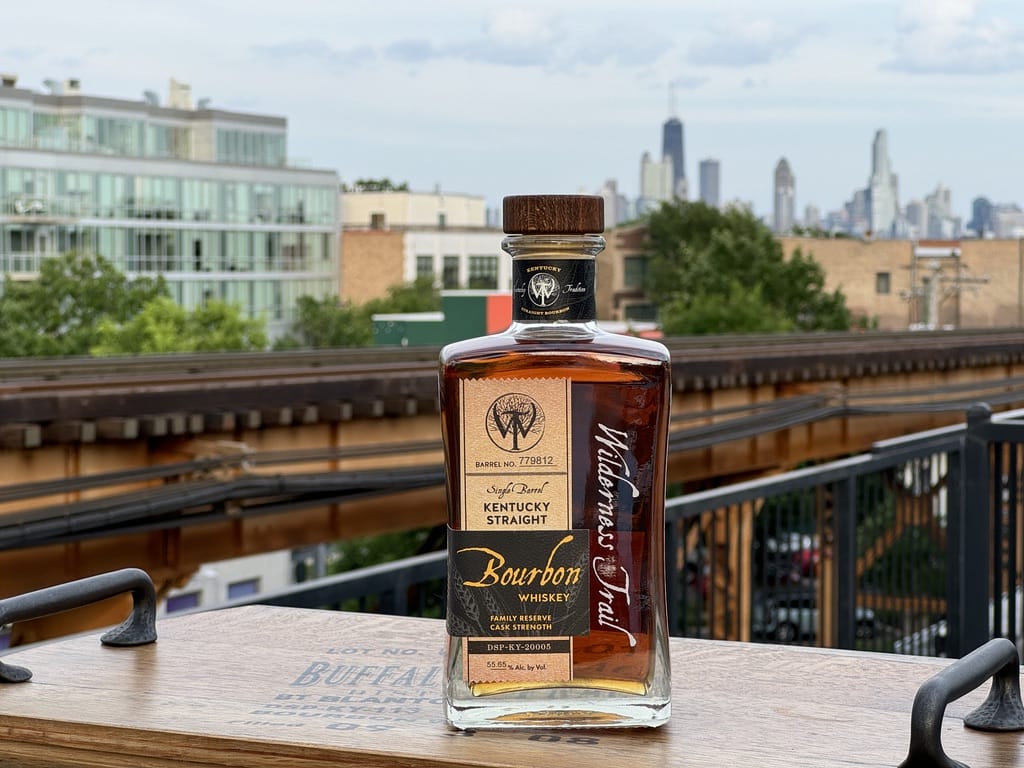
The bottle is a genuinely nice shape: rectangular, with a gentle inward curve running down both sides. It reminded me immediately of the flat, deck-of-cards silhouette FEW Spirits uses. The clear glass does its job well, as you can clearly see the deep amber whiskey inside. I always appreciate that — no opaque ceramic, no colored glass hiding what you paid for.
The label is functional and not much more: a tan background, the Wilderness Trail logo, the barrel number printed clearly. I appreciate the barrel number more than almost anything else on this bottle, because it makes the single-barrel designation feel like a fact rather than a decoration. The Family Reserve Cask Strength callout is there, along with the DSP-KY-20005 plant number. Small correction to a thing you’ll see repeated a lot online: a DSP number by itself doesn’t prove a whiskey wasn’t sourced — it identifies the registered plant that bottled it, which for a contract bottler tells you nothing about who ran the still. What confirms provenance here is that Wilderness Trail distills, ages, and bottles everything in Danville and says so on the label. The DSP number is a nice bit of transparency; the “distilled and bottled by” line is the actual receipt.
The overall design is utilitarian in a way that stops just short of boring. It gets the job done. It does not ask to be admired.
No wax, no cardboard tube, no gimmicks. The wood-topped cap is a small but appreciated detail. This is a working bottle, not a shelf piece — and I mean that as a compliment.
Neat
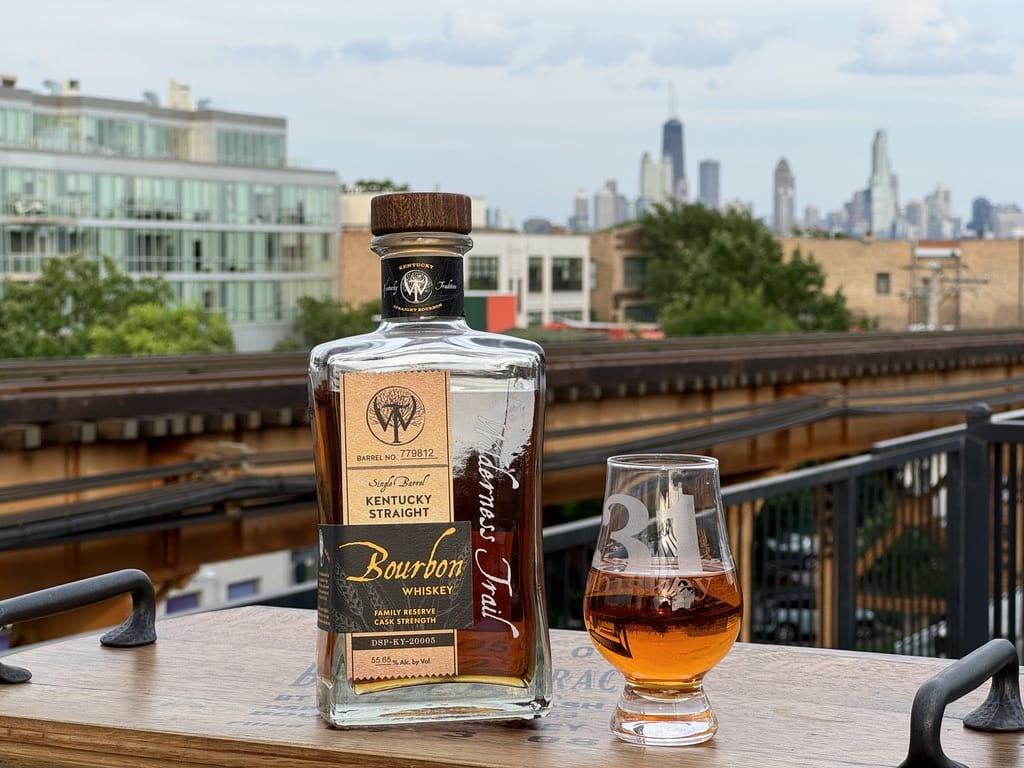
The nose on this one stopped me cold. The first thing I got was funk — and I mean that in the specific, almost barnyard-y, slightly fermented way that’s either fascinating or disqualifying depending on your tolerance. There’s some hardcore dirty-sock energy here. I realize that’s not a selling point on paper… but alongside it you get orange peel and a real marshmallow sweetness, and the combination is oddly compelling. (And a note for anyone new here: I’m the guy who enjoys Malört. Calibrate accordingly.) The toast note on the nose is bread toast, not the sweet caramelized kind — it’s more like a slice left in the toaster a minute too long.
The first sip has real bite. At 111.3 proof, that’s expected… but the heat arrives fast. What follows is strong toasted bread on the palate, a mild citrus note echoing the orange from the nose, and a hint of sweetness so understated it barely registers. The marshmallow doesn’t survive the sip. What replaces it is a faint, nondescript sweetness that seems to be trying to climb out from behind the grain-forward punch and mostly failing.
The finish is funky. The burn is genuinely mild for the proof, which is a point in its favor and probably a dividend of that low barrel entry proof. But the farmhouse funk lingers, and it’s the last thing you remember. Neat, this is a whiskey with a distinct personality… just not a personality everybody’s going to want to spend an evening with.
On Ice
Ice is where this bourbon really shows up. The bite disappears entirely, and what’s left is a focused, clarified version of what the neat pour was only hinting at. Burnt toast becomes the dominant flavor — but this time, in a good way. It’s specific and confident, like charred bread with intention behind it.
The orange that was so quiet neat comes forward hard, and paired with the toast it creates something I can only describe as burnt toast with marmalade. Now, that’s not a complaint. It’s a genuinely lovely, slightly unexpected pairing that makes the glass worth finishing. The marshmallow returns too, rounding out the sip in a way it couldn’t manage at full proof. And in a significant trade up, where the funk used to sit, now something coffee-adjacent shows up instead.
The funky finish faded almost entirely. What’s left is cleaner, more coherent, and frankly more enjoyable. If you buy this bottle, drink it on the rocks. The ice isn’t just cooling it down — it’s doing actual editorial work.
Cocktail (Old Fashioned)
Given how bold the on-ice pour was, I went into the Old Fashioned with more optimism than usual… which was a mistake. For a bourbon carrying flavors as assertive as burnt toast and marmalade, the Old Fashioned came out surprisingly, stubbornly bland.
The burnt toast survives — it’s the one thing in this whiskey that apparently cannot be killed — but instead of marmalade, now it gets buried under bitters and sugar. The orange garnish, which should have been a natural amplifier for the citrus already in the glass, vanishes into the mix. The result tastes like not much in particular, right up until the finish, where the funk comes roaring back with a tongue-numbing quality that lingers well past its welcome.
This is a cask strength bourbon that somehow gets less interesting when you add things to it.
Fizz (Mule)
I try to go into every mule with an open mind. I really do. This one made it difficult. The ginger beer and the bourbon enter into what I can only describe as a battle of bold flavors, and both of them lose. The whiskey dulls the ginger beer (which is an impressive feat, frankly) and the ginger beer flattens the whiskey’s more interesting notes. What’s left tastes like flat ginger beer and toast, which sounds less like a cocktail and more like the opening scene of a bad hangover.
There is one small mercy: the ginger beer coaxes out the orange, and it lands right at the tip of the tongue in a way that’s genuinely pleasant for about half a second before the rest of the glass reasserts itself. That half-second is the highlight of the mule, which should tell you everything you need to know about the mule.
Stick to the rocks. Leave the ginger beer for a different bottle.
Overall Rating
Wilderness Trail is a genuinely interesting distillery. Two scientists who understand at a chemical level what’s happening inside their fermenters, a real commitment to sweet mash and low entry proof when the easier path was right there, and a decade of building something substantial before the big money showed up. I have a lot of respect for what Baker and Heist created. The $600 million Campari valuation is a footnote worth knowing — not because it ruins the whiskey, but because it’s useful context for a brand that still markets itself on craft and independence.
And the whiskey has a personality. That funky, barnyard-y quality is distinctive; you won’t mistake this for anything else on the shelf. But personality isn’t the same as quality, and at $60 you’re entitled to high expectations… but here you’re not getting extra years in the wood to justify the ask, the cocktail performance ranges from dull to actively unpleasant, and the neat pour is more curious than satisfying. The on-ice experience saves this from being a disappointment — it’s legitimately good, and burnt toast with marmalade is a flavor combination I’ll remember. But one strong serving format out of four isn’t a win.
This bottle is for the drinker who takes their bourbon on the rocks, actively likes funky and grain-forward profiles, and has no cocktail ambitions. If you drink your bourbon neat or in an Old Fashioned, spend your sixty dollars elsewhere.
| Wilderness Trail Distillery Family Reserve Cask Strength Bourbon Production Location: Kentucky, United States Classification: Straight Bourbon Whiskey Aging: No Age Statement (NAS) Proof: 55.65% ABV Price: $59.99 / 750 ml   |
Overall Rating: 2/5
The wilderness was the best thing about this bottle — and I mean that as both a compliment and a warning.