
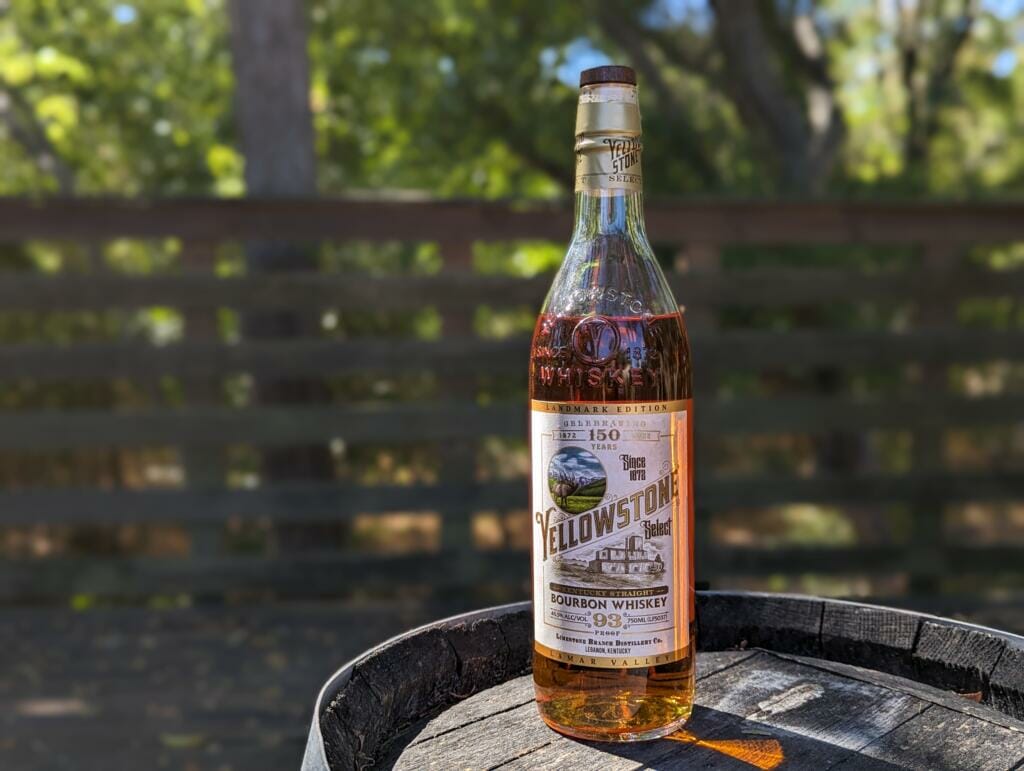
I started this review of Yellowstone Kentucky Straight Bourbon Whiskey almost a year ago (11 months, to be exact). A buddy of mine lent me their bottle and suggested I give it a try, but it kept getting moved to the back of the line. But I finally had a deadline to make this happen: getting the review done in time so I can finally give them their bottle back during a visit (even though they probably forgot about by now). And, after having a few sips, I wish I had tried this much sooner.
History
Joseph W. Dant was born in Marion County Kentucky in 1820, and at the age of 16 in 1836 he took an old poplar tree and turned it into a whiskey still. Not exactly the most popular of still making materials, but for newly founded distilleries, the practice was fairly common in those days. Dant operated a true grain-to-glass operation: he grew the grains, selected the best ones from the crop, and distilled them on-site into whiskey.
The distillery was a success, selling bottles as far away as New Orleans (which he supplied by floating them down the Mississippi on a raft himself), and Dant expanded his operation to include a new brand dubbed “Yellowstone” to honor the popular national park. In 1870, he moved to a new, larger distillery that was designed to be gravity fed — the fermentation tanks were located above the stills in the building, allowing the liquid to simply flow from one step in the process to the next without the need for pumps or buckets. After the Bottled in Bond Act of 1897 came into law, he began producing bottled in bond bourbon (one of the first distilleries to do so).
Dant died in 1902 and left the business to his two sons, J.B. and Bernard. Bernard continued to grow the original distillery, which would eventually be sold to Shenley and then Heaven Hill later in the century.
J.B. decided to strike out on his own, taking the Yellowstone brand and creating a separate distillery where he would continue to refine and improve the product. The distillery shut down operations at the beginning of prohibition but the Yellowstone brand is one of the few that continued through that period, bottled by the James Thompson and Brothers company using existing stocks from the pre prohibition era as medicinal whiskey for prescription use.
The Dant family had maintained ownership of the brand for nearly a century, but in 1944 they decided to sell the brand to the Thompson family (who had been their producer and bottler of their whiskey since prohibition). The Thompsons incorporated the brand into their Glenmore Distillery Company, which they had created by purchasing the Kentucky Tavern brand and distillery. Under their stewardship, by the 1960’s the Yellowstone brand was the #1 best selling bourbon in the state of Kentucky.
In the 1990’s, as with many bourbon brands, the ownership goes into a bit of a blender. Between Sazerac, Diageo, and Schenley, the brand changed hands a number of times before Luxco became the ultimate owner. Along with that ownership change, the production went silent and was a rare sight on shelves.
Paul and Steve Beam, descendants of the Dant family, decided to revive their family tradition and opened the Limestone Branch Distillery in Lebanon, Kentucky in 2010. In a deal with Luxco, the family sold a 50% stake in their distillery to the large Luxco corporation in exchange for the rights to once again have a Dant family member distilling and bottling the Yellowstone brand of whiskey at their own distillery.
In 2018, the Yellowstone brand partnered with the National Parks Conservation Association to provide a portion of their sales revenue to directly support the preservation and protection of Yellowstone National Park itself.
Luxco was eventually purchased in 2021 by MGP Ingredients, a mass production facility for spirits in Indiana, but the production of Yellowstone remains at the Limestone Branch Distillery in Kentucky.
Product
- Learn More: What Is Bourbon Whiskey?
Yellowstone Select is their “flagship” label, which basically means that it’s the baseline version of their spirits. They have some variations on a theme available, but this bottle is the theme upon which they variate.
As you’d expect for a bourbon, the spirit starts out as a mixture of grains. Specifically, this bourbon comes from a mixture of 75% open-pollinated white heirloom corn, 13% rye, and 12% malted barley. The use of open pollinated heirloom corn is probably as close as you can get to the original strain of corn that would have been used by the Dant family when they were distilling this spirit in the 1870’s. Those grains are then milled and cooked in a three-stage process, with each grain being cooked at just the right temperature for each specific component to ensure that they don’t scorch the ingredients.
For the fermentation, the Beam brothers actually use a strain of yeast that is identical to the original strain used by their ancestors. They found this specific strain by isolating the DNA of some yeast they found on their great grandfather’s bottles which were on display in a local museum and comparing it to modern yeast until they found one that matched. The mixture is then allowed to ferment for a longer than usual 72 hours, during which the yeast consumes the sugars in the liquid and turns them into delicious alcohol and some other useful and flavorful components.
That mildly alcoholic liquid is then distilled twice in copper pot stills to create the whiskey we have here today, which is a very traditional process that you typically see still in use in Scottish distilleries. The first run or “stripping run” is done in a modern pot still, and the second or “spirits run” is performed in a French style alembic still similar to those used in the production of cognac.
At the end, roughly 600 gallons of fermented mash have been transformed into a single 53 gallon barrel of raw white whiskey.
For this version of their whiskey, the Limestone Branch Distillery places that newly made whiskey into new charred oak barrels for a period between four to seven years. They then select the right barrels from their warehouse in that age range, blend them together, and bottle the resulting spirit.
Packaging
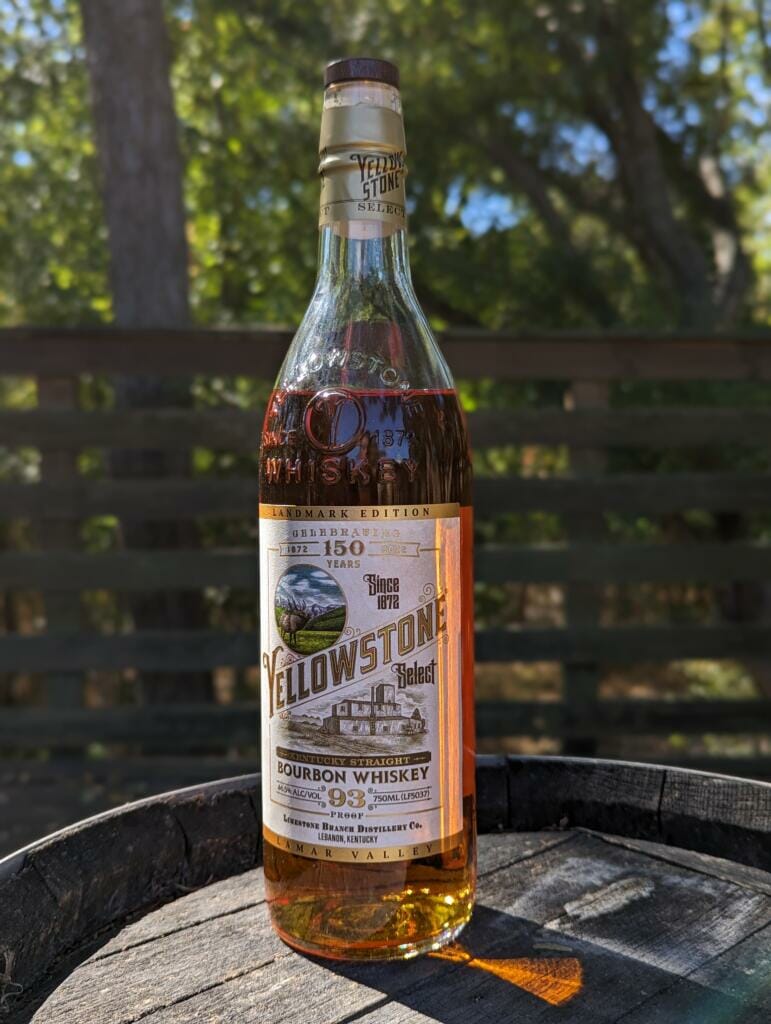
I like the design on this bottle. –I think it does a good job of balancing the nostalgia and history of the brand alongside some modern touches, and isn’t just a lazy off-the-shelf slapped together job like we often see.
Starting with the bottle, the design is decidedly old fashioned: there’s a general wine bottle shape, with cylindrical walls, gently sloping shoulder, and a medium length neck. That’s capped off with a nice wood and cork stopper. What lets you know that some care and attention went into the bottle is the fact that the distillery’s logo and some information is actually embossed into the glass itself, which requires a custom mold and some actual planning. That same logo is also on the base of the bottle, for an extra touch.
Where I think this really starts to stand out is the label. Most historical brands simply take the old design and slap it on a new bottle, and that tends to feel dated and out of place. Instead, the new Yellowstone design takes visual cues from that old design and incorporates it into something newer and more exciting. The best example is the Yellowstone brand name — every historical bottle I can find depicts that name in the same slanted position you see here, with the parallel lines above and below that name. But where the older version simply leaves the rest of the label blank, this newer version incorporates a pencil drawing of the old distillery and an illustration of some component of Yellowstone national park.
Generally, I’m on board. What I have a bit of an issue with is the “since 1872” language on the bottle. I don’t disagree that this is technically the same intellectual property that was originally created way back then, and the ownership of that name can be traced all the way to the modern day, and it’s even made by the descendants of the original owners… but there’s some Ship of Theseus shenanigans going on here.
Neat

For something that has been aging (at least partially) for seven years, this looks a little light on the color to my eye. It’s more of a golden mustard than the reddish rusty bourbon I’m used to seeing. The aroma delivers, though: bright cedar chips are the first thing I get, followed by brown sugar, vanilla, dark chocolate, apple, and a touch of floral honey.
That aromatic note of cedar chips from the aroma is also the very first thing I taste. It’s a pretty big part of the flavor profile, and something I typically associate with a “heads-y” bourbon (one where the lighter alcohol related chemical compounds, called “heads” in industry parlance, have been kept in the final product instead of being discarded as part of the distillation process). That’s a very traditional take on a bourbon, and typically the lighter components are intended to offset the darker and richer notes to create a more balanced flavor profile.
Immediately following those cedar chips is a nice hint of dark chocolate, giving the profile a bit of depth and complexity. That’s joined almost immediately by a good helping of rye bread that evolves into a more distinct black pepper spice as the flavor continues to evolve. A little while later, as the black pepper subsides, we get to the sweeter notes, starting with vanilla and brown sugar which are then followed by crisp apple and caramel. The finish is very sweet, primarily those apple and brown sugar notes with just a touch of black pepper spice.
On Ice
Ice has a tendency to eliminate some of the lighter flavors in a bourbon, leaving behind the darker and better saturated components. And honestly that’s what we want — lighter components are good for providing balance while sipping neat but for something to work in a cocktail, it needs to have some power and force behind it.
And that’s exactly what we have here.
The cedar chips are almost completely gone, leaving behind primarily a dark chocolate and rye bread combination. There’s also a little bit of burnt brown sugar in here, adding not only some sweetness but some interesting charred components that bode well for seeing this in action in a cocktail. I feel like the black pepper from the rye bread is just a touch overpowering of the other elements — so I wouldn’t recommend sipping this on the rocks, but there’s still plenty of flavors going on to keep you entertained.
Cocktail (Old Fashioned)
There are few things I like better than a darker, richer old fashioned. The combination of the flavors in one of those is just phenomenal, and something that I would happily sip all night long.
In this case, we do get a slightly darker than usual version… but it isn’t quite the “biting into a square of dark chocolate” level that I might prefer.
One interesting thing here is that the cedar chips have returned. I think the addition of the aromatic bitters helped to bring them out and accentuate them in the glass, making them visible once more. Behind that is some good dark chocolate flavor, crisp apple, and slightly charred brown sugar. The combination is frankly pretty great, and gets a thumbs up in my book.
Fizz (Mule)
Normally, a good dark and rich bourbon does well in a Kentucky mule — but in this case, I think there’s something missing.
Things that this does well include a good balance of flavors between the dark chocolate in the bourbon and the brighter lime juice and ginger beer. It isn’t as bright and sharp as a margarita (something that can happen with an unbalanced version of this cocktail).
But I think something we do pick up here instead is a bit too much bitterness from the black pepper in the rye content. It makes things just a hint unpleasant up front, when all I really need from this flavor is to add some spicy complexity to the finish. And unfortunately, in this case, on the finish all I’m getting is just a flat blandness.
Overall Rating
Generally speaking, I like what’s going on here. This whiskey is produced by a family with a legitimate tie to the history of the brand, in a historically accurate manner, and using historically accurate materials. Heck, they even went to the trouble to DNA match the strain of yeast that they use in the fermentation.
It’s an impressive resurrection of an ancient brand, and I think they did a good job.
You might be a little confused by that last statement given how I had some complaints about this spirit in the review, and that’s a fair question. Compared to everything else on the market, I do think that it comes up just short, and seems a bit simple when stacked up to others on the shelf. But that simplicity is a factor of the decisions they made in this spirit’s production. It isn’t designed to be a flavor bomb, but rather designed to evoke the same style and flavor of whiskey that their family made generations ago.
In that context, I think it’s worth a try. Even on its own merits, in an old fashioned or taken neat, the flavors in here are spot on for what I want in a good bourbon. There aren’t really any surprises, but that’s okay by me. There are plenty of experimental distilleries around, and I appreciate their dedication to making a faithful recreation of the best whiskey 1960’s Kentucky had to offer.
| Yellowstone Select Bourbon Whiskey Production Location: Kentucky, United States Classification: Straight Bourbon Whiskey Aging: No Age Statement (NAS) Proof: 46.5% ABV Price: $29.99 / 750 ml Overall Rating:   |

All reviews are evaluated within the context of their specific spirit classification as specified above. Click here to check out similar spirits we have reviewed.
Overall Rating: 4/5
A great bourbon — cedar chips, dark chocolate, rye bread, vanilla, brown sugar, and a heavy dash of family history.