
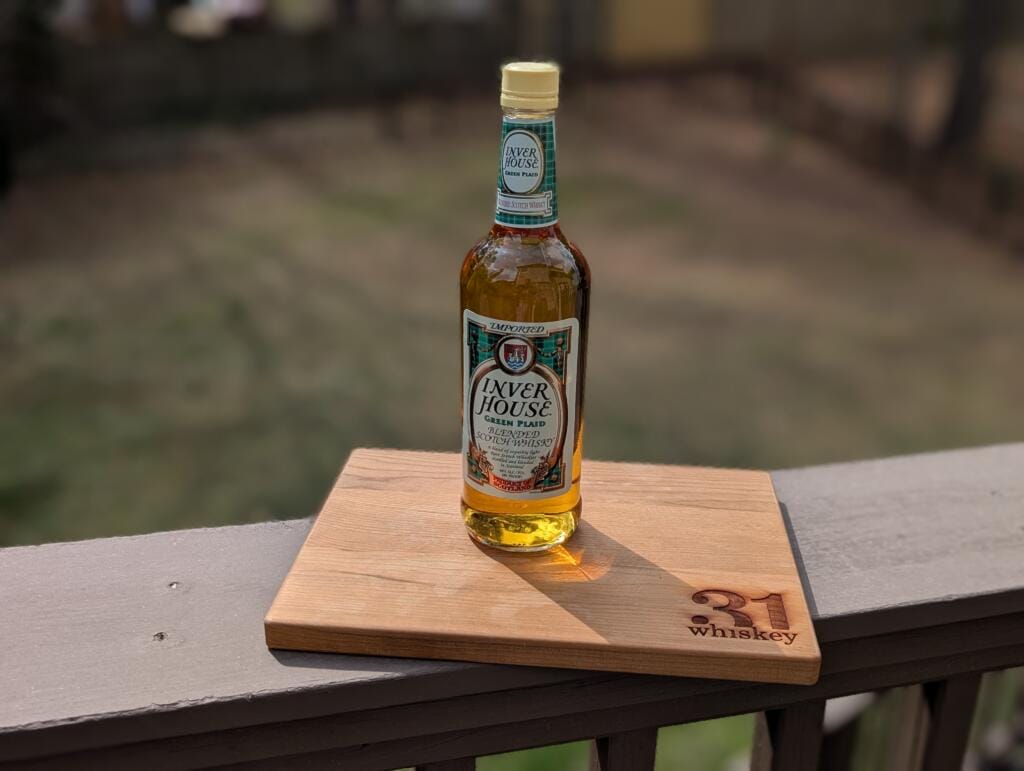
Imported whisky is likely to get rather expensive in the coming months and years, which is unfortunate for those of us who enjoy a good scotch now and again. Thankfully, there are a number of brands that produce imported scotch whisky at a fraction of the price of the name brand stuff — so today we’re going to look at another bottom shelf scotch to see if it passes muster: Inver House Green Plaid Blended Scotch Whisky.
History
Thomas S. Moore was born in 1853, and his family moved shortly thereafter to Bardstown, Kentucky. He later dropped out of school at the age of 11 to start working to support his mother and his sisters, after his father died suddenly. One of his sisters eventually married Charles Willett, whose wealthy family had made a fortune in the distilling business.
At the age of 22, Moore married Jennie Collings and went to work for his in-laws, the Willetts, at their distilleries. There he met Ben Mattingly, who would go on to marry one into the Willett family, as well. The two became fast friends and colleagues, and in 1876 John Willett (head of the family and head of the company) handed Ben and Tom ownership of one of their distilleries south of Bardstown to operate under the name “Mattingly and Moore”.
Mattingly would rather quickly sell his shares in the new company to a group of investors, but Moore would stay on for eight more years until, in 1899, he purchased around 100 acres of land directly adjacent to the old distillery and constructed a new facility in his own name. The old Mattingly and Moore distillery company kept operating until 1916, when it went bankrupt. Moore swooped in to purchase the assets, tearing down the buildings and constructing new facilities.
The Tom Moore distillery produced 10 barrels of whiskey per day in its time and was quite profitable until it was closed down by prohibition in 1920. Moore retired at that point, but he lived long enough to see prohibition repealed and his son take over the old distillery, bringing it back online and restarting production.
The distillery was sold in 1944 to a Chicago liquor merchant named Oscar Getz who changed the name to the Barton Distillery, a name he reportedly picked out of a hat. Under his ownership, the distillery produced some notable brands such as Kentucky Gentleman, Tom Moore, and Kentucky Tavern among others.
Over the years, the company expanded to include a large number of brands and varieties of spirits, more than were just produced at that single distillery. But when they sold their Canadian whiskey venture in the 1970s, things came crashing down quickly, with more expenses than revenue and unable to pay their bills. The brand was sold to a number of owners, eventually ending with the Sazerac Company where it remains today.
This specific bottle of whisky is not produced by Sazerac, but instead is sourced from Scotland where it is bottled and then imported by Barton Brands for distribution in the United States.
Product
- Learn More: What Is Scotch Whisky?
In Scotland, blending whisky is a tradition as old as whisky itself. Since the beginning of the whisky trade, the most recognizable brands have come from bottling and blending houses rather than individual distilleries, which is a trend that has only started in the very recent history.
This is a specific bottle of whisky that is at least two legal entities removed from the people who actually distilled the contents — which means that getting a straight answer about what went into making this spirit is going to be next to impossible. Add in the fact that this is a blend of different strains of whisky and you may as well ask what glacier that drop of water in your cup came from.
What we do know is that this is a blended scotch whisky, which is one of the least restrictive labels that you can put on a bottle of Scottish spirits. Whiskey is always made from grains, and with Scottish whiskey the normal expectation is that you’d get some malted barley as the majority source of your spirit. But with a “blended whiskey”, you really don’t know what you’re getting.
Whatever the source of the whiskey, the grains are milled and fermented to create a mildly alcoholic liquid. That liquid is then distilled to concentrate the alcohol, and then placed into oak barrels for a period of at least three years. Once properly matured, the spirit is mixed with other barrels to create a specific flavor profile and then blended with the spirits from other distilleries to create the finished product we have today.
Packaging
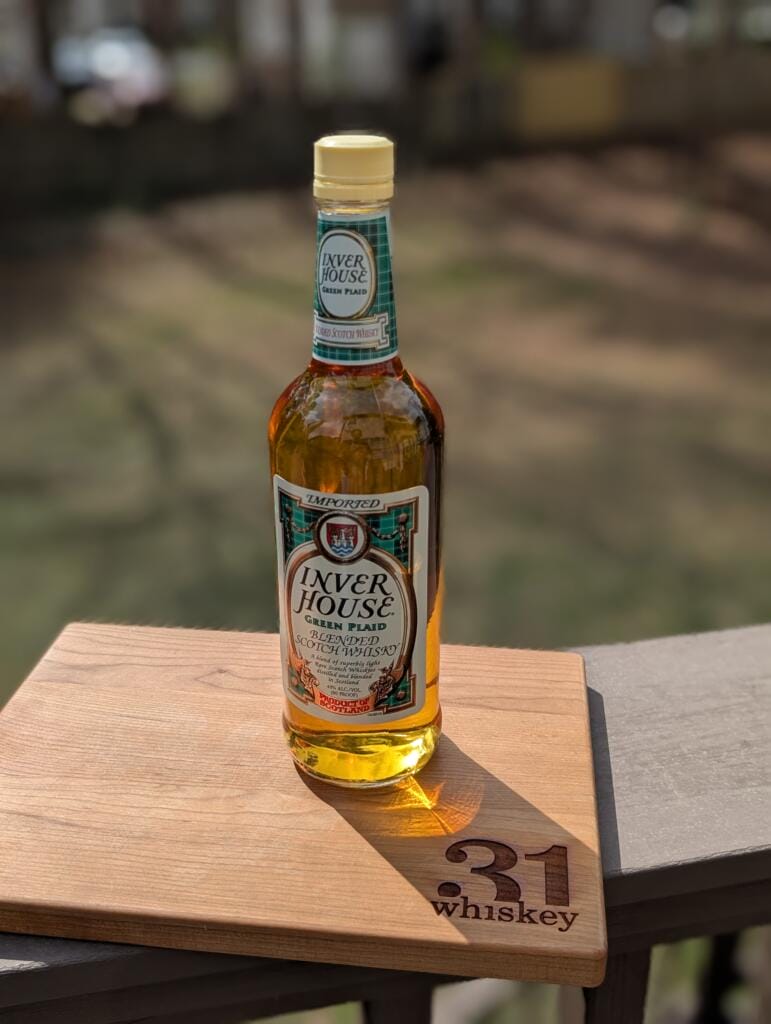
Wow. They really spared no expense here, eh?
The bottle is shaped like any other whiskey bottle in the world, with a cylindrical base, rounded shoulder, and medium length neck. There are all sorts of manufacturing marks on the bottle from the production process and which don’t seem to have been buffed out or covered (including an aggressively apparent seam where the mold for the glass forming process came together). The bottle is capped off with a plastic screw-on cap.
For the label, this is giving me aggressive flashbacks to cheap British souvenirs that you’d see at the airport in the 90’s. The background follows through with the promise of a green plaid, and the remainder is occupied by illustrated golden framing and a coat of arms that is vaguely British but frankly I just can’t place. Proudly shouted across the top of the label is the word “IMPORTED”… just in case you couldn’t figure it out from the tablecloth background.
All in all, it looks like something that would be right at home in a speed well at a bar, never actually seeing the light of day.
Neat
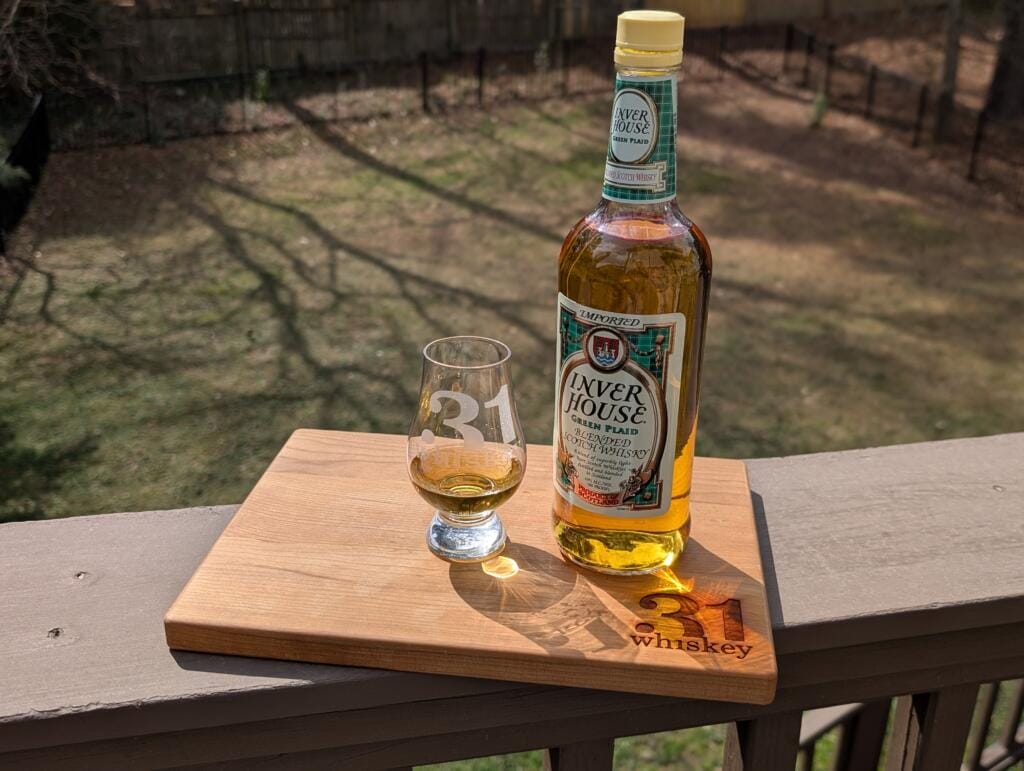
It’s the right color, which is a good start: light gold in the glass. Coming off the liquid I’m getting some nice highland scotch aromas, including fresh baked bread, honey, flower blossoms, sliced melon, and fresh grapes. All lighter, sweeter notes like you’d expect at a nice brunch.
The hallmark of a blended scotch is that it smells complex and interesting, but collapses to a few simple flavors when you actually take a sip. And that’s exactly what we have here. The flavors are good — honey sweetness, caramel, and some light vanilla near the finish — but there’s very little depth or variety.
The good news here is that I don’t taste any faults or issues with the spirit, it smells pretty good and tastes acceptable. The bad (or more accurately, meh) news is that it’s just kinda boring.
On Ice
I’m actually fairly surprised here, since this gets much better with the addition of some ice. Usually, a scotch will fall apart when some ice is added to the mix — but in this case I’m getting much more complexity and more of those flavors that we saw in the aroma.
Specifically, the floral blossoms are starting to shine through here, elevating the floral component of that honey sweetness we saw when taken neat. It’s then combined with more of the fresh baked sourdough bread that we expect from malted barley based spirits, to result in something that really does taste like a proper highland scotch whisky.
Overall Rating
I was frankly surprised at this bottle of scotch. I was expecting something much more awkward and faulty, but what I experienced here instead is a simple, clean, well-composed blended scotch. It’s not going to knock your socks off, but it has enough flavor and complexity (especially when taken on the rocks) to make for an enjoyable sipping experience. I likely wouldn’t ask for it by name, but I wouldn’t be mad if someone served it to me either.
The saving grace here really is the price tag. For ~$11 as of publication, this is one of the cheapest bottles of spirits we’ve ever tried. Some of the bottles down in this end of the price range are downright terrible, but this one is actually quite nice.
| Barton Brands Inver House Green Plaid Blended Scotch Whisky Production Location: Scotland Classification: Blended Scotch Whiskey Aging: No Age Statement (NAS) Proof: 40% ABV Price: $10.95 / 750 ml   |
Overall Rating: 4/5
A cheap bottle of scotch that will scratch your itch for a fine bottle of whisky without breaking the bank.
I tried a bottle of this not long ago.
I think I paid $16/handle.
Initially, I thought it was okay, but I tired of it quickly.
Overall, I prefer Canadian whisky to Scotch. In this price range, I think Rich & Rare Reserve is better.
Thanks for your review!
I have fritzed around with hard liquor since the early 1970’s mostly as a spectator of the bespoke and unbespoke brands, always looking for the best value. I have given lot’s of unfinished bottles of liquor away over the years. I gave up on Scotch when my go to Johnnie Walker Black changed and the price of Scotch soared over the past decade or two. I always thought JWB was overpriced but liked it well enough compared to others so I kept buying it .until around 2010.
I bought Inver-house green plaid on a whim, $8 on sale for a 5th October 2025. I didn’t want to risk $50-60 for a bottle of scotched I didn’t like. I fully expected to toss it out and drink wine on my vacation….but I really liked it. I liked it for the same reasons I liked it in 1976 when I was given two bottles of Inver House green plaid. I still tastes exactly the same. The price differential between it and other scotches was not as pronounced as it is today. So I stuck with JWB for nearly 50 years. Nick (Foghorn) Leghorn’s, review captures the reality of Inver house Green plaid accurately. It is a high quality whiskey in terms of the quality of it’s spirit and the balanced design of it’s light scotch profile. Regardless of it’s ranking as a bottom shelf scotch… it just tastes good and it never does harm. Inver House makes the best Old fashion I have made with scotch and prefer this to any other spirit for an Old Fashion. It’s ok neat…. but. it’s predictable sweet smoothness and gentle peat finish has grown on me. Like Leghorn’s review it’s very nice on ice. It makes a lackluster scotch n’ soda if done carelessly. It can be improved by pouring it on ice, and not over diluting it with club soda… a small pinch of pink salt helps a lot. So does a very minimal spritz of lemon rind.
I love love Highland Park single malts and Inver House enables me to buy a couple of high dollar bottles without feeling I am being overly extravagant. .Inver House is how I earn them. Not a bad trade off at all. I would do this even if I didn’t live on a budget, even if money were no issue, Yet today for me money is much less of an issue now than ever before. The key is to avoid spoiling myself. What is there to look forward to if consuming at the apex of Whiskey brands? Endlessly striving after rare bespoke bottles of whiskey is a great recipe for being ripped off. There is joy in great values.
“There is joy in great values.”
Words to live by!