
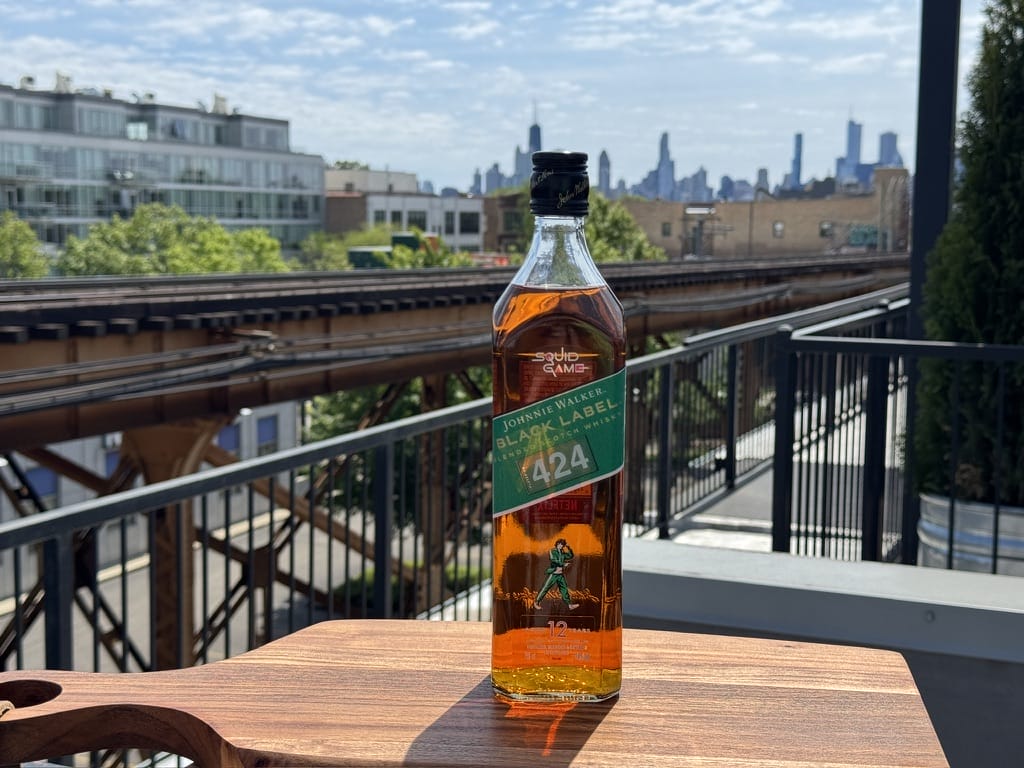
Diageo, the large liquor conglomerate owner of Johnnie Walker, likes to use their scotch in entertainment related tie-ins. From the “Johnny Drama” bottle for the Entourage movie to the White Walker by Johnnie Walker (that actually tasted like the final season of Game of Thrones…), it seems like they are always willing to partner up and create a new face for Johnnie. Since the final season of Netflix’s hit Squid Game released on June 27th, Diageo naturally partnered with them on a bottle. So we figured it would be a good time to grab the tracksuit green-labeled-black-label and give it a taste.
History
John Walker sold his family farm in 1819 and bought a grocery store in Kilmarnock, Scotland. Following the 1823 licensing of distilleries in Scotland, Walker (who surprisingly did not drink) started producing his own brand of blended spirits for sale in his store. He would produce blends to his customer’s requirements since, as someone who did not drink alcohol, he had none of his own.
The brand became somewhat popular and, following Walker’s death in 1857, his sons took up the family business. With the passage of a new law in 1860 that allowed for a wider variety of blended whisky to be produced, his sons solidified the company as a producer of blended whiskys by being among the first to innovate with the larger varieties now available. They also introduced the first square bottle in 1860, which allowed more bottles to fit on store shelves, as well as the distinctive tilted label that visually differentiated the brand and remains a feature to this day.
The Walkers purchased the Cardhu distillery in 1893, which became the primary source of single malt scotch used in the production of their red and black label whiskys.
In 1909, the descendants of John Walker embarked on a rebranding effort. They hired cartoonist Tom Browne to create a new logo, resulting in the Striding Man that remains the iconic logo of the Johnnie Walker brand.
In 1925, the company joined the Distillers Company, which was acquired by the Irish Guinness in 1986, and subsequently merged with Diageo in 1997.
Despite local backlash, Diageo decided to close the original Johnnie Walker distillery in Kilmarnock, the place where it all started, in 2012.
Product
- Learn More: What Is Scotch Whisky?
I tasted the White Walker edition of Johnnie Walker. I remember it vividly — after all, I was sitting at the rooftop bar of the Ritz Carlton in Bangalore. I wanted to order Oban, but the bartender convinced me to try this new Johnnie Walker instead – the hook, a double pour for the price of one. I should have known better.
So sure, let’s do this again.
The base for this bottle is Johnnie Walker Black Label. There’s not much to talk about here — Johnnie Walker is a famous blended whisky producer and they don’t share much about where they source their spirit from or what the grain bill is for their source. We can assume that the majority of the spirit comes from the Cardhu distillery, but even that is an educated guess.
In terms of what they actually say about the spirit, this is the most we get from the company:
Johnnie Walker Black Label is a smooth and beautifully balanced whisky with a distinctive smoky flavour, expertly crafted using an unrivalled selection of Single Malts and Grains each aged for at least 12 years.
Since this is a scotch whisky, we can make a couple assumptions — namely, that this spirit was aged in oak barrels and that the youngest drop of whisky in this bottle is 12 years old. Beyond that we don’t have much information other than “it’s brown”.
But we do know this bottle is more than just Black Label with a new label: it’s blended with Bori-Cha tea, which is the Korean name for a popular barley tea that is used in place of water in many homes and restaurants. So here is the hypothesis we’re testing today: will proofing down whisky with tea change the generally ho-hum taste of Johnnie Walker?
Packaging
Johnnie Walker has a distinctive shape to their bottle: square body with faceted edges, short neck, and metal screw-on cap. That’s all present here. Rather than taking the full shrink-wrapped approach that they took with White Walker, they simply updated the standard slanted Johnnie Walker label to use the colors and aesthetic of Squid Game.
It feels lazy. The slanted label is printed to look like green fabric, meant to resemble the tracksuits worn by the Squid Game contestants. The biggest change being the text is now top justified on the label, and a large number patch is shown. Apparently, you can find bottles numbered from 001 to 456 (representing the number of players in the game on the show), which is a fun touch that I’ll give them credit for.
Below that, the well known Johnnie Walker walking man is seen wearing a green tracksuit of his own.
Overall, the tie in feels haphazardly done. This isn’t an entirely new redesign done with shrink-wrap and color change material like White Walker. And it’s not like they had a lack of inspiration to work from — the visuals in Squid Game are often striking and bright, so they could have gone a completely different direction with a wrapped bottle covered in bright iconography. However, I do appreciate the fact that the minimal labeling still allows you to see the tawny whiskey inside, unlike the shrink-wrap versions.
Neat
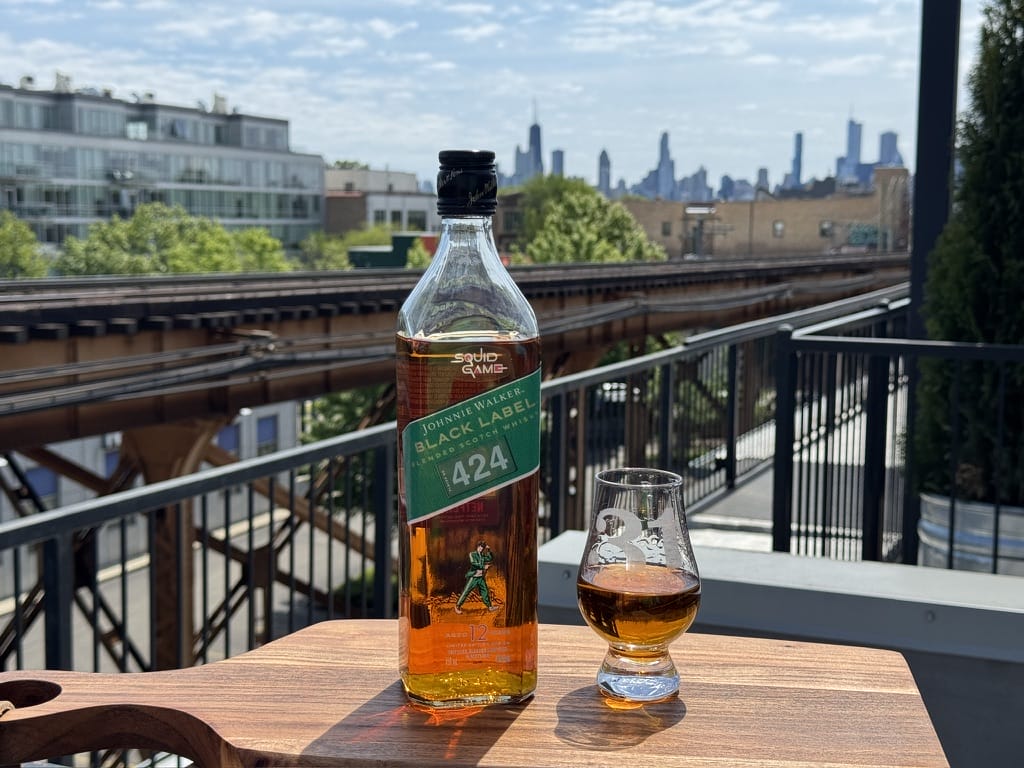
The first aromas I get are similar to what you would expect from Johnnie Black Label: vanilla, caramel, and maybe a little clove. However, there is also a distinct earthy or grainy note that I’m picking up, which I’m assuming is from the barley tea.
The first sip is textbook Johnnie Walker. Just like on the nose, there are notes of caramel, vanilla, and clove. But it’s generally smooth — not something I often associate with JW, which tends to be a little sharper. Mixed in, you get a set of very mellow, grainy, earthy flavors that remind me of a gentle tea that I think actually fills a gap in the flavor profile for me. JW is not known as a peaty Scotch, and this helps to bring some of the earthiness back into the fold.
I’m not blown away by the flavors, but nor are they bad… they just are.
On Ice
After pulling out a large cube and adding a splash of whisky, I had hoped things would start to open up a little more.
The first sip was pleasantly surprising — the ice helps to bring a little more sweetness out of the whisky and accentuate the tea flavor. It actually reminds me of drinking sweetened tea (but no, not the diabetes-inducing sweet tea from the American south) with a splash of whisky.
It reminds me of what Nick said about the White Walker whisky:
I think what’s happening here is that the flavor is actually “off” when taken straight neat — too saturated in the fruitiness on purpose. But when chilled, it turns back into a mediocre scotch whisky.
I wonder if this is part of the playbook: create a product that is meant to be consumed on the rocks, knowing it will be off if you drink it neat.
Scotch Whisky Sour
We don’t often do Scotch cocktails — but with the strong tea flavor, I wanted to experiment. I had a hunch that, based on that ‘sweet tea’ profile, using this whisky in a sour would create a bit of an Arnold Palmer situation.
After shaking the whisky, lemon juice, and simple syrup over ice, I strain it into my glass… but the results are mixed. It’s not a bad cocktail, but you mostly just get the lemon. It’s more like a boozy lemonade rather than an Arnold Palmer, sadly. You cannot pick out any of the whisky flavors and you definitely lose the tea behind the lemon.
Overall Rating
Netflix’s Squid Game has been a culture phenomenon. And mainstream America has never been big on dubbed or subtitled media, making it an even more unique, surprising phenomenon. So it makes sense for Diageo to lean in and partner for another gimmicky whiskey for marketing purposes. (And fair enough — I mean, here we are talking about it, even after the White Walker disaster.)
Behind the green label and Squid Game inspired stickers, this is still just a mediocre whisky that should only be enjoyed on the rocks. If you really like Johnnie Walker, really like Squid Game, or (god help you) are trying to collect all the numbered bottled like they’re Pokémon… then by all means grab a bottle. But don’t say we didn’t warn you that the contents aren’t that great overall.
| Johnnie Walker Black Label Squid Game 456 Edition Production Location: Scotland Classification: Single Malt Scotch Whiskey Aging: No Age Statement (NAS) Proof: 40% ABV Price: $32.99 / 750 ml Overall Rating:   |
Overall Rating: 2/5
If this whisky were competing in Squid Game, it wouldn’t make it past Red Light, Green Light.