
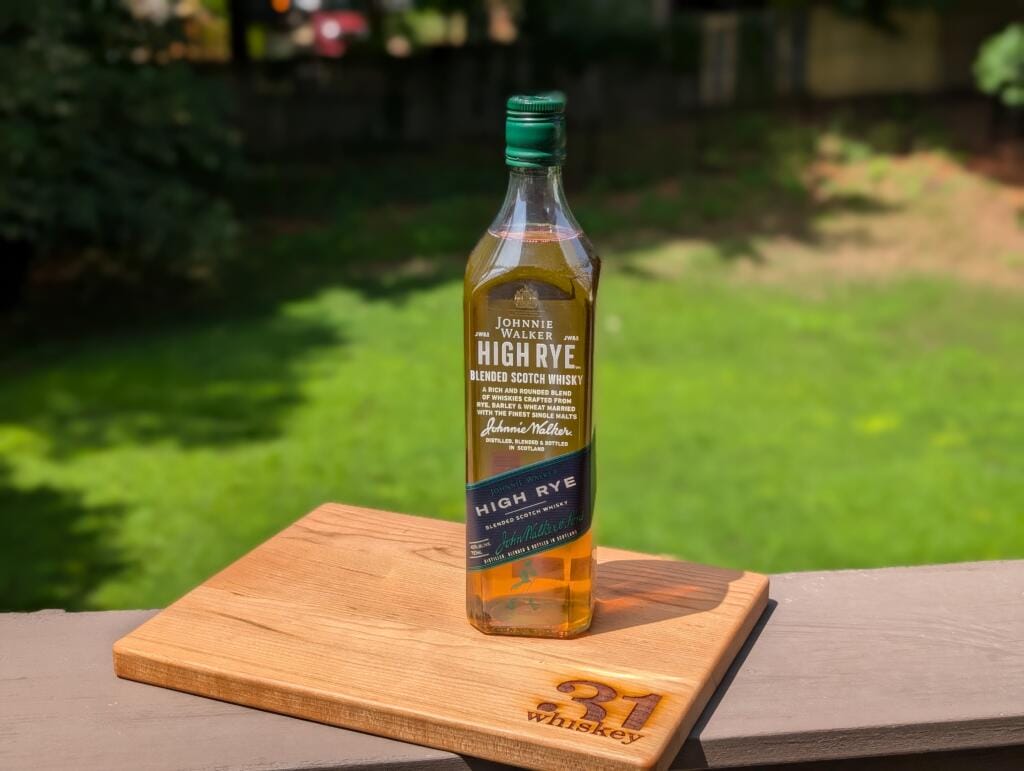
I’m a big fan of rye whiskey, and I’m a big fan of scotch. So when I saw that Johnnie Walker had a (relatively) new line of spirits that combined both those worlds, it naturally seemed like something I needed to try out. For me, the primary question was whether they could succeed in marrying two very different flavor profiles and concepts into a single barrel — and if that the result would be something I actually wanted to keep around on my shelf.
History
John Walker sold his family farm in 1819 and bought a grocery store in Kilmarnock, Scotland. Following the 1823 licensing of distilleries in Scotland, Walker (who surprisingly did not drink) started producing his own brand of blended spirits for sale in his store. He would produce blends to his customer’s requirements since, as someone who did not drink alcohol, he had none of his own.
The brand became somewhat popular and, following Walker’s death in 1857, his sons took up the family business. With the passage of a new law in 1860 that allowed for a wider variety of blended whisky to be produced, his sons solidified the company as a producer of blended whiskys by being among the first to innovate with the larger varieties now available. They also introduced the first square bottle in 1860, which allowed more bottles to fit on store shelves, as well as the distinctive tilted label that visually differentiated the brand and remains a feature to this day.
The Walkers purchased the Cardhu distillery in 1893, which became the primary source of single malt scotch used in the production of their red and black label whiskys.
In 1909, the descendants of John Walker embarked on a rebranding effort. They hired cartoonist Tom Browne to create a new logo, resulting in the Striding Man that remains the iconic logo of the Johnnie Walker brand.
In 1925, the company joined the Distillers Company, which was acquired by the Irish Guinness in 1986, and subsequently merged with Diageo in 1997.
Despite local backlash, Diageo decided to close the original Johnnie Walker distillery in Kilmarnock, the place where it all started, in 2012.
Product
- Learn More: What Is Scotch Whisky?
Johnnie Walker is a blended scotch whisky, which means that it sources its spirit from multiple distilleries and also, sadly, that there’s not much to talk about here. They don’t share much about where they source their spirit from or what the grain bill is for their source… we can assume that the majority of the spirit comes from the Cardhu distillery, but even that is just an educated guess.
What makes this version different is that they use a higher proportion than usual of grain whiskey in the blend, specifically rye grains. Typically, a blended scotch will have some proportion of grain whisky included because it’s a cheap additive that allows them to stretch out their expensive single malt stocks a little further — but in this case, that additive seems to be the star of the show.
In terms of what they actually say about the spirit, this is the most we get from the company:
Johnnie Walker High Rye Blended Scotch Whisky features a unique mash bill of 60% rye aged in American oak barrels, and includes notable single malts from distilleries such as Cardhu, an important part of the Johnnie Walker Black Label flavor.
So, essentially, this is an American-style rye whiskey that has been diluted with some single malt scotch.
Packaging
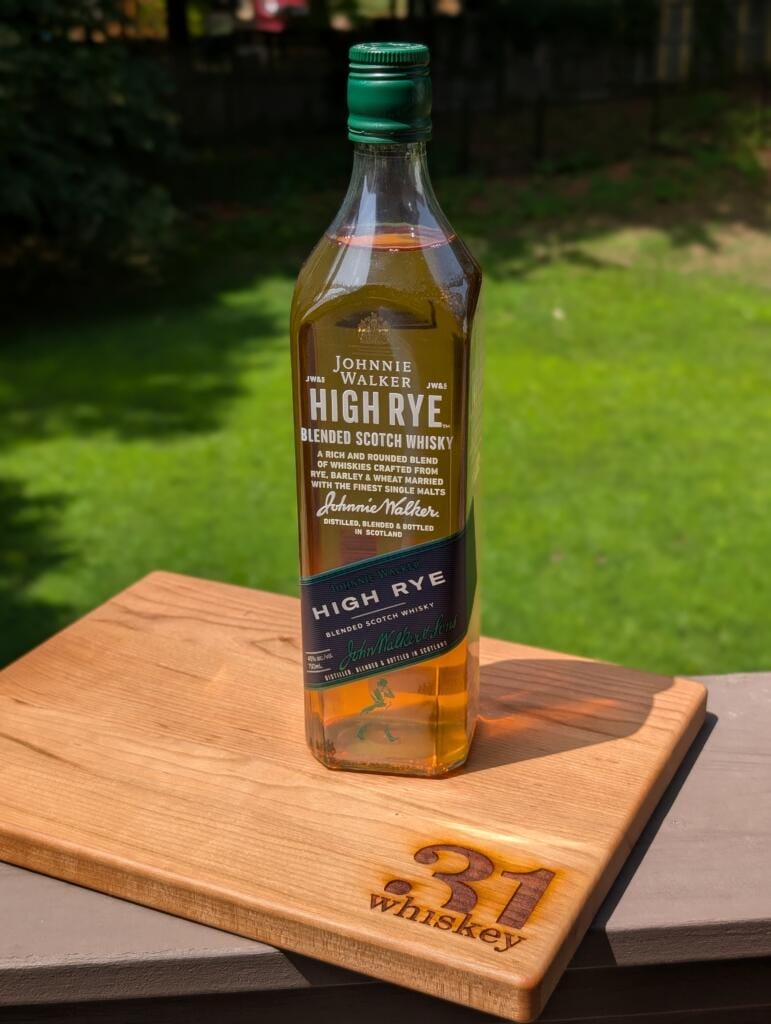
I’m not sure if this was due to my particular liquor store or if this is just a note of the quality, but this bottle didn’t arrive with the typical cardboard sleeve I usually see surrounding a bottle of Johnnie Walker. Not a dealkiller for me, but something to note.
Generally speaking, this bottle is a fairly standard design from Johnnie Walker. The square bodied and clipped cornered bottles have become almost iconic for the brand, evoking just the right level of old world charm and modern sensibilities to pull off something that looks pretty good on a back bar.
What sets this bottle apart from the others is that there’s more writing and text on the label, and as a result they have wrapped the bottle in this cheap looking and feeling plastic wrapper. Instead of printing the details on the bottle itself, the text is printed on that plastic wrapper and shrink wrapped around the bottle. It makes the package feel cheap, and mine came with some moisture trapped between the label and the bottle — something that only gets worse as the bottle sweats in the North Carolina summer humidity.
One thing I do like is that they went with a green color scheme for this version. I usually associate rye whiskey with the aroma of green apples, and so it makes sense (at least in my mind).
Neat
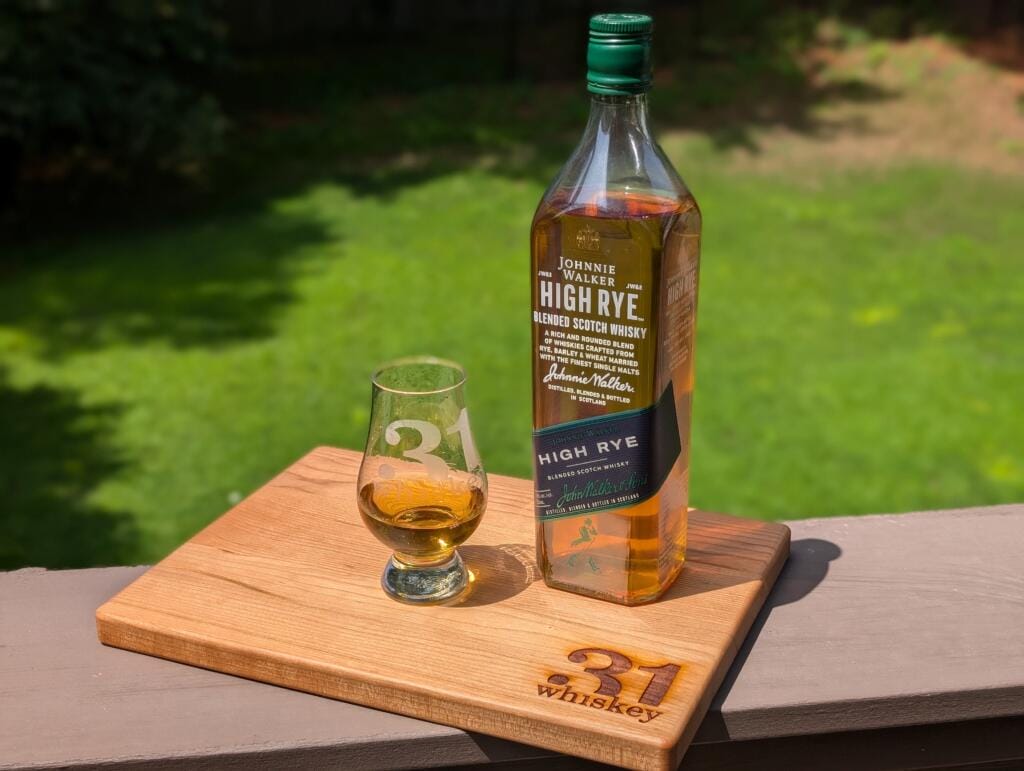
As soon as you take a whiff, you’ll know that there’s something different going on here. It might look like a standard glass of Johnnie Walker, but there’s much more character than I’d usually expect. There’s a good base of vanilla, caramel, and some cinnamon spice, but the real stars of the show are notes of brown sugar, crisp apple, and black pepper. Hiding in the background are also some of those floral and fruity notes that we saw in the Red Label version.
The aroma might have been great, but the flavor is only mediocre at best. Right up front, I’m getting positive confirmation that this is mainly a rye whisky: it tastes like a slice of fresh baked rye bread with some honey and a slice of apple. That’s pretty quickly soured by a strong hit of black pepper spice, which is then joined by the dinner-roll-bread qualities you’d normally get from a malt whisky. On the finish there’s a hint of the dried fruits you’d expect from an oaked whisky and especially a Highlands scotch, but those quickly fade as the peppery spice from the rye once again kicks in.
On Ice
I’m starting to get an understanding for why they decided to make this spirit. Taken neat, it doesn’t seem to do anything particularly well — but with a little bit of ice, the flavors start to mellow out and coalesce.
The biggest highlights here are the dried fruits (think dried figs and plums), some floral honey, and a bit of rye bread. And all of these are great flavors that I’m a big fan of — but then we run into the finish, where the black pepper spice starts to step out of line and become a bit overpowering.
The good news is that this might turn out to be a good option for cocktails… the bad news is now I’m wondering if there is anything new this brings to the table that a rye whisky couldn’t already provide.
Cocktail (Gold Rush)
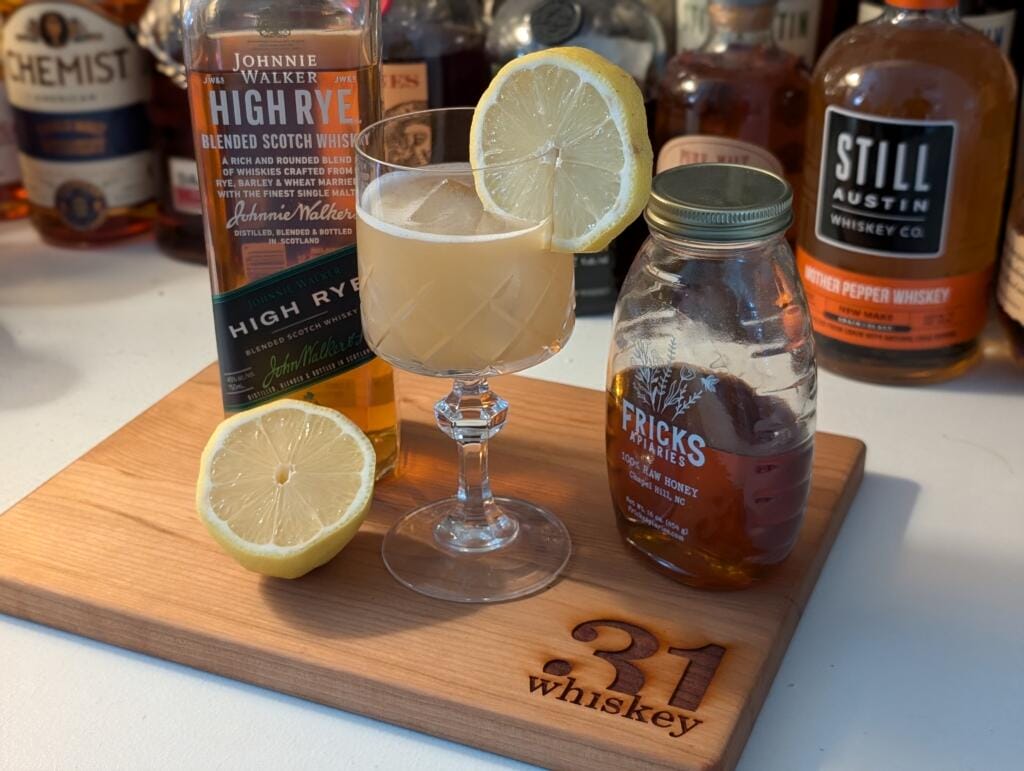
I tried to find cocktails that other people have worked up specifically for this spirit, and I may have hit gold here. Specifically, the recipe for this gold rush is:
1.5 oz Johnnie Walker High Rye
3/4 oz honey syrup (2:1 honey to water)
1/2 oz lemon juice (half a lemon)
Shake until cold, serve on the rocks
In my case, I think the honey I used was a bit richer and darker than expected, but the end result was pretty delicious. Even my wife (who normally hates anything with whiskey) was pleasantly surprised by the flavor profile.
But here’s the catch: I think it’s the rye content doing all the heavy lifting.
I don’t think I see any of the single malt elements of the spirit coming through. There’s floral and herbal components for sure, but all of those can be accounted for by the honey. The only thing that the spirit is adding is the black pepper spice and perhaps a bit of green apple, which combine nicely in the cocktail.
Overall Rating
Once again, I feel like the actual flavor of a blended scotch is letting me down. The aroma has so much promise, but the fact that blenders take advantage of the ability to “water down” their spirits with grain whisky means that you lose much of those amazing flavors. In the end, what you’re left with is a mediocre rye whisky that has some interesting aromas, but doesn’t really bring anything to the party that any other cheaper rye whisky could have done just as easily.
I appreciate the attempt, and the desire for Johnnie Walker to do something different… but this feels like a stretch of their brand. They are trying to fit their refined blended scotch flavor profile into a category where the competition is fierce and well established, and I don’t foresee that going very well — especially at this price point.
| Johnnie Walker High Rye Blended Scotch Whisky Production Location: Scotland Classification: Blended Scotch Whiskey Aging: No Age Statement (NAS) Proof: 45% ABV Price: $39.99 / 750 ml Overall Rating:   |
Overall Rating: 1/5
Unless you are specifically trying to look like a big spender, go with literally any other rye whiskey instead.
I think it’s a spectacular Feeling when you have a couple drinks on a fancy Glass and ice will take you further for that. There is no competition or simulation to the taste of this bottle. I’ve been buying it for two month , Quality shape of the bottle, the taste and the smoothness smoke. I would love you guys to send me the biggest size bottle for my weeding . sorry my for my English it’s the fifth language spoken and thank you for all