
One hundred reviews. When I wrote my first review for Thirty-One Whiskey, I was a freshly minted Chicagoan who didn’t yet know what he was getting into with the bottle in front of him. That bottle was Jeppson’s Malört. It felt like the right way to introduce myself to Chicago: lean into the thing everyone warned me about, put it in a glass, and… um… sip it neat.
Five years later, I have reviewed a wide array of spirits: Eagle Rare. Traverse City Whiskey Co. American Cherry Edition. Pappy Van Winkle Family Reserve 15 Year. Kirkland’s Canadian Whiskey. Some are bottles people wait in line for, trade favors for, and join waiting lists just to have the chance to purchase. Others are appalling — and I have tried to be honest about both ends of that spectrum. Ninety-nine reviews in, and here we are at number one hundred.
It was never really a question. It had to be Barrel Aged Malört.
In the years since that first review, Malört has become genuinely personal to me in a way I didn’t expect and cannot fully explain. I order it when someone offers to buy a round of shots (much to the chagrin of my friends). I buy bottles to bring back to Ohio so my family can experience the full horror of it firsthand. There are not many things I enjoy more than watching someone take their first shot. The face is always the same: somewhere between betrayal and existential confusion. I even attended a book reading for Josh Noel’s deep-dive history of the brand, Malört: The Redemption of a Revered and Reviled Spirit.
So when CH Distillery released Barrel Aged Malört – officially nicknamed BAM – it wasn’t really a question of whether I would try it. It was a question of whether it could possibly live up to the spirit that started all of this. One hundred reviews later, Malört has a lot to answer for.
History
The full story of Malört is one of the more remarkable narratives in American spirits, and Josh Noel did it proper justice in his book. The short version goes like this: Carl Jeppson emigrated from Ystad, Sweden — a country where wormwood grows wild and bäsk brännvin, a bitter wormwood-flavored spirit, has been a tradition for centuries. He settled in Chicago’s Swedish enclave and, by the 1920s, was producing his own version and selling it door to door as a medicinal product, leaning on the legal loophole that let “medicine” survive Prohibition. Federal enforcement apparently agreed with the premise, on the reasoning that nobody would drink the stuff recreationally. Reader, they were wrong.
Jeppson may have brought it to Chicago, but George Brode made it a thing. Jeppson sold the recipe in the mid-1930s to Bielzoff Products, the liquor company where Brode — a lawyer and budding entrepreneur — was an executive. Brode bought out the company in 1945, sold the liquor business in 1953 to go practice law, and kept exactly one brand: Jeppson’s Malört. He ran it for the next four decades as something between a passion project and a local institution. I’m not sure why a man would choose “a spirit somewhere between gasoline and regret” as his hobby, but he did.
When Brode died in 1999, he left the company to Pat Gabelick, his longtime secretary, who then ran it out of her Lakeview condo for the better part of twenty years — a detail that should tell you everything you need to know about the scale and spirit (all puns intended) of the operation. Along the way, a younger generation of Chicagoans embraced Malört as a rite of passage, and a small crew of fans-turned-brand-stewards did the work that made it an icon: Peter Strom as unofficial historian, Chris Depa building the digital presence, and Sam Mechling supplying the gleefully abusive creative voice the brand still speaks in today. Oh, and don’t forget the edge-of-your-seat trademark fight that eventually established “Malört” as Carl Jeppson Company property, sending competing bottlings scrambling for new names (Letherbee’s became Bësk; FEW’s became Anguish and Regret). The book makes it genuinely suspenseful.
In September 2018, CH Distillery bought the Carl Jeppson Company, and by 2019 Malört was being made and bottled in Chicago’s Pilsen neighborhood again — the first time it had been distilled in the city since the Mar-Salle distillery closed and production wandered off to Kentucky and then Florida for thirty-odd years. CH makes several spirits under its own label (bourbon, vodka, and a London Dry gin among them) and has used its Chicago home base to expand the Malört lineup well beyond the original. Barrel Aged Malört is the most ambitious expression of that expansion: a blend of Malört aged in ex-bourbon barrels, designed to coax something resembling sippability out of Chicago’s most aggressively bitter export.
Product
At its core, Malört is a bäsk brännvin, the Swedish style of wormwood-flavored spirit that Carl Jeppson carried across the Atlantic. The base is neutral grain spirit, a deliberately humble canvas. The character of Malört has always come from the wormwood, not the underlying alcohol. Sugar is added after flavoring, which is what technically classifies it as a liqueur rather than a spirit — the TTB requires at least 2.5% sugar by weight to earn that label. Beyond that, there are not a lot of governing rules for how a liqueur can be made or flavored, which is exactly as freeing (or in this case, as terrifying) as it sounds.
The barrel aged version takes that same wormwood-forward base and runs it through single-use ex-bourbon barrels. The result is a blend, with CH adjusting the ratio each year to hit their target profile, so no two releases are identical. At 35% ABV, it sits at the same strength as standard Malört; the practical difference between the two has nothing to do with alcohol content. What the barrel contact does is introduce new flavors and potentially mellow the patriotic earwax note of the original… whether that mellowing is a feature or a bug, though, turns out to depend entirely on what you are trying to do with the glass.
Packaging
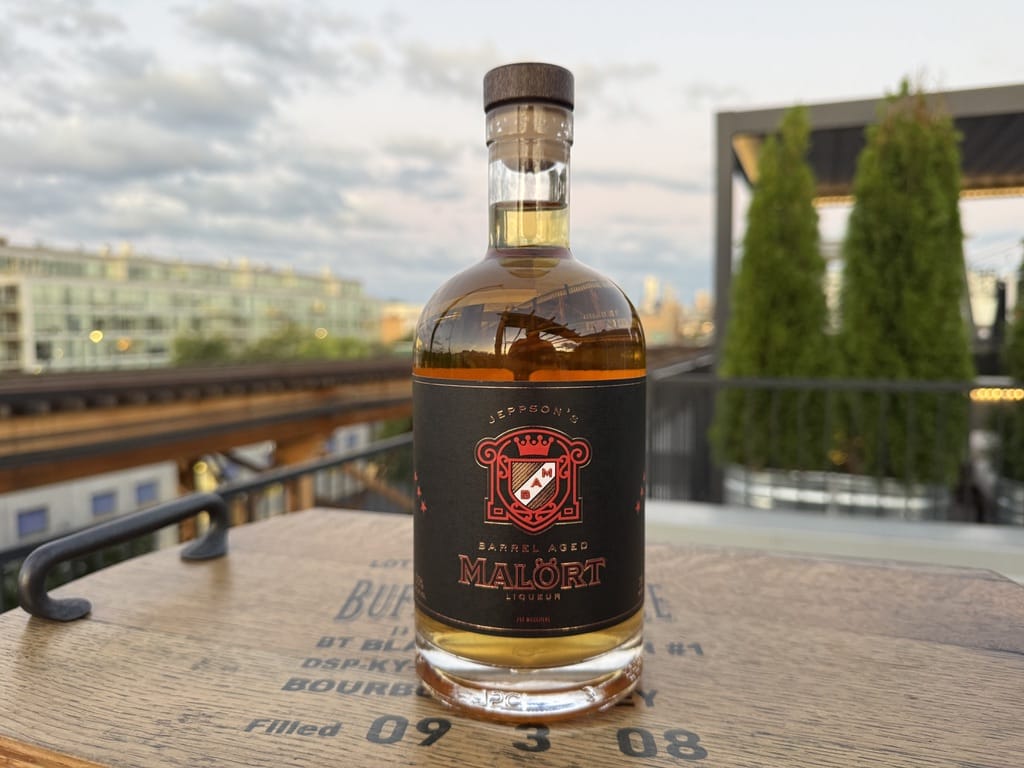
I will say this: somebody tried. The bottle is a basic shape, nothing unusual there, but the label leans hard into the premium aesthetic that tends to come with barrel aged spirits. Dark background, red and gold crest, a wood-topped cork instead of the plastic twist-off lid the original sports with zero apology. The whole presentation is noticeably fancier than the standard Malört bottle (though I’m not sure that’s saying much).
Part of me appreciates the effort. They dressed up the familiar elements, reworked the original crest, and put a real cork on it. But there is something about Malört that earns its charm precisely because it has no pretense whatsoever. The original label still carries the three-star Chicago flag of 1933 and looks like nobody has touched it since. Which is the point: Malört does not need to impress you. Barrel Aged Malört, with its dark label and fancy cap, seems to be trying just a little too hard to be something its ancestor explicitly refused to be.
Credit where it’s due: the bottle pours well. When the time comes to pour shots for your closest friends and your enemies, it delivers cleanly and without drama. That counts for something.
Neat
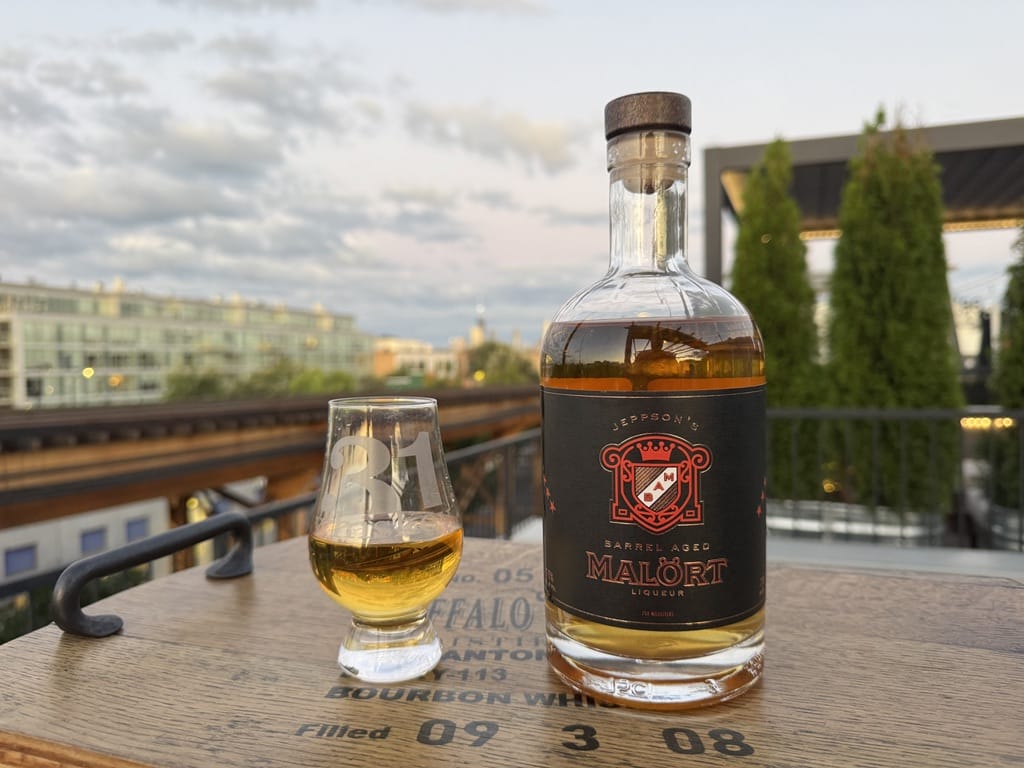
The nose is honest about what it is. You can tell it’s Malört. There is a sour, botanical aroma that announces itself immediately, and somewhere in the middle of it is something I can only describe as Elmer’s Glue (not a typical tasting note, I realize, but Malört is not a typical spirit). And yet underneath all of that, there is something almost pleasant lurking. Like taking a deep breath in an English garden. Unexpected, briefly charming, and gone before you can fully trust it.
The first sip reframes the whole experience. Mine happened on South Bass Island in Lake Erie at a family gathering, because I like to share the wealth. The sun was setting. I poured a glass neat and called it my “walkin’ around Malört” much to the chagrin of cousins who by now know too much about Malört (you’re all welcome). It was genuinely enjoyable to sip while wandering around in the evening air. I will note that I had exactly one taker when I offered a pour: my cousin’s boyfriend, who accepted with the appropriate level of cautious curiosity and, for reasons I still cannot explain, served us both in small styrofoam bowls. Small styrofoam bowls are the only correct way to drink Barrel Aged Malört for the first time, and I will not be convinced otherwise.
The flavor is more sour than bitter, a meaningful distinction from the original, which leads with the bitterness of a grapefruit holding a grudge. The barrel aging has done real work here. You get good oak, a general botanical sweep, and mild baking spice. There is still bitterness, but it sits in the background. The flavor also doesn’t linger the way standard Malört does, which is either a relief or a disappointment depending on your relationship with the original. For a walkin’ around sip at sunset? It’s a good call.
On Ice
Here is where things get interesting, and not in a good way. Ice does something counterintuitive to Barrel Aged Malört: it hits control-Z on the barrel aging’s good work. Where a few cubes typically mellow and open up a spirit, here they strip away the very thing that makes the aged version worth drinking. The pleasant sourness recedes, the oak influence fades, and what’s left tastes increasingly like standard Malört. Which is to say: a Band-Aid soaked in a puddle behind a gas station.
The bitterness returns. The botanical sharpness reasserts itself. If you handed this to someone without telling them what it was, they’d guess it was the original, not the aged expression. It’s a strange and slightly dispiriting transformation, and worth noting that it runs exactly opposite to my experience with the standard bottle, where ice performed a small miracle. Skip the ice here. Drink it neat or find another approach entirely, because the rocks actively undercut the best parts of this bottle.
Cocktail (Old Fashioned)
I was not prepared for this. This is a damned good cocktail. Let me be clear: not just a good Malört old fashioned. A good old fashioned, full stop.
The wormwood comes through clearly — you always know exactly what you’re drinking — but the bitters, the sugar, and the orange peel work together to put a frame around it. The edges are mellowed. The bitterness is brought in line. The result is something complex and interesting that I would order at a bar without hesitation. In fact, I have, and it blew the mind of at least one Chicago bartender. It’s a cocktail that rewards the adventurous drinker, and any bartender who doesn’t have a bottle of BAM behind the bar is missing a genuinely useful tool.
Fizz (Mule)
There are not many spirits on earth that can completely overpower ginger beer. Ginger beer is not a subtle ingredient. But, like the honey badger, Barrel Aged Malört don’t care.
You get the faintest suggestion of ginger in the first half-second. Then it is all Malört. Aggressive, wormwood-forward, bitterness-first Malört. The barrel aging that did such good work in the neat pour and the old fashioned evaporates entirely under the ginger beer, and what’s left tastes essentially identical to mixing the original with watered-down ginger beer — or, if I’m being precise about it, like the liquid pooled under a truck at a discount seafood market, with ginger beer. Much like the rocks, the fizz strips the BAM right out of BAM. I would not recommend this preparation. The old fashioned is the move. Stay there, or get creative and find out what a BAM boulevardier tastes like. I don’t care.
Overall Rating
I started my journey in spirits reviews with Malört, and it only made sense to come back around. Which is either poetic or absurd… and honestly, I think it’s both.
Barrel Aged Malört is a genuinely impressive achievement for a spirit that has no business being impressive. CH Distillery took the most aggressively difficult bottle in Chicago and figured out how to make it sippable, cocktail-worthy, and (in the right context) genuinely enjoyable. The BAM old fashioned is one of the better craft cocktails I’ve had in a while — which is not a sentence anyone expects to type when Malört is involved.
At $34.99, roughly fifteen dollars north of what the standard bottle cost me when I reviewed it back in 2021, the value is real. If you see it, buy it. It’s worth every penny for the cocktail application alone. Who doesn’t want a barrel aged version of a spirit best known as a traumatic bar dare that arguably violates the Geneva Conventions? The spirit that started all of this for me has grown up.
| Jeppson's Barrel Aged Malört Production Location: Unknown Classification: Liqueur Aging: No Age Statement (NAS) Proof: 35% ABV Price: $34.99 / 750 ml Overall Rating:  |
Overall Rating: 5/5
Perfect, no notes! [EDITOR’S NOTE: For Chicago residents, maybe.]