
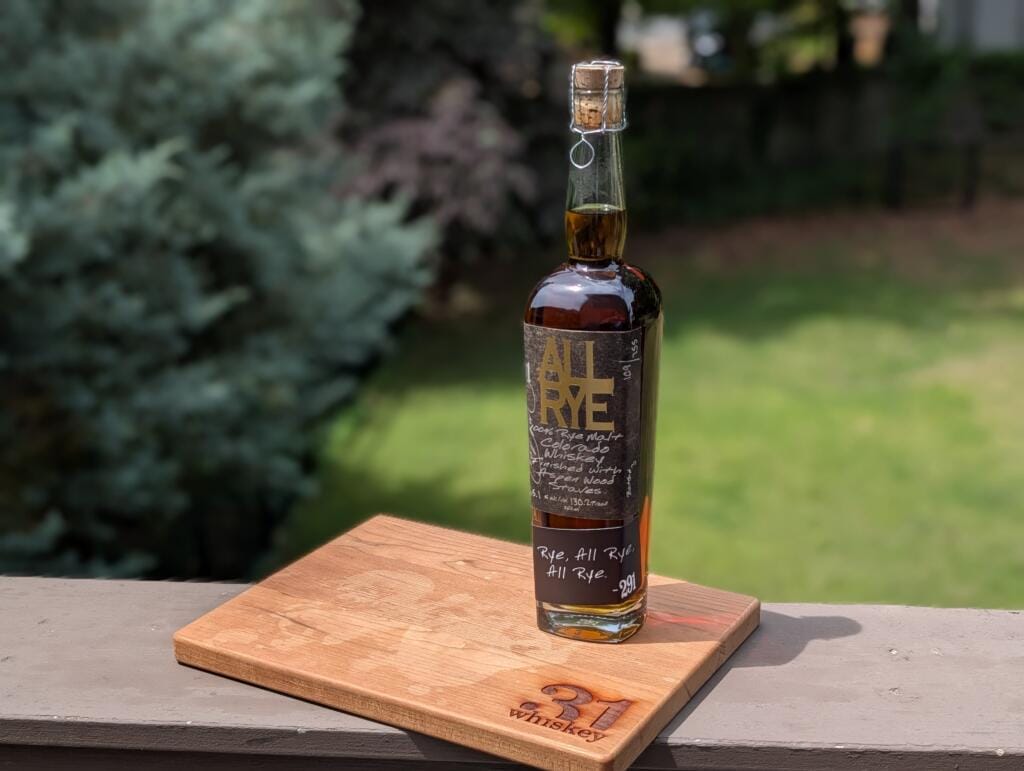
Of the four bottles I picked up from Distillery 291 during a hiking trip to Colorado Springs in May 2026, this is the one that made me do a double take at the liquor store shelf. Because hand-scrawled along the bottom of the label in white paint pen is: “Rye, All Rye, All Rye.” — and as someone who has lived in Austin, Texas for over a decade, that Matthew McConaughey reference landed immediately. And if you’re going to name your 100% rye malt whiskey with a wink and a nod to Austin’s most famous slow-talking philosopher (and by that, I mean Wooderson), you’ve already won me over before the cork comes out. We recently reviewed the Big Horn Bourbon from 291 and came away impressed — so this time, we’re going full rye and seeing what happens when the corn steps aside entirely.
History
Distillery 291 has one of those origin stories that sounds like a movie pitch, except it’s entirely real. The distillery was founded in 2011 by Michael Myers (not the horror villain and not the comedian), a Georgia native who grew up on a family farm in Sandy Springs, just north of Atlanta. His family also raised Tennessee walking horses on a property in Flat Creek, Tennessee, situated between the Jack Daniel’s Distillery and Cascade Hollow Distilling Co.
Myers attended the Savannah College of Art and Design, where his dorm room happened to be number 291 — a number that would later take on a second layer of meaning when he discovered that photographer Alfred Stieglitz had opened the first gallery dedicated solely to photography at 291 Fifth Avenue in New York City back in 1907. He took it as a sign and built a successful career in fashion and beauty photography in New York City, eventually living just a few blocks from the World Trade Center.
On September 11, 2001, Myers was walking his youngest son to school when the first plane hit. The family eventually relocated to Colorado Springs, and what was supposed to be temporary became permanent. For nearly a decade, Myers continued commuting back to New York for photography assignments. The turning point came in 2010, on a flight back to Colorado after a magazine shoot, when he read an article about Steven Grasse, the marketing mind behind Hendrick’s Gin and Sailor Jerry Rum. Having grown up in Georgia and Tennessee, he’d been around whiskey his entire life. The leap didn’t feel as far as it might seem from the outside.
Here’s where it gets interesting: a proper copper pot still from a reputable manufacturer would have run upward of $50,000… not exactly pocket change for a career-changer. So instead, Myers built his own. He had previously exhibited a series of photogravure prints (a process where images are etched onto copper plates) at a gallery in Tribeca. He drew up the dimensions for a still, made a paper mock-up, and brought seven copper plates from his art exhibit to a local welder. A whiskey still, built from photographs. Today, a much larger 300-gallon still handles the primary distillation, but the original still continues to operate as a doubling still… meaning every drop of 291 whiskey still flows through those original seven copper plates from Myers’ photography career.
A series of delays pushed the project through the summer of 2011, and the still wasn’t ready until early September. Myers decided to wait until September 11th to run his first batch — remaking the anniversary into something about creation rather than loss. The name “291” tied everything together: dorm room, gallery, and now distillery. For three years, he worked solo, distilling, aging, blending, and bottling thirty-gallon batches inside a three-hundred-square-foot facility.
Today, Distillery 291 operates out of a much larger space in Colorado Springs, with head distiller Eric Jett working alongside Myers. The operation is still small by industry standards (for comparison, the big Kentucky distilleries probably spill more whiskey than 291 makes in a year) but the trophy case is absurd for a craft operation: World’s Best Rye (2018 World Whiskies Awards), World’s Best Wheat (2021), Icons of Whisky 2022 American Craft Producer of the Year, 2023 Colorado Distillery of the Year, nine Liquid Golds from Jim Murray’s Whisky Bible, and multiple Double Golds at the San Francisco World Spirits Competition.
Critically, Distillery 291 remains independently owned and operated by Michael Myers. No corporate parent company. No multinational lurking behind the curtain. Nearly fifteen years in, this is still a genuinely independent craft distillery, and at this level of recognition, that’s increasingly rare.
Product
The All Rye is something of a departure for 291. While the distillery has always leaned heavily on malted rye varieties more common in brewing than in traditional whiskey-making, this expression goes all the way: 100% rye malt — no corn, no wheat, no barley to hide behind. The mashbill is a 50/50 split between Colorado malted rye sourced from Root Shoot Malting in Loveland, Colorado, and German rye malt from Weyermann Specialty Malting. Which is a fascinating choice — sourcing half your grain from a fifth-generation Colorado family farm and the other half from one of the most respected specialty maltsters in Bavaria. It’s a mashbill that exists… precisely nowhere else in American whiskey, as far as I can tell.
The All Rye grew out of 291’s earlier experiments with single malt expressions. Myers was apparently so pleased with the results of an all-rye experiment with this grain bill that the decision was made to formalize it as its own product line. And because 291 was built on rye from the beginning, naming it was simple — Myers reportedly just exclaimed the obvious, and a trademark was born.
Like all 291 whiskeys, the mash is soured in open-air fermenters before being triple-distilled through the distillery’s custom copper pot stills (including that original still built from photography plates). The whiskey is aged in virgin, heavily charred American white oak barrels and finished with toasted Aspen wood staves harvested from nearby forests. Distillery 291 also employs what they call the “El Paso County Process”, a proprietary technique that recycles secondary stillage back into the mash. It seems like their Colorado twist on the traditional sour mash concept where the “cut” portions of previous distillation runs are recycled and re-distilled in future runs.
There’s no age statement on this whiskey, so we don’t really know how long it sat in a charred oak barrel before bottling. 291 has historically used smaller-format barrels, which accelerate the aging process through increased surface-area-to-volume contact. This is especially important given the high altitude of their distillery: there is less oxygen available to interact with the whiskey and create those delicious flavors that we all know and love, and the smaller barrels increase the surface area of oxygen and oak available to the whiskey. When properly matured, the whiskey is removed from the oak barrels and finished with toasted Aspen wood staves harvested from nearby forests, giving it that distinctive Colorado character that runs through all 291 expressions. The whiskey is then bottled, corked, and caged by hand.
Packaging
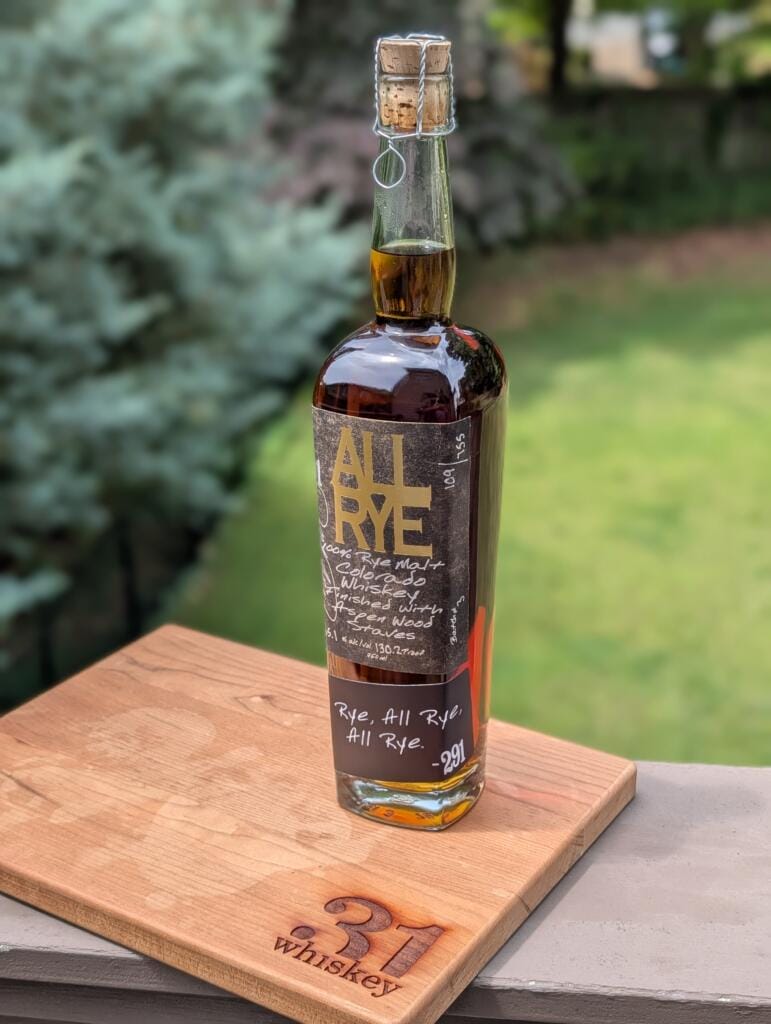
The bottle shares the same DNA as the rest of the 291 lineup: tall, cylindrical, clear glass that lets you see every bit of the gorgeous liquid inside. The natural cork is held in place by a wire cage during transit, with “291” burnt into the top of the cork. It’s a nice touch, and one that’s consistent across their bottles.
The label continues the 291 handwritten aesthetic, with the same dark, nearly black rectangle occupying the lower two-thirds of the bottle and”ALL RYE” rendered in prominent gold and white hand-painted lettering. Below that, “100% Rye Malt Colorado Whiskey” in flowing script, followed by “Finished with Aspen Wood Staves”, the lot number, batch number, proof, and volume — all in what appears to be actual handwriting. The artist-photographer founder’s fingerprints are all over this design, and it works.
But the real star of the label is at the very bottom, where in white script it reads: “Rye, All Rye, All Rye. — 291”. As someone who spent over a decade absorbing the particular cultural radiation that emanates from Austin, this reference hit like an inside joke between the bottle and me. It’s the kind of small, stupid-smart detail that tells you there’s a sense of humor behind this operation, not just a marketing department.
The label-to-bottle ratio is the same as the Big Horn: borderline too much real estate taken up by that dark rectangle. I’d love to see more of the gorgeous brown-orange liquid, but the design itself is consistent and compelling enough that I can live with it.
Neat
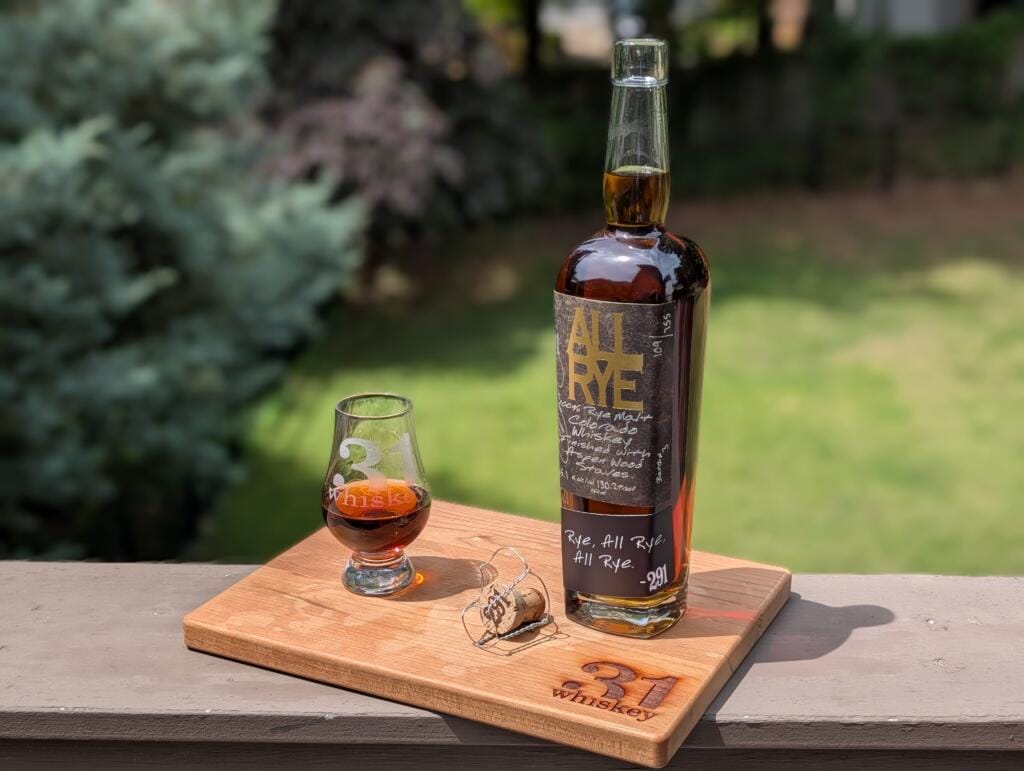
The color is a rich brown with a tint of orange around the edges, like the color of toasted caramel on top of a perfectly torched crème brûlée. It’s a shade warmer and more orange than the Big Horn Bourbon, which leaned darker and more amber.
On the nose, the first thing that hits you is the alcohol… and I do mean hits. At 130.2 proof, this spirit nearly singes the nostrils. It arrives with a physicality that demands you respect its personal space before proceeding. Once you push past the heat, though, there’s an unexpectedly delicate and seasonal aroma hiding underneath: crisp green apple, cinnamon, nutmeg, and a whisper of caramel. It smells (and I’m not being cute here) like a New England Christmas morning. Like someone is making cider downstairs and there are pies in the oven and the house smells like possibility and brown butter.
But then you take that first sip, and… well,if you read our Big Horn Bourbon review, you’ll recall that the 132.8-proof bourbon punished the unprepared. The All Rye follows the same playbook, except instead of a freight train, this one is more like getting caught in the wrong lane of a Colorado avalanche chute. The first sip is pure alcohol — a scorched-earth approach that annihilates your taste buds and leaves you wondering if there are actually any flavors in here at all. There are. But you need a second sip to find them, after most of your palate has been sufficiently cowed into submission.
That second sip reveals a rich, earthy core of dark chocolate and coffee, and this is where the 100% malted rye grain bill starts to make itself known. There’s an earthiness to those coffee notes that I don’t typically get from standard rye whiskeys; the malted grains are contributing something that tastes like the deeply roasted, slightly bitter base note of a properly pulled espresso. Black pepper spice develops underneath, and the green apple from the nose is present way, way off in the far distance — like seeing someone wave from across a canyon. But at this proof, anything more delicate than dark chocolate and coffee is fighting an uphill battle through a wall of ethanol.
This is not a whiskey I would recommend neat, even for experienced high-proof drinkers. It’s not that the flavors aren’t interesting – they are – but the alcohol so thoroughly dominates the experience that you’re getting maybe 30% of what this spirit has to offer. My experience with the Old Forester Single Barrel Barrel Strength at 65.4% ABV followed a similar pattern, where the first sip damn near knocked me out of my chair. The All Rye is even higher proof and even more combative. It has opinions, and it would like to express them directly into your sinuses.
On Ice
Generally speaking, adding a bit of ice to a spirit washes out the weaker flavors while taming the harsher elements, smoothing the edges and leaving you with a slightly diminished but more approachable version of the neat pour. For the All Rye, though, the ice doesn’t simply help — it’s essentially mandatory. This whiskey needs ice to be properly enjoyed. Without it, the alcohol is simply too powerful for the rest of the flavor profile to compete.
With a few cubes, however, the All Rye opens up beautifully. The dark chocolate and coffee notes that were fighting for survival are now front and center, rich and present and deeply satisfying. But more importantly, the crisp apple that was barely a rumor on the neat pour starts to come through with real presence, providing a welcome counterpoint of brightness and levity to what is otherwise a very rich, very earthy spirit. The black pepper texture develops nicely in the finish, adding a pleasant warmth that’s now distinguishable from the raw alcohol burn.
What I think is happening here is that the malted rye grains are contributing a unique earthy quality, almost like the roasted grain character you’d get from a really good stout beer. This reinforces and amplifies the coffee note in a way I don’t always encounter in rye whiskeys. It’s a flavor fingerprint that feels specific to this 100% rye malt mashbill, and it’s one of the most interesting things about this bottle.
On ice, the All Rye transforms from a nearly undrinkable neat spirit into something genuinely delicious and layered. The gap between the neat and on-ice experience here is the largest I’ve encountered in a 291 expression yet.
Cocktail (Old Fashioned)
Ice did a great job taming the beast, but adding a bit of sweetener (simple syrup works, demerara syrup is even better) turns this into a truly drinkable and exceptional Old Fashioned.
The aromatic components from the bitters do a fabulous job here, balancing beautifully with the rich and earthy dark chocolate and coffee notes that define this whiskey’s core character. Rather than fighting those heavy, brooding flavors, the bitters seem to accentuate the black pepper spice that’s already lurking in the spirit, pulling it forward and giving the cocktail a third dimension of flavor that ties everything together. The sweetener bridges the gap between the earthy base and the bright aromatics, creating something genuinely complex and rewarding.
This is a great version of an Old Fashioned — a little stronger than most people might prefer, but with a depth and complexity that had me reaching for the bottle more often than I expected. Where the Big Horn Bourbon Old Fashioned was all dark chocolate and cedar, brooding and mountain-bar-complex, the All Rye trades cedar for coffee and pepper, creating something warmer, earthier, and just as compelling.
Fizz (Mule)
The whole point of a good mule is to provide depth and complexity to an otherwise bright and acidic cocktail — to prove that there’s more happening in the glass than what you’d get from vodka or some less interesting spirit. And the All Rye absolutely makes the grade.
What’s normally an overly bright, citrus-forward cocktail is here transformed into something that might be just as at home in a dark cocktail lounge as it would be on a patio. The malted nature of the grains is doing fantastic work here, providing a richness and earthiness that balances out the aggressive brightness of the ginger beer in a way that corn-based spirits just don’t achieve. And here — finally — we can detect the crisp apple note that’s been hiding just behind the curtain all review. It joins the lime citrus to create something genuinely interesting, complex, and delicious.
For a spirit that I genuinely wouldn’t recommend neat, the All Rye makes an exceptional mule. There’s a certain poetic justice in the fact that the cocktail format most associated with less interesting spirits is where this particular whiskey really gets to show off what makes it unique.
Overall Rating
The 291 All Rye is a fascinating, powerful, and ultimately rewarding whiskey that happens to be completely unsuitable for drinking neat — and I say that as someone who regularly drinks spirits north of 130 proof. The alcohol content on this one is so dominant in the neat pour that it genuinely prevents you from experiencing the complexity that the 100% rye malt mashbill and Aspen stave finish have created. This is a cocktail whiskey, full stop. Because when you put it in a cocktail or throw some ice in the glass, it transforms into something special.
At $130 for a 750ml of a limited-edition expression with only 802 bottles produced per batch, you’re paying a premium — but you’re also getting something that exists nowhere else in American whiskey. The 50/50 split of Colorado and German malted rye, triple-distilled through copper photography plates, aged in charred American oak, and finished with toasted Aspen staves harvested from the foothills of the Rocky Mountains… that’s a production process and a flavor profile you literally cannot find from any other distillery.
This is a half-step up from the Big Horn Bourbon we reviewed, which earned a solid 4 out of 5. The All Rye has a more unique flavor profile (that dark chocolate and coffee core, the malted grain earthiness, the crisp apple that emerges in cocktails) and it performs exceptionally well in both the Old Fashioned and the Mule, which is a rare double win. The Big Horn was good in an Old Fashioned but merely fine in a mule; the All Rye excels in both. The neat experience holds it back from a perfect score, but not by much.
Our colleague Dan reviewed the Bad Guy expression from Distillery 291 and was equally impressed with the distillery’s craftsmanship and bold approach. At this point, 291 is three for three on our scorecard: each expression different, each expression rewarding, and each expression unmistakably Colorado.
| Production Location: Unknown Classification: Aging: No Age Statement (NAS) Price: $?????  |
Overall Rating: 4.5/5
All rye, all rye, all rye — and all worth it, as long as you bring ice.