
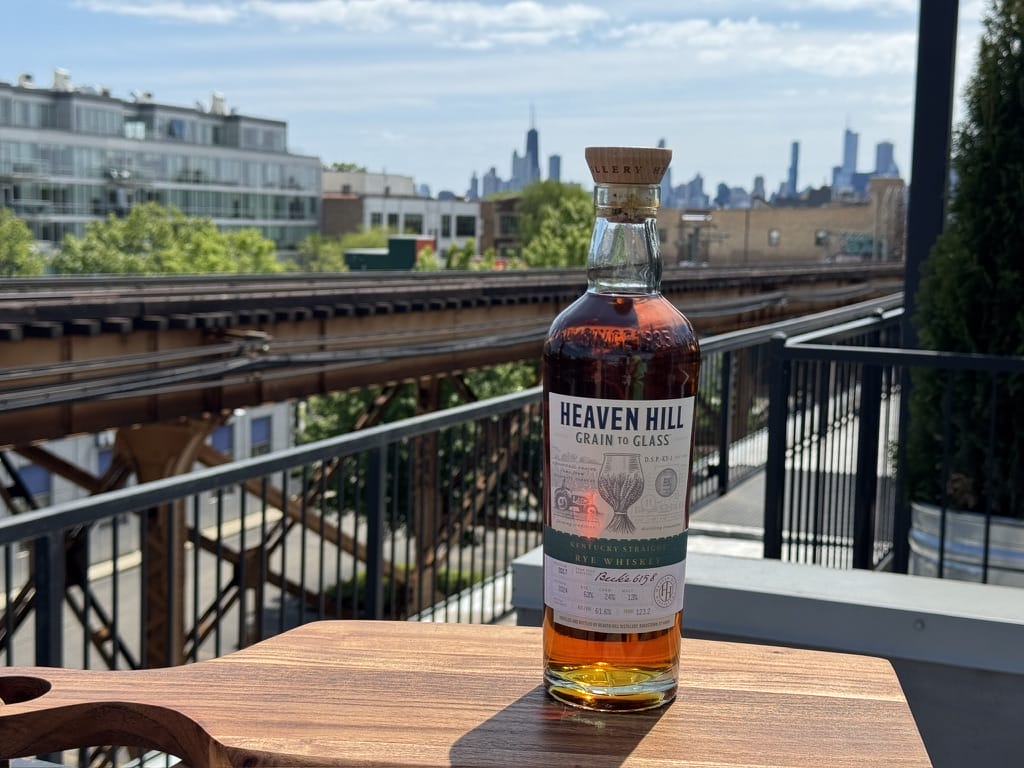
We recently took a look at the bourbon offering from Heaven Hill’s new Grain to Glass series, and now it’s time to turn our attention to the rye. If you haven’t read that review yet, I’d recommend checking it out — the Grain to Glass lineup is an interesting departure for Heaven Hill, focusing on transparency and traceability from the seed all the way to the bottle. It’s a concept I can get behind, and the bourbon was a solid first impression.
I’m also a sucker for a good rye whiskey. There’s something about those bold, peppery, grain-forward flavors that just speaks to me. So a barrel proof rye from one of the biggest distilleries in America, with a higher-than-usual rye content and a focus on showcasing the grain? Sign me up.
History
Established in 1935, shortly after the end of prohibition, Old Heavenhill Springs Distillery was founded by a group of investors in Bardstown, Kentucky. They were gambling on the idea that alcohol production would be a booming business after prohibition and invested heavily in being one of the first companies to service that market. One of those investors was well known distiller Joseph L. Beam (first cousin to Jim Beam), who would also become the first master distiller of the facility.
As the years went on, five brothers in the investment group, the Shapira brothers, bought out all of the other investors to become the sole owner of the business and changed the name to “Heaven Hill Distillery”, which was a typo on the paperwork from the original Heavenhill distillery. Despite being bought out, though, the descendants of Joseph Beam remain the master distillers of the facility to this day.
Their primary distilling facility burned down in 1996, destroying 90,000 barrels of whiskey and lighting the creek that feeds the distillery on fire for nearly two miles downstream. I did a visit to the distillery back in 2024 (more about that in this review of Five Brothers Bourbon) and according to the distillery tour guide, the fire melted 5 fire trucks and burned for nearly 4 days. But they also said that “the truth is agreed upon fiction”… so take that as you will.
Regardless of how long it burned, the business survived and they purchased a new distillery in Bernheim from Diageo in 1999. All production now takes place there, but all aging still takes place at the original Bardstown facility.
That 1935 bet has paid off big time. Heaven Hill Distillery is currently the biggest family-owned distillery in the United States and the second largest holder of bourbon whiskey inventory in the world. Their flagship brands include Deep Eddy vodka and Elijah Craig, and their facility hosts the annual Kentucky Bourbon Festival.
Product
The Grain to Glass series represents a new direction for Heaven Hill, focusing on transparency and traceability from the very beginning of the whiskey-making process. The series launched in 2024 with three expressions: a bourbon, a wheated bourbon, and a rye whiskey, each featuring unique mashbills that differ from Heaven Hill’s traditional recipes. Each year, the master distiller works with Beck’s Hybrids to select a specific corn seed varietal, which is proudly displayed on the label. The corn seed varietal chosen for the first edition was Beck’s 6158, and every bottle bears detailed production information including the distillation year, aging location, and barrel entry proof. It’s a bold move for a distillery of this size and scale, and I appreciate the effort to give whiskey enthusiasts a deeper connection to the liquid in their glass.
My bottle was distilled in 2017 and bottled in 2024 at bottled at whopping cask strength of 123.2 proof. For this bottle of Grain to Glass Rye, it features a mashbill of 63% rye, 24% corn, and 13% malted barley. That’s a higher rye content than Heaven Hill’s traditional rye whiskey recipe, which is used for the Rittenhouse Rye.
Let’s also take a moment to highlight that with only 24% of the mashbill being corn, the “traceability” concept with Beck’s starts to go out the window. Considering this is a rye, it makes sense… but it would still be nice to see the same level of traceability that we saw in the bourbon.
Those grains are milled, cooked, and fermented to create a mildly alcoholic distiller’s beer, which is then distilled at the Bernheim Distillery in Louisville, Kentucky. The resulting new make whiskey went into the barrel and was aged for just over six years at Heaven Hill’s Cox’s Creek rickhouse on the third, fourth, and fifth floors.
Packaging
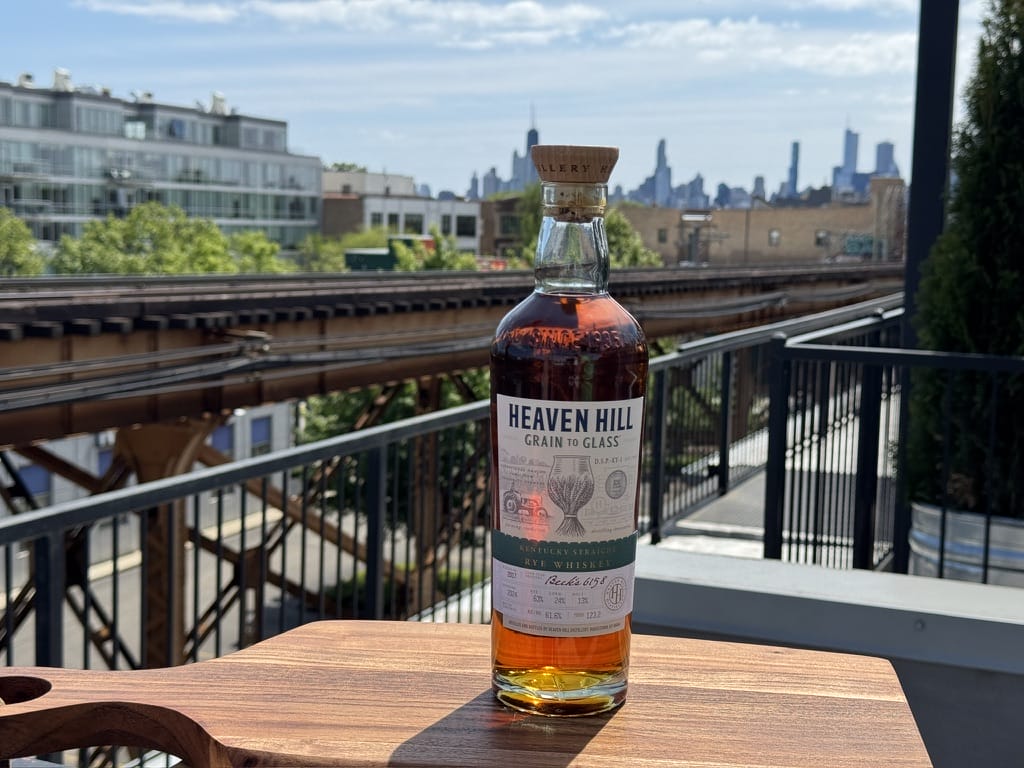
As I said in the last Heaven Hill review, I like the overall vibe of the Grain to Glass series. The bottle is a tall cylinder that’s narrower at the base than at the shoulder, with a gently sloping shoulder that tapers up to a short, bulbous neck. It’s topped with an oversized cork stopper that gives the whole thing a premium feel. Each variety in the series shares a similar look but with a different color to distinguish them: bourbon is blue, rye (this bottle) is green, and wheated is red.
It’s a good looking bottle that has a higher-end feel to it — which is appropriate given the price point. That feel is present both when you’re pouring, and when you see it on a shelf. I appreciate that Heaven Hill invested in new custom glassware for this line, because it signals that this isn’t just another limited release destined to disappear, but rather something they seem intent to build on for years to come.
The label is where things get interesting. Heaven Hill went all in on the transparency angle with their labels, packing them full of production details that you rarely see from a distillery this size. I first started to see this from Bardstown Distillery, and really have come to appreciate the transparency. Not only do see the exact mash bill, but you’ll find the specific corn seed varietal (Beck’s 6158), the distillation year, and the aging details all right there on the bottle. The label also features custom illustrations that include a blueprint of the Bernheim Distillery and designs depicting farming tradition. Overall, the packaging is a win: it looks good on the shelf and communicates exactly what this product is trying to be.
Neat
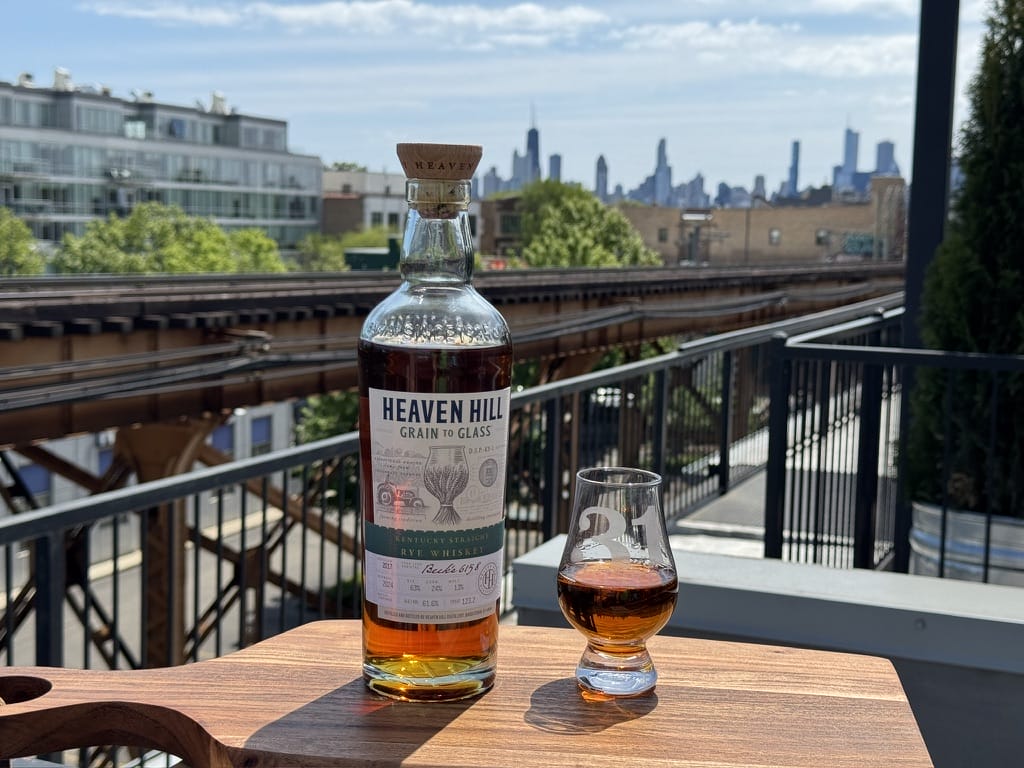
The very first thing that hits you on the nose is spice — lots and lots of spice. I’m talking you-just-landed-on-Arrakis level spice. This is a very spicy rye whiskey and the aroma makes no effort to hide that fact. Front and center is the kind of bold, peppery rye bread scent that I look for in a good rye whiskey — it’s here in spades. However, underneath all that spice, there is a subtle hint of sweetness trying to make itself known… but it’s fighting an uphill battle against the sheer intensity of the rye.
Taking a sip of this rye neat is an experience — and not necessarily a gentle one. There’s a lot of heat here (which, at 123.2 proof, shouldn’t come as a surprise). Even by barrel proof standards, this one brings a significant amount of fire to the party.
The black pepper is immediate and intense. It’s the dominant flavor throughout the entire experience and it doesn’t let up… to the point where it’s nearly too much to comfortably sip neat. The heat and the pepper are so overpowering that it’s genuinely difficult to pick out any other flavors hiding underneath.
If you really focus and power through the heat, there is a very faint sweetness lurking in the background — something in the neighborhood of brown sugar… but it’s buried so deep under the avalanche of black pepper and alcohol burn that you’d be forgiven for missing it entirely.
I enjoy a spicy rye, but this is pushing the limits of what I’d consider an enjoyable neat pour. If you’re someone who regularly sips barrel proof whiskey without batting an eye, you might have a different experience, but for most people, I’d recommend proceeding with caution here.
On Ice
Adding ice can soften a whiskey, mellowing out some of the more extreme flavors and smoothing the edges on some of the rougher characteristics. And in this case, I am thankful that the ice does exactly what it needs to do because this rye is much more drinkable on the rocks.
Don’t get me wrong, there’s still plenty of spice here and the heat is still present, but now it’s actually enjoyable for those who enjoy those flavors. The ice tames the sandworm (to continue with my Dune metaphor) just enough that you can sit with this pour and enjoy what’s going on in the glass.
With the heat dialed back, the flavors that were hiding behind the pile of black pepper finally get a chance to step forward. The brown sugar sweetness that was barely detectable before is now much more prominent, providing a nice counterbalance to the spice. The black pepper is still here and still a major player, but it’s joined now by some baking spices, cinnamon and maybe a touch of clove, which all add some welcome complexity. If you’re going to sip this rye, I’d strongly recommend doing it on the rocks. The ice transforms this from a whiskey that’s fighting you into one that’s working with you, and the difference is night and day.
Cocktail (Old Fashioned)
This makes a great old fashioned — maybe one of the best I’ve had in a while. The sugar and the bitters do an excellent job of taming the more aggressive characteristics of this rye, and the resulting cocktail is well balanced in a way that the neat pour simply is not. The rye shows through clearly (and there is nothing worse than making a rye old fashioned only to have the rye take a back seat). The spice from the rye plays nicely with the herbal components of the bitters, and the added sweetness from the sugar rounds out the experience into something that is genuinely enjoyable.
Now, could I drink this old fashioned every single night? Probably not. At 123.2 proof, this is still a big rye, and even with the dilution from the ice and the other ingredients it’s not exactly a lightweight. (I did my tastings for this review over a number of evenings that spanned a week, because it’s hard to enjoy more than one and still keep all of your wits about you.) And the bold rye spice, while delicious, is the kind of thing that demands your attention rather than fading into the background of a lazy Tuesday evening. But when you’re in the mood for a rye old fashioned with some real backbone, this is a fantastic option.
(Pro-tip: after the version made for this review, I also tried this with some other bitter combinations, and which allow you to really play with the flavor profile. My favorite was replacing the angostura bitters with a couple of shakes of black walnut and orange bitters.)
Fizz (Mule)
If you’ve read my reviews, you know I’m not always the biggest fan of the mule. I would go as far as to say that I’m rarely, if ever, a fan of the mule.
So it’s high praise to say that as far as mules go, this one is decent. The bold, spicy flavors of this rye pair exceptionally well with the ginger beer, creating a combination that feels like it was meant to be. Where some whiskeys get lost against the brightness of the ginger beer and the lime, this rye has more than enough personality to stand its ground, and even push back a little. The spice from the rye is clear and noticeable, and plays off the ginger beer in a way that amplifies the best qualities of both.
The lime notes in the mule also do a great job of helping to tone down some of the rougher edges of the rye. The aggressive heat that made the neat pour such a challenge is nowhere to be found here, replaced instead by balanced cocktail with plenty of kick. It’s a mule where the whiskey is the main attraction instead of the ginger beer — and that’s not something I can often say about spirits we put through this test.
Overall Rating
Overall, I enjoy a spicy rye, but this one neat is a little too much even for me. The 123.2 proof barrel strength rye is too aggressive to not add some rocks or to use in a cocktail. The neat pour is borderline undrinkable for all but the most seasoned barrel proof enthusiasts, and while the rocks pour is significantly improved, it still requires a pretty high tolerance for heat and spice.
Where this rye really earns its keep is in cocktails — the bold character of the rye ensures it doesn’t get lost in the mix. The old fashioned is great and the fizz is on the better end of my spectrum. But this is where my problem comes in… if you’re buying this bottle primarily for cocktail duty, you’re going to be very happy. However, $110 a bottle is a tough pill to swallow for a rye you can’t enjoy on its own, especially when there are plenty of highlight rated rye whiskeys available with a lower price tag.
| Heaven Hill Grain to Glass Kentucky Straight Rye Whiskey Production Location: Kentucky, United States Classification: Straight Rye Whiskey Aging: 6 Years Proof: 61.65% ABV Price: $110 / 750 ml Overall Rating:   |
Overall Rating: 3/5
The spice must flow… just not neat.