
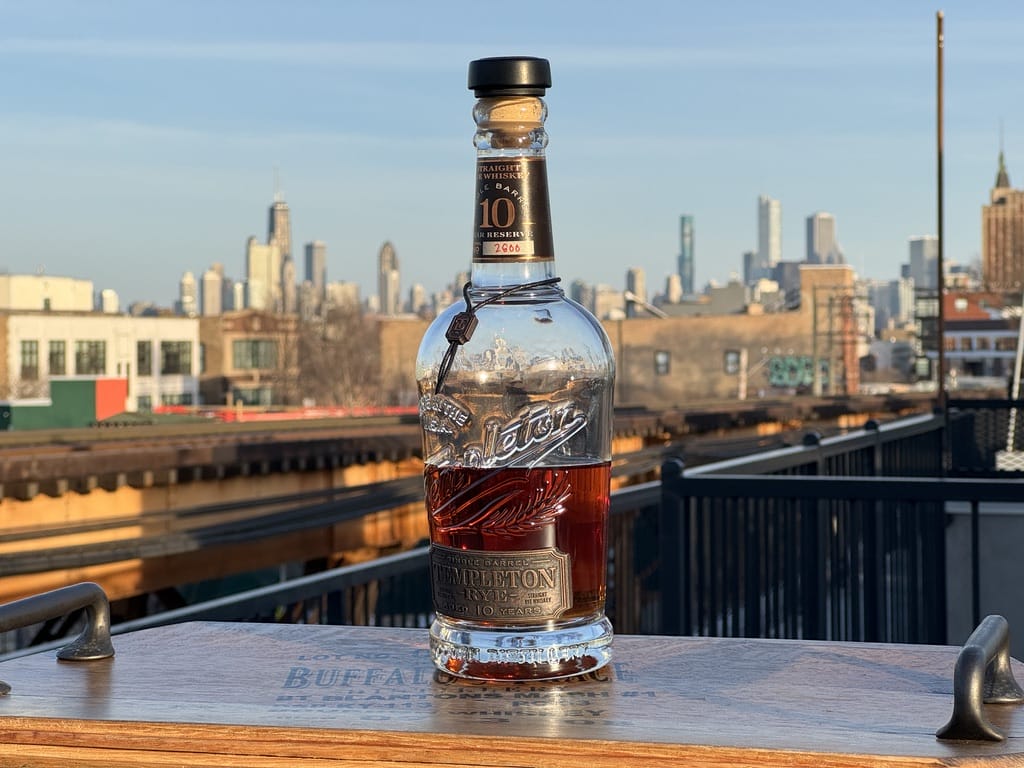
This 10-year bottle was my first introduction to Templeton, purchased on the recommendation of the manager at my local Garfield’s Beverage. He knows that I am always looking for interesting bottles and mentioned that it was one that most of the staff was obsessed with — and it just happened to be the last one on the shelf. I’m not fool enough to ignore a good pro tip, so I grabbed it… and that was the start of my downfall.
Quick note: At the time of purchase, I was not aware that much of the product in this bottle actually came from the MGP mass production facility in Indiana, and not their site in Iowa. We’ve looked at a four-year old product that came from the new Iowa distillery and a more similar six-year product also from Indiana, let’s see how some extra years change a mass produced rye.
History
Prohibition in the United States wasn’t exactly universally beloved (to put it mildly). While it may have been the law of the land, a significant chunk of the country felt that it was an unjust imposition — and decided that if they weren’t allowed to buy whiskey, they would just make it themselves.
That feeling extended to Templeton, Iowa, where a group of citizens in the small town of only 350 residents decided to start distilling their own whiskey. During prohibition, the town would produce a rye whiskey that would come to be known as “The Good Stuff”, which helped lubricate not only their small town but also others far and wide.
With the end of prohibition, the demand for illegal whiskey saw a sharp decline and not long after the distilling operations there ceased.
The tradition would be resurrected in 2002, when Meryl Kerkhoff (son of one of the distillers in that original group from Templeton) joined with Scott Bush and California based spirits production company Infinitum Spirits to restart production on the famous rye whiskey brand. (Infinitum Spirits is the same company behind Skrewball, by the way).
Product
When Templeton was originally revived as a brand, despite being “produced and bottled” by the new Templeton Rye Spirits, LLC based in Templeton, Iowa, their whiskey was actually distilled and aged by the mass production facility MGP in Indiana. That fact wasn’t originally clear enough, though, and as the result of a class action lawsuit brought against them, Templeton Rye was forced to add the clarifying statement “distilled in Indiana” to their bottles. This bottle is another product that seems to have not been actually made by Templeton, but instead distilled by MGP and only finished by Templeton.
As a rye whiskey, this starts with a mixture of grains that is required to be at least 51% rye. As to what the other portion of grains are…. well, that’s a mystery known only to MGP. Once cooked and fermented, the resulting slightly-alcoholic-beer is distilled and then placed into charred new oak barrels for a period of time. In this case, the bottle claims that the whiskey has been aged a minimum of ‘TEN FULL YEARS’ prior to bottling. Once finished, the whiskey is reportedly blended with other flavors to make it taste as close to prohibition era whiskey as possible.
When it’s time for bottling, the whiskey takes a road trip from Indiana to Iowa. Being a single barrel product, the best barrels are chosen and bottled without being blended with other barrels.
Packaging
Templeton seems to have taken the opportunity over the last few years to completely redesign the bottle. After the lackluster effort to design a decent bottle for The Good Stuff rye, the design team really stepped up to the challenge.
The bottle is a medium height and round with an extra thick bottom that functions like the base of a classical pillar with “Templeton Distillery” embossed at the front. The bottle has a very slight outward flare moving from the bottom to the top, and a gently curving shoulder to a medium length neck. There is some additional detail at the mouth of the bottle: two slightly thicker rings rather than the usual single bump. I am not sure if this is intentionally engineered for a smoother pour or not, but either way the rye does pour very smoothly over the rings. The entire thing is topped with a dark wood and synthetic cork.
While the four- and six-year ryes had a paper label, this ten-year product has an embossed plastic plaque in its place. It contains the same information a the label does, but it gives it a much more upscale feeling. The label on the neck also contains a handwritten barrel number (mine happens to be 2,800).
The script Templeton logo and a shaft of grain (rye, I assume) are also embossed on the middle of the bottle. The fact that the bottle has such a large section dedicated to embossing not only classes up the product but also allows much of the dark amber whiskey to shine through.
The last thing to call out is that this bottle comes wearing a bolo tie, and I’m not really sure what to think of it. Frankly, I think it just takes away from the overall packaging. The plastic that holds the waxy string together has an interlocked “TD” on it, and it just feels out of place and takes away from an otherwise great bottle.
Neat
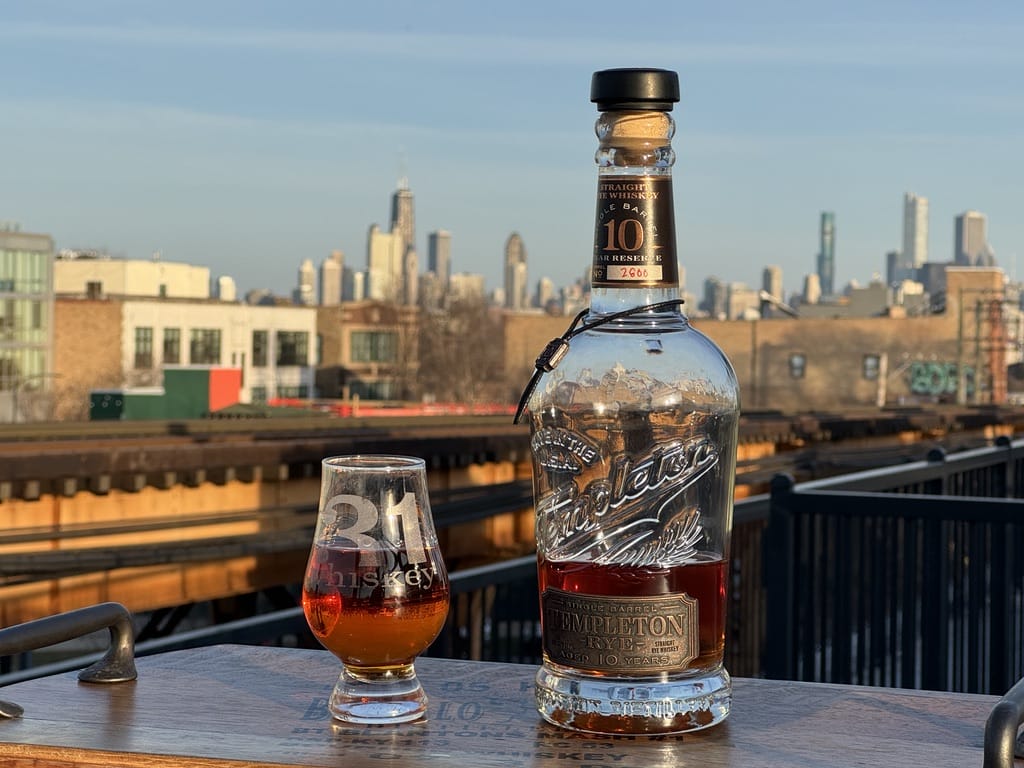
The first thing I notice the deep burnt umber color of this rye. This is the first sign of that ten years spent in a charred new American oak barrel — it’s a darker and richer color than I’m used to seeing. When first taking in the aroma coming from the glass, I get lot fresh apple and sweet caramel. There are also notes of black walnut mixed in there, reminding me of a caramel dipped apple that was rolled in walnuts.
The first sip gives the strong impression of sourdough bread straight from the oven. It’s interesting — in the six-year rye, there was a lot of sour that reminded me of sour beer, but here it’s as warm and inviting as a fresh baked roll.
The next sip still starts with that sourdough, but there are also notes of apple, grape, and black walnut, all wrapped up in a sweet woody oak. The finish has the rye spice that I love, but also has notes of tobacco, chocolate, and clove. There is a lot going on here, and it all works very well together. This is a delicious rye.
This flavor from the ten-year rye is why I decided to look deeper into the Templeton portfolio. The only thing that gives me pause about this is questioning if any of these flavors are additives used to achieve the flavor of desired by Templeton. (A question to which we don’t have a clear answer, to be transparent.)
On Ice
As we’ve often mentioned in our reviews, adding ice can mellow out some of the more delicate flavors and smooth the edges on some of the more rough flavors. In this case, the more delicate early flavors of apple, grape, and sourdough disappear. Which, frankly, gives me hope that those were not artificial flavors, as those artificial flavors tend to stick around even when the ide enters the game.
The flavors that you do get with this whiskey on ice can be best described as a cigar bar: primarily, that sweet woody flavor that reminds me of a humidor. The lingering smell of leather from the big comfortable chairs, and of course: rich tobacco with notes of black walnut, chocolate, clove, and cinnamon all pulled together with a deep rye spice.
Drinking this on the rocks is just as good as drinking it neat. It’s a coin toss to determine which is better, probably just depending on your specific mood at that time.
Cocktail (Old Fashioned)
After tasting this on the rocks, I had high expectations for the old fashioned. I was not disappointed.
Adding sugar, a little water, angostura bitters, and an orange peel works surprisingly well with all of the flavors going on with this whiskey. The sugar muddled with water adds a nice hint of sweetness to cut through some of the bold savory flavors, and the herbal components of the bitters pair well with the spices and chocolate. Finally, that orange peel just pulls it all together with that hint of citrus.
My favorite part is that the rye heat does not fade and remains one of the more prominent flavors in this drink. (There is nothing worse when you make a rye old fashioned and the rye decides to take a back seat.)
It would be interesting to play with some various bitters for this cocktail — both chocolate and black walnut bitters come to mind. I could see both being a unique twist to this already delicious drink.
Fizz (Mule)
Well, Templeton’s Single Barrel Ten-Year Reserve is currently batting 4 for 4 in this review.
If you’ve read my reviews, you know I am not shy about my dislike of the Kentucky mule. It’s far from my drink of choice, but it does a great job of putting a whiskey to the test against the loud ginger and lime components.
In this case, the bold flavors of this rye can be clearly tasted through the cheeky playfulness of the ginger beer. And it’s not just the rye spice, but also the tobacco and walnut. You do tend to lose the chocolate and clove with the ginger beer, but in the end it’s still a delicious combination.
Overall Rating
I am very impressed that this ten-year year rye was produced at a mass production facility. It’s got a lot of flavor and is very versatile. That said, we still do not know if there is any artificial flavoring going on — I don’t think so, but we can’t write it off. In looking at all of our Templeton reviews to date, the four-year product made at their own distillery stood out the most as a potential strong future — but for an MGP-produced bottle, this ten-year holds its own too.
This rye tasted great neat, on the rocks, and makes a fantastic cocktail. Add to that some great packaging (other than that bolo tie), and we have all of the makings of a 5-star whiskey. However, I just cannot in good conscious give a mass produced spirit where the label and bottle are the only value added by the namesake “distillery”. That said, I can’t wait for the day (five or six years from now, presumably) when Templeton is putting out an Iowa-produced ten-year rye.
| Templeton Rye Single Barrel 10-Year Reserve Rye Production Location: Indiana, United States Classification: Rye Whiskey Aging: 10 Years Proof: 52% ABV Price: $89.99 / 750 ml   |

All reviews are evaluated within the context of their specific spirit classification as specified above. Click here to check out similar spirits we have reviewed.
Overall Rating: 4/5
A great 10-year rye; if only it were actually distilled by it’s Iowa distillery.