
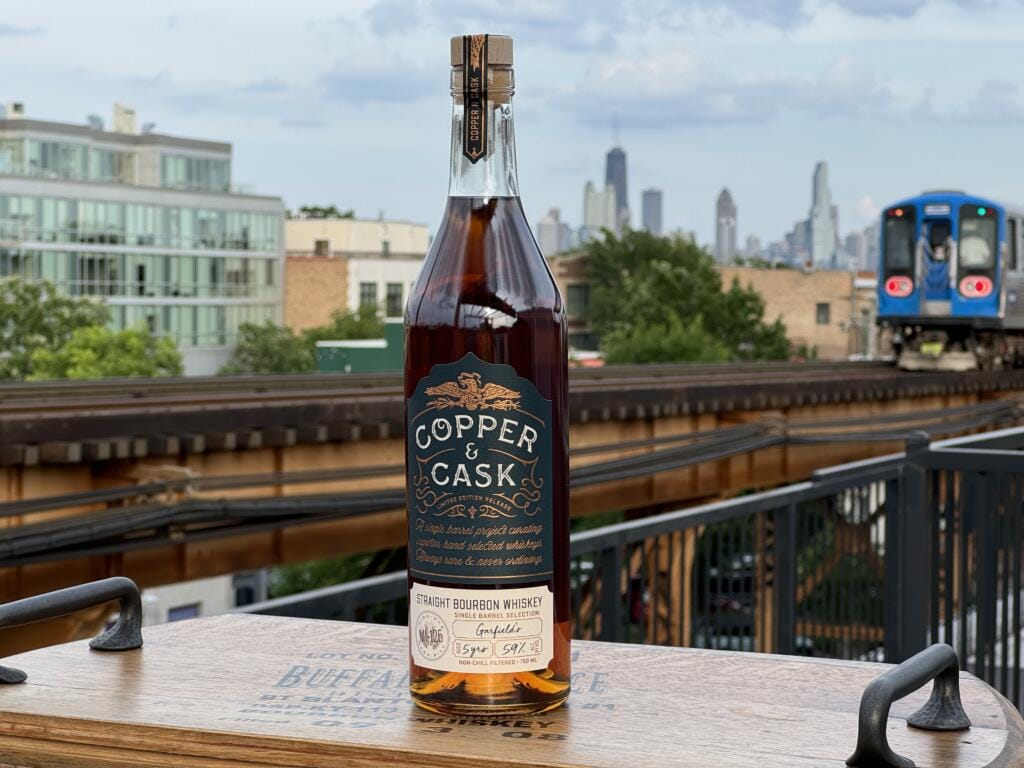
Every whiskey drinker has that one store. The one where you know the shelves by heart, where you trust that the person behind the counter has actually tasted the stuff, and where you believe that when they put their name on a barrel pick that they waded through a lot of mediocre juice so you wouldn’t have to. For me, that store has always been Garfield’s Beverage in Chicago. It’s was here that the whiskey guy first pointed me toward Templeton years ago, and where I once walked out with an Eagle Rare barrel pick that remains one of the best bottles I’ve ever grabbed for under forty bucks.
So when I was back in the neighborhood and spotted a Copper & Cask single barrel with a “Garfield’s Selection” tag hanging off the neck, I barely paused. A cask-strength barrel that the Garfield’s crew tasted and liked enough to buy outright, for $49.99? That’s exactly the kind of low-risk gamble a store pick is supposed to be.
The promise of a store pick is simple: somebody with a good palate did the hunting for you. The only question left is whether the barrel earns the tag. And this one, it turns out, does its best work before you add a single thing to it.
History
Here’s the thing about Copper & Cask: there is no distillery. There’s no founding family hand-mashing corn in a copper pot in some Kentucky holler. Copper & Cask is an independent bottler launched in 2021, and it belongs to Latitude Beverage Company, a Boston outfit founded by Kevin Mehra in 2007.
If that name rings a bell, it might be because Latitude is the company behind 90+ Cellars, the wine brand built on a very old idea: the négociant model. Buy quality product that somebody else made, put it under your own label, and sell it for less than the original would have cost. Mehra launched 90+ Cellars in 2009, right as the recession had wineries looking for somewhere to move good juice, and over the years the company has run the same playbook in spirits. Wheel Horse Whiskey, Tequila Zarpado, and Copper & Cask all live under the same roof.
Copper & Cask is the enthusiast-facing end of that portfolio. There’s no flagship bottle to memorize, and that’s by design. The whole concept is to go barrel by barrel, bottle at full strength, keep the runs small, and let each pick stand on its own. In 2022 they brought on Barrel Master Stephen Corrigan, who the company says has nearly two decades of experience in distilling, aging, and blending, to steer the selection. Whether that shows up in the glass is, of course, the entire point of a review like this one.
Product
- Learn More: What Is Bourbon Whiskey?
Now for the fun part: reading the label like a detective. The front says “Straight Bourbon Whiskey”… but note what it doesn’t say: Kentucky. That one missing word is the tell: putting a state name in front of “Straight Bourbon” means the whiskey was distilled in that state. When a bottle leaves the state off the front, the smart money says the juice came from somewhere the marketing team would rather not lead with. In this category, that somewhere is almost always Indiana, specifically MGP (whose Lawrenceburg plant now goes by the Ross & Squibb Distillery name), the enormous contract distillery responsible for a huge share of the “craft” bourbon on your shelf.
To Copper & Cask’s credit, they don’t play coy about it. The state of distillation is on the label (which, to be fair, federal labeling rules generally require anyway), and the brand goes a step further by naming MGP on its individual barrel pages, which is more transparency than a lot of sourced brands bother with. The label also tells you the things that matter: this is a single barrel, non-chill filtered (meaning they skipped the cold-filtering step that strips out fatty acids and esters, so you keep more flavor and body at the cost of a little cloudiness when it gets cold), five years old, and bottled at a genuine 59% ABV, or 118 proof. The barrel and store details are noted on the front, with Garfield’s name written into the selection line.
What’s inside is almost certainly one of MGP’s well-worn bourbon mash bills, most likely their 21% rye recipe (75% corn, 21% rye, 4% malted barley). That would line up neatly with what actually shows up in the glass, because if there’s one flavor MGP’s rye-forward bourbon is famous for, it’s a big hit of orange. (And hold onto that thought, because we’ll come back to that.)
Packaging
Let’s be blunt: nobody is buying this for the bottle. It’s a tall, cylindrical, slope-shouldered thing that looks less like a bourbon and more like a bottle of red wine that wandered into the wrong aisle. Points in its favor, though: the glass is at least clear (so you can actually see the whiskey) and the whiskey is dark enough to be genuinely striking.
The closure is the highlight: a real cork under a wooden top, which sits right where I like it on the closure hierarchy (comfortably above the screw caps of the world). The label is where things get busy. It’s a deep teal-and-gold affair with an eagle crest and a swirl of ornate, curling Victorian typography, all “Always Rare & Never Ordinary” in a script that evokes an old apothecary cabinet or a 19th-century patent-medicine tonic. It’s also huge, sprawling across a good chunk of the lower bottle, and the single-barrel specifics (the part I actually care about) are printed so small and so ornately that I had to tilt the thing toward a window to make out the proof and the age. When the most useful information on the label is the hardest to read, the design has its priorities backwards. It’s a handsome label trying so hard to look rare and special that it forgot to be legible.
Neat
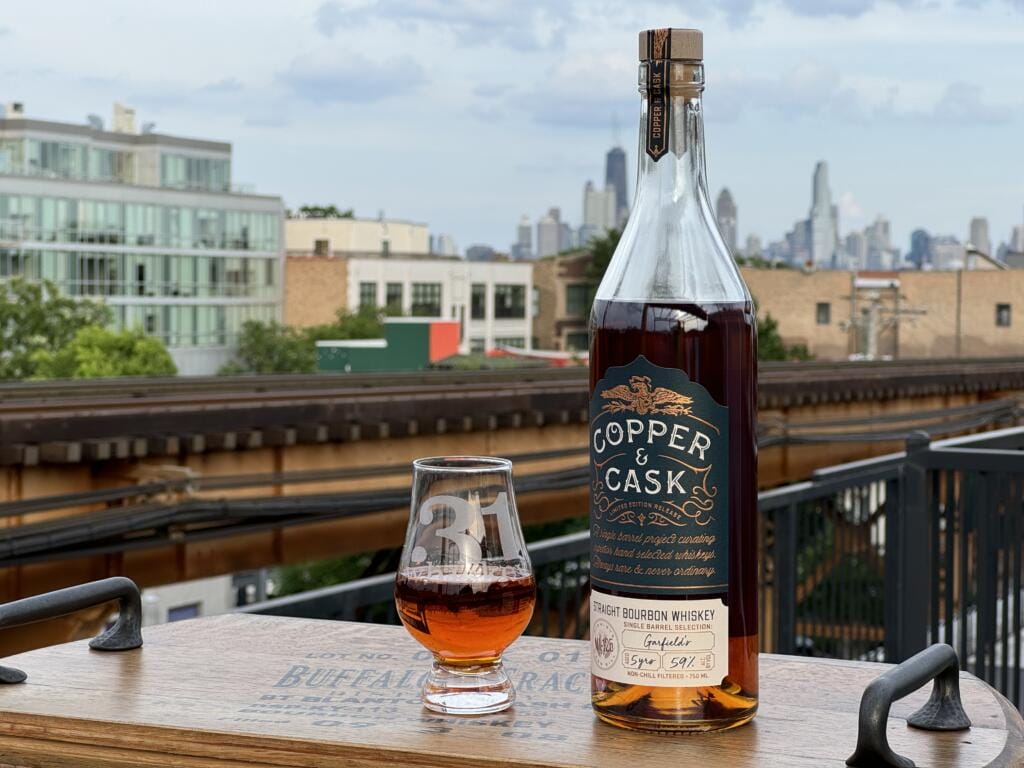
In the glass, this pours a deep amber leaning toward mahogany, noticeably darker than you’d expect from a bourbon that’s only seen five years in wood. At 118 proof and non-chill filtered, it has real weight to it: a thick, coating body that clings to the sides of the glass.
The nose is bold. Almost too bold. Orange comes roaring out of the glass first (there’s that MGP signature, right on cue), followed by a big wave of caramel and vanilla, a hint of cherry underneath, and just a whisper of baking spice around the edges. It smells like an Old Fashioned somebody already built for you, which is either wonderful or a little much, depending on how close your nose is.
The first sip is a lot. Overwhelming, even, in the way high-proof single barrels sometimes are before your palate finds its footing. It’s loaded with orange and vanilla, though it lands noticeably less sweet than the nose promised. There’s a spiciness that reads like the rye asserting itself, but the burn is remarkably restrained for 118 proof, which is a real credit to the barrel. The whole thing drinks like a thick, pre-mixed Old Fashioned: orange and sugar and a little spice, minus the ice and the bitters. Taken on its own terms, neat, this is a solid, bold pour.
On Ice
Here’s where the wheels come off. Normally, ice is going to impact a whiskey like this favorably. With a bold, high-proof barrel, ice is usually a tool, not a threat. It tames the heat, dilutes the more aggressive notes, and lets the subtler flavors step forward.
But not here. Add ice to this one and it doesn’t mellow; it evaporates. The bold orange and vanilla that dominated this neat now thin out into almost nothing. What’s left is a strangely bland glass with barely any spice, a faint oaky note, and, oddly, a little lingering burn with none of the flavor that’s supposed to come with it. The ice didn’t soften the whiskey — it deleted it. Compare that to the Four Roses Single Barrel Barrel Strength that Garfield’s picked, another cask-strength single barrel at nearly the same proof, where the ice actually opened things up and coaxed out flavors the neat pour had been hiding. This barrel folds the instant the ice hits it.
Cocktail (Old Fashioned)
Given that this whiskey tastes like a thick Old Fashioned all by itself, building an actual Old Fashioned around it should have been a layup.
Spoiler alert: it wasn’t. The finished drink smells, bizarrely, like bubble gum. It tastes like sugar and bitters, full stop, because the bourbon that’s supposed to be the backbone of the drink is nowhere to be found. Zilch. You could build this exact cocktail with a mystery well bourbon and never know the difference. When a whiskey that drinks like a ready-made Old Fashioned neat can’t survive being made into an Old Fashioned, something has gone very wrong with how it handles a little dilution.
Fizz (Mule)
The Kentucky Mule tells the same sad story. A good bourbon mule needs the whiskey to do two things: make a statement loud enough to cut through the ginger beer, and bring something to the party that vodka wouldn’t. And sadly, this one does neither. It washes out exactly the way it did on the rocks and in the Old Fashioned, leaving you with a glass of ginger beer wearing a bourbon name tag.
Forgettable, and a genuine waste of a cask-strength pour.
Overall Rating
I keep circling back to the same frustrating summary: this is a fine, even enjoyable bourbon, right up until you ask it to do anything other than sit in a glass by itself. Neat, it’s a bold, orange-forward, thick pour that a lot of people would happily sip. But the moment you introduce ice, bitters, or a mixer, it collapses into near-nothing, which is a genuinely strange way for a 118-proof, non-chill filtered single barrel to fail. The whole point of cask strength is that there’s enough flavor to survive dilution. This one doesn’t.
At $49.99, that one-dimensionality is the whole problem. We judge whiskey against its price, and for fifty bucks you’re entitled to a barrel that earns its keep in more than one glass. Contrast this with that Four Roses Single Barrel Barrel Strength pick from the same store, which also landed at 2/5, but for the opposite sin: it was so bitter and bold it was nearly undrinkable neat, and only really came together on the rocks or in an Old Fashioned. That one also cost $110, so neither of these is a store-pick triumph, but at least the Four Roses gave you something to work with. If you want the version of the Garfield’s program that actually delivered, go find their Eagle Rare 10 Year Barrel Select, which cost ten dollars less and earned a full 5/5 by being excellent in every format I threw at it. There are plenty of great cask-strength MGP single barrels out there around this price. This particular barrel just wasn’t one of the special ones.
None of this makes it a bad whiskey, exactly. It makes it a narrow one. If your entire relationship with bourbon is a neat pour after dinner, you’ll get your money’s worth. If you ever reach for ice or a shaker, look elsewhere.
| Copper & Cask Single Barrel Straight Bourbon Production Location: Indiana, United States Classification: Straight Bourbon Whiskey Aging: 5 Years Proof: 59% ABV Price: $49.99 / 750 ml   |
Overall Rating: 2/5
A single barrel with exactly one setting: neat. Add ice and it pulls a Houdini.